
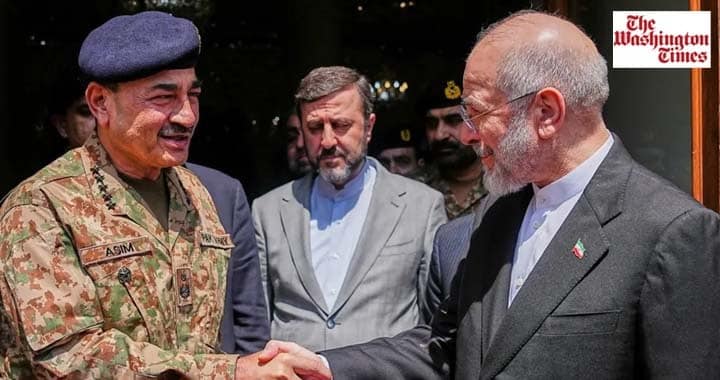
Prominent international media outlets have reported Pakistan’s emerging diplomatic role in facilitating dialogue between Iran and the United States, with particular reference to efforts attributed to Pakistan’s Chief of Army Staff, Field Marshal Asim Munir.
According to reports published by the The Washington Times, Field Marshal Asim Munir is being described as having played a significant mediatory role in encouraging engagement between Iranian and American leadership during recent diplomatic developments.
The publication claims that Field Marshal Asim Munir held a series of high-level meetings with officials from both sides, contributing to discussions aimed at shaping the draft framework of a potential Iran–U.S. understanding. These engagements are reported to have supported ongoing backchannel diplomacy and facilitated communication between the two regional powers.
Similarly, the The New York Times has also reported on Pakistan’s involvement in the evolving diplomatic process, noting that Pakistan’s military leadership played a key role in encouraging constructive dialogue and supporting efforts toward de-escalation between Tehran and Washington.
The report further characterizes Field Marshal Asim Munir’s recent visit to Iran as part of high-level diplomatic engagement, reflecting Pakistan’s continued efforts to contribute to regional stability and dialogue-driven conflict resolution.
According to these media accounts, Pakistan’s engagement is being viewed within the broader context of regional diplomacy, where Islamabad has historically maintained relations with multiple stakeholders across the Middle East.
Analysts cited in international commentary suggest that Pakistan’s strategic positioning and diplomatic outreach have increasingly placed it in a potential facilitative role in complex regional negotiations, particularly in situations involving high geopolitical sensitivity.
While the reports emphasize diplomatic interactions and high-level engagements, they also highlight the broader importance of sustained dialogue between Iran and the United States in reducing regional tensions and promoting stability.
The developments, as reported by international media, underscore growing global attention on diplomatic channels aimed at de-escalation in the Middle East. Observers note that any progress in Iran–U.S. relations could have far-reaching implications for regional security, energy markets, and global geopolitical stability.
Pakistan, according to these accounts, continues to position itself as a stakeholder advocating for dialogue, restraint, and peaceful resolution of conflicts in the region.
While official confirmations from all parties remain limited, international reporting reflects increasing acknowledgment of diplomatic efforts involving multiple regional actors. The alleged role of Pakistan’s leadership in facilitating communication between Iran and the United States highlights the complex and evolving nature of backchannel diplomacy in contemporary geopolitics.
Further developments are expected as discussions between relevant stakeholders continue.



