
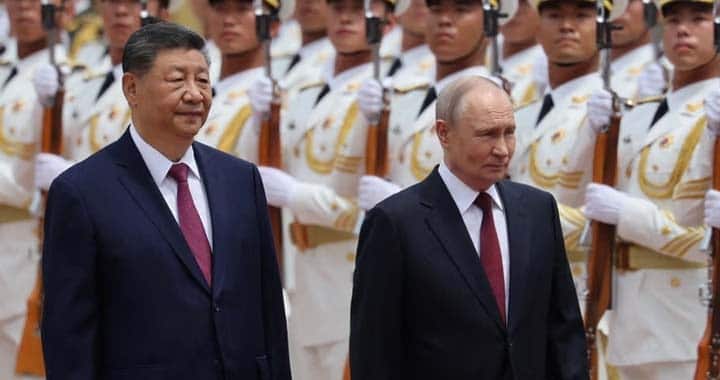
Following the Russian President’s recent visit to China, Moscow and Beijing have jointly expressed serious concern over the continuing threat of terrorism emanating from Afghan territory, warning that instability in Afghanistan remains a significant risk to regional and global security.
In a joint statement released on Wednesday, both countries emphasized that terrorism continues to pose a grave and persistent challenge not only to Afghanistan but also to neighbouring states and the broader international community. The two powers stressed that the situation requires enhanced coordination and collective action to prevent Afghan soil from being used by terrorist elements against other countries.
Russia and China called on regional states and the wider international community to strengthen counterterrorism cooperation with Afghanistan, underscoring the importance of preventing the country from becoming a safe haven or operational base for groups that could threaten regional stability.
The statement reiterated support for Afghanistan’s stated commitment to combating terrorism and preventing its territory from being exploited for hostile activities. Both Moscow and Beijing expressed readiness to deepen bilateral and multilateral cooperation aimed at addressing evolving security challenges linked to Afghanistan.
The two countries further highlighted the importance of establishing durable peace, order, and stability in Afghanistan at the earliest possible stage, stressing that long-term regional security depends on effective governance and sustained counterterrorism efforts within the country.
Reaffirming the significance of diplomatic engagement, Russia and China pointed to the role of established regional mechanisms in addressing the Afghan issue. These include the Moscow Format consultations on Afghanistan, meetings of foreign ministers of Afghanistan’s neighbouring countries, the quadrilateral regional group comprising Russia, China, Iran, and Pakistan, as well as the Shanghai Cooperation Organisation (SCO).
Both governments described these platforms as critical for advancing political dialogue, enhancing coordination, and ensuring a structured regional response to security challenges emanating from Afghanistan.
Afghanistan continues to remain a central security concern for regional powers, particularly Russia and China, amid ongoing fears regarding the presence and activities of various terrorist organizations operating within its territory. Since the political transition in Afghanistan, multiple neighbouring countries have repeatedly raised concerns over the potential misuse of Afghan soil for militant operations.
Russian officials have consistently expressed concern over the activities of Islamic State Khorasan Province (ISKP) and other extremist groups, warning that instability in Afghanistan could pose a direct threat to Central Asia and potentially extend toward Russia’s southern borders. Moscow has also cautioned against the reported movement of foreign extremist fighters into Afghan territory, highlighting risks of regional spillover.
China has similarly raised security concerns, particularly regarding the possibility of extremist elements linked to separatist movements targeting its western Xinjiang region. Beijing has repeatedly emphasized the need for strict measures to prevent Afghan territory from being used for cross-border terrorism or separatist violence.
Despite these concerns, both Russia and China have maintained diplomatic engagement with Afghanistan’s current authorities, seeking to influence security and political developments through dialogue and regional cooperation frameworks.
While Moscow has formally recognized the Taliban administration, Beijing continues to maintain close political and economic engagement without extending formal recognition, reflecting a cautious but pragmatic approach to evolving conditions in Afghanistan.
The joint statement underscores the persistence of complex security challenges in the region, even amid ongoing diplomatic efforts, and highlights a growing consensus among major regional actors on the need for coordinated counterterrorism action.



