
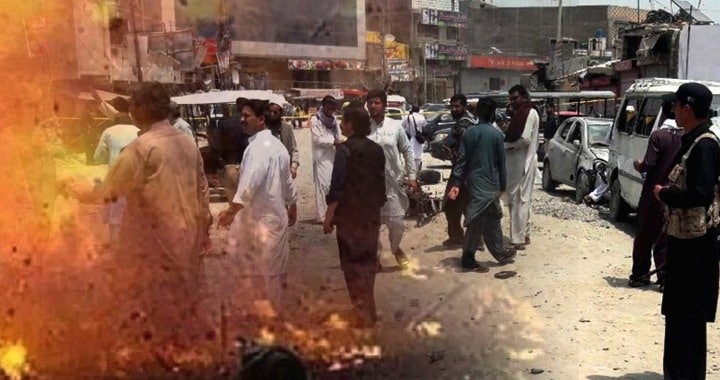
A heavily coordinated and lethal assault on the Fateh Khan police checkpost in Bannu has resulted in significant casualties and renewed urgent concerns over the deteriorating security situation in the region, the operational preparedness of law enforcement agencies, and the expanding capabilities of extremist networks.
According to police sources, the attack was carried out when a vehicle laden with explosives rammed into the Fateh Khan police checkpost, followed immediately by a ground assault by armed attackers. Officials confirmed that 18 personnel were deployed at the checkpost at the time of the attack, out of which 15 were killed.
Security officials further confirmed that the attackers also used drone technology during the assault. The personnel stationed at the checkpost reportedly did not have access to modern counter-drone systems capable of neutralizing such aerial threats, exposing a critical operational gap in defensive preparedness.
The attackers reportedly struck the checkpost at a time when nationwide celebrations were underway following what was described as the success of “Ma’arka-e-Haq” (Battle of Truth).
A preliminary security assessment suggests that nearly 100 armed individuals took part in the attack. These attackers are reported to have travelled long distances, crossing multiple highways and routes, before successfully reaching the police checkpost.
The scale and coordination of the operation has triggered serious internal discussions within the police force in Bannu, where personnel reportedly questioned how such a large group was able to infiltrate deep into the district without interception. The incident has also contributed to growing concern within police ranks, with reports indicating that personnel are experiencing fear, frustration, and declining morale due to repeated high-intensity attacks in the region.
Following the attack, a pamphlet attributed to a group identifying itself as “Ittihad-ul-Mujahideen Pakistan” appeared on WhatsApp and other messaging platforms. The pamphlet allegedly detailed the operation, claiming responsibility and stating that the attack was carried out after blocking roads on both sides. It further claimed that a “fidayee” (suicide) operative rammed an explosive-laden vehicle into the police checkpost.
The document also claimed that the checkpost was located in a non-populated area and asserted that video footage of the attack would be released soon. It included a message directed at police forces as well. Authorities have not independently verified the authenticity of the pamphlet or its claims.
Reports indicate that the worsening security situation in Bannu and surrounding areas has become a major subject of concern among police personnel and civilians alike. The situation has been described as one in which both law enforcement officials and ordinary citizens are increasingly disillusioned with the state of security and governance.
Bannu has remained one of the regions most affected by repeated episodes of militancy over the past several years. Local populations have consistently attributed responsibility for instability to multiple armed extremist factions operating in the area.
Historical context shows that in July 2004, large-scale public protests were held in Bannu and other districts against rising militancy. During those demonstrations, there was a consensus demand for the removal of both so-called “good and bad Taliban,” with calls for all armed groups to be expelled from the region.
Following those protests, authorities had closed certain offices associated with such groups and expelled them from settled areas. However, reports suggest that these elements later re-emerged in different forms. There were also allegations at the time that parallel judicial structures were established by these groups in certain areas, effectively creating informal governance systems alongside state institutions.
According to local accounts and historical reporting, these groups imposed a range of social restrictions during periods of influence, including limitations on women’s mobility and access to public spaces, closure of music shops, and enforcement of strict behavioral codes on barbers and youth regarding grooming styles.
Analysts note that such measures reflected attempts to impose parallel governance structures in certain regions, often resulting in conflict with local communities and state institutions. At the same time, the proliferation of weapons and illicit financial flows, including narcotics trade revenues, contributed to the emergence of multiple armed groups in the region, including reports of the rise of ISIS-linked factions.
Some sources have also alleged foreign support dynamics, with claims that certain groups received external assistance from India, while international reporting has at times described ISIS-linked networks as operating within broader transnational frameworks.
Clashes between various armed factions have been reported over the years, further complicating the security landscape. Security observers and regional experts argue that inconsistent policy approaches toward extremist groups, often described as the “good Taliban versus bad Taliban” framework, have contributed to long-term instability. Analysts note that following the Taliban’s return to power in Kabul, militant attacks in Pakistan increased significantly. Political statements in past years, including interpretations of the Taliban takeover in Afghanistan as a “victory,” have also been cited in public discourse regarding the evolving ideological environment.
Observers further highlight that multiple Taliban factions, including those aligned under different leadership structures, are believed to be influenced by broader ideological frameworks extending across the region. The foundational objectives of certain groups, analysts note, include the establishment of governance systems aligned with their interpretation of religious law across parts of Afghanistan and Pakistan.
Reports from conflict-affected areas indicate that at different times, armed groups established informal courts and dispute resolution mechanisms, handling both minor and major disputes. These structures reportedly enforced strict social codes, including restrictions on music, public entertainment, and personal grooming practices. Such parallel systems, according to analysts, undermined state authority and contributed to the erosion of formal governance structures in certain areas.
In recent months, Pakistan and Afghanistan have witnessed multiple cross-border tensions and armed exchanges. Diplomatic efforts mediated by Qatar and China have resulted in temporary ceasefire understandings, though underlying tensions remain unresolved.
Pakistan has reportedly suspended trade with Afghanistan amid security concerns, while China has made significant investments in Afghanistan and is seen as a potential influential actor in shaping regional policy dynamics.
Diplomatic sources suggest continued engagement between Beijing and Kabul could influence regional security outcomes.
Experts monitoring the situation in Afghanistan note that the Taliban administration does not exercise full control across all parts of the country, with varying degrees of authority in different regions.
Despite governance claims, analysts argue that groups such as Tehreek-e-Taliban Pakistan (TTP) continue to operate from cross-border safe havens, contributing to sustained attacks in Khyber Pakhtunkhwa and Balochistan.
The resulting security vacuum has had significant impacts on Pakistan’s defense, economic stability, and social environment.
Security analysts and policy experts emphasize the urgent need for a comprehensive reassessment of counterterrorism strategy, including:
- A unified and consistent state policy toward all extremist groups without distinction
- Strengthening of military and administrative counterterrorism frameworks
- Removal of ideological content promoting extremism from educational curricula, including madrassas and mainstream institutions
- Large-scale counseling and awareness programs for students, teachers, journalists, and public opinion influencers
- Increased budget allocation for poverty reduction and modernization of education systems
Political observers also urge national political leadership to adopt a clearer stance against religious extremism and militant narratives.
Analysts warn that if current trends continue, the instability already affecting Balochistan and Khyber Pakhtunkhwa could expand further into other urban centers, posing broader national security risks.
Authorities are expected to issue a detailed investigation report regarding the Bannu incident in the coming days.



