
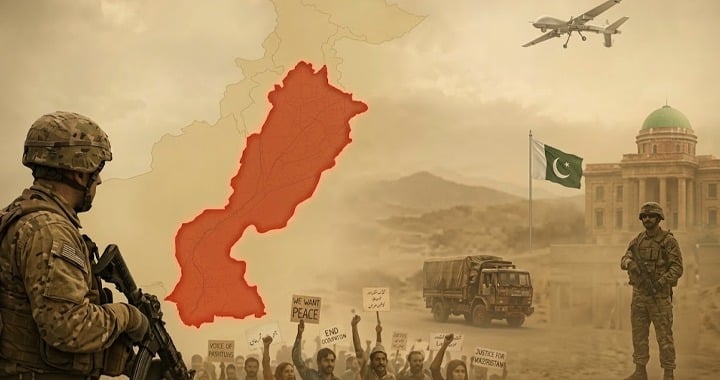
A detailed security overview of Khyber Pakhtunkhwa outlines an evolving and complex counterterrorism environment shaped by sustained military operations, shifting militant tactics, and persistent challenges along the Pakistan–Afghanistan border region.
Security sources state that in response to what they describe as continuous cross-border militant activity allegedly facilitated from across the border, Operation Ghazab Lil Haq was launched on 26 February. Officials claim the operation has significantly disrupted militant networks and infrastructure operating in sensitive border areas, marking a major phase in ongoing counterterrorism efforts.
According to official security assessments, since the initiation of the operation, more than 736 militants and alleged facilitators have been neutralized, while over 1,043 individuals were reportedly injured in various engagements. Authorities further claim that extensive strikes led to the destruction of 286 border posts, the capture of 44 strategic positions, the destruction of 249 armoured vehicles and tanks, and the dismantling of 81 logistical and support infrastructures allegedly linked to militant activity. Officials describe these outcomes as a key factor behind a temporary reduction in militant incidents in the immediate aftermath of the operation.
Security sources indicate that during March and April, a relative calm was observed in parts of the region; however, they claim this was followed by a regrouping of armed elements. These groups are reported to have adapted their tactics, moving away from direct confrontations with military installations and instead targeting softer and more vulnerable objectives, including police infrastructure within Khyber Pakhtunkhwa.
Officials maintain that Khyber Pakhtunkhwa Police have continued to demonstrate resilience and operational commitment despite facing repeated attacks. However, they acknowledge that the force is operating under significant constraints, including shortages of modern equipment, protective gear, manpower limitations, and infrastructure gaps. Security assessments further note that a considerable portion of police personnel is engaged in protocol and protective duties for public representatives, judiciary members, and other designated individuals, which impacts overall operational capacity in high-risk areas.
Despite these challenges, security sources emphasize that the Pakistan Army continues to conduct high-tempo intelligence-based operations across the region. Officials claim that more than 180 intelligence-based operations are carried out daily, resulting in the neutralization of over 800 militants this year, along with the arrest of several individuals, including foreign nationals. They further state that border movement attempts have been significantly restricted, contributing to a measurable reduction in infiltration activities.
In parallel, authorities report continued counter-narcotics and border control operations, particularly in the Tirah Valley, where extensive poppy cultivation areas spanning hundreds of acres have reportedly been destroyed. Officials say these measures have disrupted illicit economic networks linked to militancy. They also note that enhanced border management efforts have curtailed smuggling activities, while the repatriation of undocumented foreign nationals is ongoing at a rate of approximately 3,500 to 4,000 individuals per day.
The overview also highlights concerns over what officials describe as a lack of political ownership and the alleged politicisation of counterterrorism efforts, which they claim complicates operations against militant networks. Authorities allege that following major security actions, protests and alternative narratives often emerge, accompanied by competing claims and interpretations of incidents on media and social platforms, which they say contribute to public confusion and misinformation.
Security sources further allege that coordinated information campaigns by hostile external actors and online networks are actively attempting to shape perceptions of Pakistan’s internal security situation. These campaigns are said to include amplification of militant propaganda, exaggeration of operational claims, and dissemination of unverified reports regarding collateral damage during intelligence-based operations.
Despite these challenges, state institutions reaffirm that they remain fully committed and operationally prepared to counter all forms of militancy. Officials stress that ongoing counterterrorism operations will continue until militant networks are fully dismantled and lasting stability is restored in the region. They reiterate that national security forces remain confident in their strategy and determined to achieve long-term peace and security across Khyber Pakhtunkhwa.



