
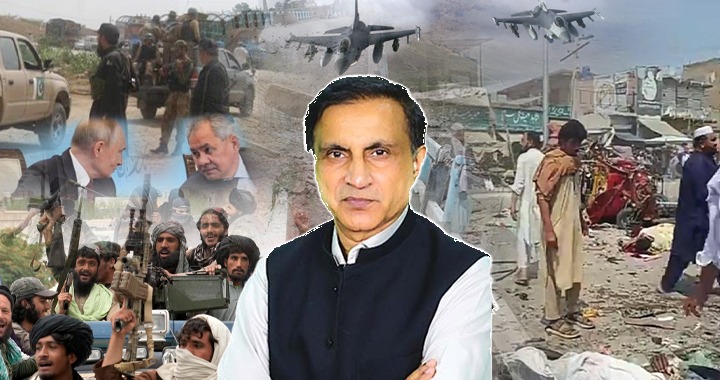
Security incidents unfolding across Bajaur, Sarai Naurang, Bannu, and other districts of Khyber Pakhtunkhwa over recent weeks are no longer isolated attacks occurring in parallel. They increasingly reflect a coordinated escalation pattern aimed at stretching Pakistan’s security apparatus across multiple fronts simultaneously through suicide bombings, assaults on military installations, quadcopter strikes targeting civilians, and attacks designed to generate both casualties and psychological pressure. The recent assault on the Mina Camp in Bajaur, where terrorists attempted a coordinated breach through explosives and sustained gunfire, the Fateh Khel suicide attack in Bannu, and the Sarai Naurang blast collectively demonstrate that militant organizations are attempting to regain operational momentum through synchronized pressure on both civilian and security targets.
What is equally important, however, is that these attacks are increasingly being met not with paralysis or retreat, but with rapid and aggressive counterterror operations. In Bajaur, security forces repelled the assault before attackers could penetrate the installation, neutralizing multiple terrorists despite the scale of the attack. In Bannu’s Jani Khel region, terrorists attempted to spread panic through quadcopter strikes that injured civilians, including women and children, yet within the same operational environment security forces launched intelligence-based actions targeting the militant infrastructure linked to previous attacks. Similar operations in Dera Ismail Khan and other southern districts indicate that Pakistan’s counterterror posture is gradually shifting toward faster intelligence coordination, preemptive targeting, and continuous pressure on facilitators and operational cells rather than relying solely on static defensive responses.
The pattern emerging across Khyber Pakhtunkhwa also reveals an important tactical evolution. Militant organizations are no longer depending exclusively on traditional ambushes or isolated suicide bombers. Increasing use of quadcopters, coordinated multi-stage assaults, propaganda amplification through social media, and attacks timed for psychological impact demonstrate adaptation toward more complex asymmetric warfare methods. In several incidents, attackers combined suicide blasts with follow-up assaults intended to exploit confusion and breach defensive positions. These methods are not random innovations. They reflect operational learning, external facilitation, and access to evolving militant infrastructure capable of transferring tactics across regions.
At the center of this expanding threat environment lies the Afghan sanctuary issue that Pakistan has repeatedly highlighted for years. The connection is no longer limited to intelligence assessments alone. Statements by militant commanders themselves, including public acknowledgments that attacks inside Pakistan were linked to developments across the border, have increasingly reinforced Pakistan’s position regarding the use of Afghan territory for planning, facilitation, recruitment, and operational coordination. The broader operational pattern has become difficult to ignore whenever pressure intensifies inside Afghanistan or regional dynamics shift, infiltration routes activate, militant movement increases along frontier regions, and attacks inside Pakistan escalate accordingly.
This is precisely why recent international warnings regarding Afghanistan carry unusual significance. Russia’s latest assessment that nearly 30,000 militants linked to more than twenty extremist organizations remain active inside Afghanistan effectively validates concerns that Pakistan has consistently raised at regional and international forums. For years, such warnings were often dismissed as diplomatic exaggeration or security rhetoric. Today, however, the United Nations, Russia, the United States, and multiple regional actors are increasingly converging around the same conclusion: Afghanistan has evolved into a permissive operational environment for transnational militancy.
The concern extends far beyond Pakistan alone. According to multiple international assessments, Afghanistan today hosts a wide spectrum of organizations including ISKP, TTP, Al-Qaeda, ETIM, BLA-linked elements, foreign fighter networks, and extremist factions relocating from other conflict zones. More dangerously, these organizations do not function independently anymore. Afghanistan increasingly operates as a convergence space where recruitment pipelines, arms trafficking, narcotics financing, ideological indoctrination, and militant training overlap within the same ecosystem. The threat therefore is not confined to border infiltration alone but extends into broader regional destabilization stretching across South Asia, Central Asia, China, and Russia.
Pakistan’s current security posture must therefore be understood within this larger strategic environment. The operations underway in Bajaur, Bannu, Dera Ismail Khan, Mastung, Nushki, and other sensitive districts reflect a state attempting to deny militant organizations the operational depth needed to sustain long-term insurgent pressure. Drone surveillance, intelligence-led raids, search-and-clearance operations, and rapid retaliation mechanisms increasingly indicate that Pakistan’s counterterror doctrine is evolving toward disruption before consolidation. Rather than allowing militant groups to dictate tempo and geography, security forces are attempting to continuously degrade operational capability through relentless pursuit of networks, facilitators, and cross-border linkages.
At the same time, the battlefield is no longer purely physical. Militant organizations and their external backers increasingly rely on information warfare alongside violence itself. Fabricated narratives regarding attacks, exaggerated claims of security breaches, coordinated propaganda campaigns, and digital amplification strategies are designed to create perceptions of state weakness even where operationally militants fail to achieve meaningful objectives. This hybrid approach combines psychological warfare with kinetic attacks in an attempt to undermine public confidence and create political pressure disproportionate to actual militant capabilities on ground.
Yet despite the intensity of recent attacks, the broader trajectory does not suggest militant dominance. In fact, the growing desperation visible in repeated suicide assaults, symbolic attacks on transport routes, and propaganda-driven operations often reflects organizations under sustained operational pressure. Security forces across Khyber Pakhtunkhwa and Balochistan continue expanding intelligence penetration, disrupting logistics chains, eliminating facilitators, and targeting militant hideouts with increasing frequency. The operational environment remains dangerous, but the response is increasingly proactive, coordinated, and strategically layered.
The larger international dimension now emerging from Afghanistan also carries an important warning for countries still attempting to selectively tolerate or politically exploit militant ecosystems for strategic advantage. Terrorist infrastructures rarely remain permanently aligned with the interests of any external actor. Pakistan’s warnings regarding Afghan sanctuaries are now being echoed globally because the consequences have started extending beyond one border or one conflict theater. The same networks destabilizing Pakistan today possess the capability to threaten broader regional and international security tomorrow. By the time that realization fully matures internationally, the cost of delayed action may become far greater than the cost of confronting the problem at its roots now.



