
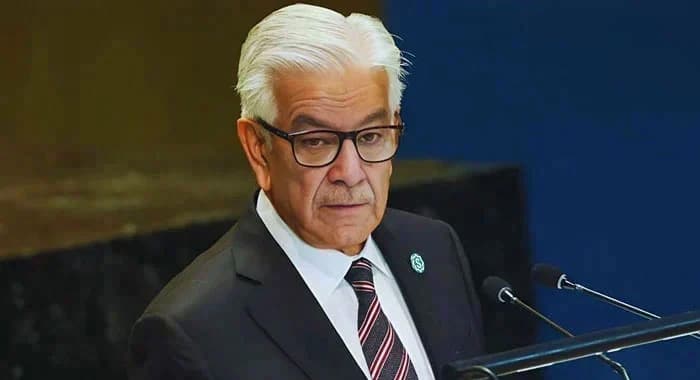
Pakistan’s Defence Minister Khawaja Asif commended the country’s armed forces for their swift and decisive response to what he described as Indian aggression during “Marka-e-Haq,” warning that any future hostility would be met with an even more forceful reaction.
Speaking at the launch ceremony of “The Battle of Truth (Marka-e-Haq),” a picture book published by the Ministry of Information and Broadcasting in collaboration with Inter-Services Public Relations (ISPR), the minister emphasized national unity and military readiness in the face of external threats.
“The entire nation stands united against any form of enemy aggression,” Asif stated, adding that Pakistan has emerged stronger, more stable, and a key guarantor of regional stability. He underscored that the country remains fully prepared to counter any form of proxy conflict.
The minister’s remarks referenced the escalation between Pakistan and India in May last year, when hostilities intensified following an attack on tourists in Indian Illegally Occupied Jammu and Kashmir (IIOJK). India attributed the attack to Pakistan-based elements—an allegation Islamabad rejected, calling instead for an impartial international investigation.
According to Pakistani officials, the situation escalated further after India conducted missile strikes inside Pakistani territory, resulting in civilian and military casualties. In response, Pakistan launched a series of defensive and retaliatory measures, including the downing of multiple Indian aircraft, drones, and the targeting of military installations.
Officials stated that Pakistan’s response included neutralizing advanced defense systems and conducting precision strikes on strategic military sites. The conflict, involving two nuclear-armed neighbors, concluded on May 10 following a ceasefire agreement brokered by the United States.
During his address, Asif reiterated that Pakistan’s armed forces had successfully countered what he termed hostile designs and maintained the country’s sovereignty. He also criticized India’s regional posture, describing it as a challenge to long-term peace and stability in South Asia.
“Pakistan has consistently responded with responsibility while maintaining its commitment to peace and territorial integrity,” he said.
The defence minister highlighted Pakistan’s contributions to international peacekeeping, noting its role as one of the leading contributors to United Nations missions worldwide. He described the country as a responsible global actor committed to promoting peace and stability.
Asif also emphasized the unity of the Pakistani people during times of crisis, stating that citizens across political and regional lines have repeatedly demonstrated solidarity in the face of external threats.
Referring to the newly launched publication, he described the book as more than a historical record, calling it a “living narrative” that reflects the nation’s resilience, sacrifices, and collective determination.
He concluded by reaffirming that Pakistan’s armed forces and its people remain fully prepared to respond to any future challenges while continuing to pursue peace and stability at both regional and global levels.



