
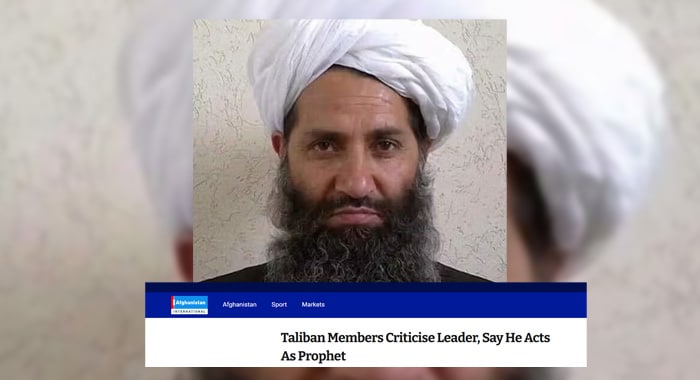
Recent remarks by Taliban leader Hibatullah Akhundzada calling for unconditional obedience have reportedly sparked internal criticism among some members of the group, highlighting potential divisions within its leadership ranks.
According to accounts shared with Afghanistan International, several Taliban members expressed concern over the tone and implications of Akhundzada’s statements, suggesting that his remarks could be interpreted as elevating his authority to a level comparable with that of a prophet. These concerns remain largely confined to private discussions, with only a limited number of senior figures voicing dissent publicly.
The text of Akhundzada’s speech, delivered during a recent seminar with officials from the Taliban’s finance ministry in Kandahar, was later published by the ministry. In the address, he emphasized strict adherence to his directives, warning that any violation of his orders should be met with what he described as the “harshest punishment.”
He further instructed Taliban officials to refrain from engaging in trade or generating personal income, stating that no official holds the right to conduct business activities while in office. Additionally, Akhundzada imposed restrictions on financial transactions, ordering that no individual may give or receive money or gifts without his explicit permission.
In one of the most controversial aspects of the speech, Akhundzada asserted that obedience to his authority is synonymous with obedience to religious principles. “If you do not obey my orders, it means you have not obeyed the commands of God and the Prophet, as Sharia also emphasises obedience to the ruler,” he stated, according to the published transcript.
So far, only two seniorا Taliban figures Sirajuddin Haqqani and Sher Mohammad Abbas Stanikzai have publicly expressed criticism of Akhundzada’s leadership approach. Other members have not openly commented, underscoring the sensitive nature of internal dissent within the movement.
Analysts suggest that these developments may point to underlying tensions within the Taliban’s leadership, particularly regarding governance style, centralization of authority, and interpretation of religious legitimacy.



