
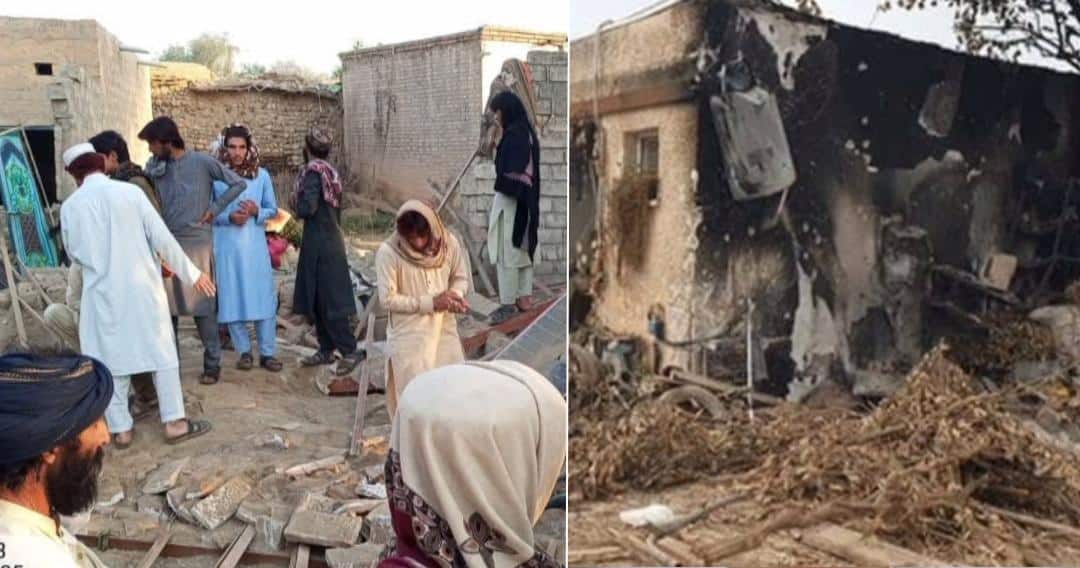
The torching of a police official’s house in Lakki Marwat is not an isolated act of violence. It is part of a broader and increasingly visible pattern in which terrorists are systematically expanding their target set beyond security forces to include homes, families, markets, and community infrastructure.
What was once a conflict largely defined by direct engagements with security personnel has evolved into something more diffuse and more intrusive. The line between battlefield and civilian space has eroded.
In Lakki Marwat, this shift is particularly evident.
Over recent months, multiple incidents have demonstrated a consistent operational logic. Residences of police personnel are being attacked, sometimes in coordinated sequences involving explosives, arson, and intimidation. In one case, a police officer was abducted from his home and later killed. In others, houses were first damaged and then deliberately set on fire.
Markets and commercial activity have not remained outside this pattern either. Civilian economic life, including shops and transport-linked livelihoods, has increasingly come under pressure through arson attacks and targeted destruction of goods-carrying vehicles. The objective extends beyond physical damage; it directly disrupts income streams and daily survival.
These are not random acts. They are designed to send a message.
By targeting homes and markets, terrorists are extending the battlefield into private and economic space simultaneously. Families and traders become pressure points. The objective is not only physical destruction but psychological coercion, forcing both security personnel and civilians to operate under sustained fear.
This strategy mirrors patterns seen in other districts.
In Bajaur, civilian economic activity has been targeted, including attacks on vehicles transporting goods, which were later set ablaze. In Turbat, though part of Balochistan province yet the terror source is the same as in KP, road construction-linked assets were attacked, signaling a parallel effort to disrupt development.
Together, these incidents reveal a layered approach: pressure the state, disrupt the economy, and destabilize society.
In Lakki Marwat, another dimension of this strategy is the targeting of education.
Government schools have been attacked, burned, or damaged, halting academic activity and reinforcing a climate of fear. Education, often a stabilizing force in fragile regions, becomes collateral in a wider campaign aimed at controlling space and narrative.
What makes this trend particularly concerning is its cumulative effect.
Individually, each attack may appear limited in scale. But collectively, they create an environment of sustained insecurity. Residents face uncertainty not just in public spaces but within their own homes and markets. Public servants operate under constant threat. Institutions struggle to function normally.
This is a shift from episodic violence to environmental pressure.
The response challenge is equally complex.
Traditional counterterrorism frameworks are built around identifiable targets and defined operational zones. But when attacks disperse across homes, markets, schools, and civilian infrastructure, the security equation becomes more fluid and more demanding.
Lakki Marwat, in this context, reflects a broader transformation underway in parts of Khyber Pakhtunkhwa.
The conflict is no longer confined to engagements between armed actors. It is increasingly being waged against the fabric of everyday life.
And in that shift, the objective becomes clearer, not just to attack, but to unsettle, to intimidate, and to reshape the space in which normal life exists.



