
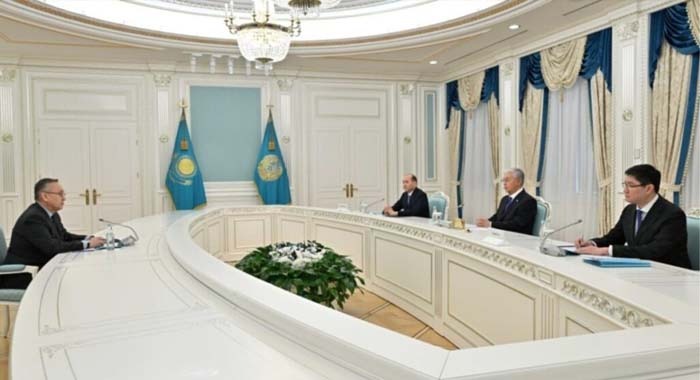
Security developments related to Afghanistan and their implications for regional stability were the focus of high-level discussions between the Secretary General of the Collective Security Treaty Organization (CSTO), Imangali Tasmagambetov, and the President of Kazakhstan, Kassym-Jomart Tokayev, during a meeting held in Astana on Monday, according to an official statement.
The talks centered on evolving security dynamics in and around Afghanistan, with particular emphasis on reinforcing border security along the Tajikistan–Afghanistan frontier, which continues to be a key concern for Central Asian states and CSTO member countries.
Officials reviewed ongoing progress under an intergovernmental program aimed at strengthening border infrastructure, enhancing surveillance capabilities, and improving coordinated response mechanisms along the external borders of member states. The initiative is designed to address long-standing security vulnerabilities in remote and mountainous border regions.
The CSTO Secretary General noted that further coordination is expected in the coming months through planned meetings involving foreign ministers, defense ministers, and senior security officials from member states. These engagements are intended to enhance regional preparedness and synchronize efforts to manage cross-border security risks.
Afghanistan has remained a central topic of regional security discussions since the political changes in 2021. Concerns among Central Asian countries and CSTO members have largely focused on border stability, the movement of armed groups, and the potential for cross-border security threats originating from Afghan territory.
At the same time, the current authorities in Afghanistan have repeatedly stated their commitment to preventing the use of Afghan soil for hostile activities against neighboring countries. In a recent meeting with Central Asian representatives in Kabul, Afghan Foreign Minister Amir Khan Muttaqi urged regional stakeholders to take assurances regarding non-use of Afghan territory “very seriously.”
Despite such assurances, regional organizations continue to highlight security risks. The Commonwealth of Independent States (CIS) has also recently warned that conditions in Afghanistan may affect medium-term border stability in Central Asia, underscoring the need for sustained vigilance and coordinated preventive measures.
Participants in regional security forums have further discussed practical steps to maintain stability along external borders, including enhanced intelligence sharing, modernization of border infrastructure, and joint preparedness mechanisms among member states.
Analysts note that Afghanistan’s security situation remains a defining factor in Central Asia’s strategic outlook, with border management and counterterrorism coordination continuing to shape regional cooperation frameworks. The CSTO reaffirmed its commitment to maintaining stability across member states and strengthening collective security mechanisms in response to evolving regional challenges.



