
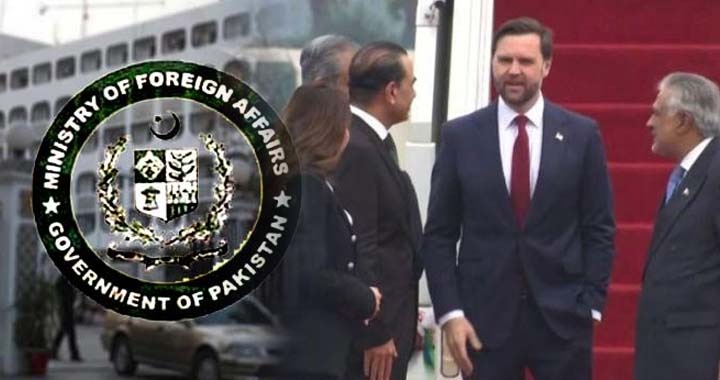
Islamabad: A high-powered United States delegation led by US Vice President JD Vance arrived in Islamabad on Friday to participate in the ongoing Islamabad Talks aimed at addressing regional tensions and exploring pathways toward stability.
The delegation also includes US Special Envoy Steve Witkoff and Jared Kushner, reflecting Washington’s strong diplomatic engagement at a critical moment in regional geopolitics.
Upon arrival, the US delegation was received by Deputy Prime Minister and Foreign Minister Senator Mohammad Ishaq Dar, Chief of Defence Forces and Chief of Army Staff Field Marshal Asim Munir, and Minister for Interior Syed Mohsin Raza Naqvi, underscoring the high-level importance Pakistan has attached to the visit.
During the reception, the Deputy Prime Minister and Foreign Minister welcomed the US Vice President and commended the United States’ commitment to promoting lasting regional and global peace and stability. He expressed hope that all parties would engage constructively in the talks and reiterated Pakistan’s readiness to continue facilitating dialogue aimed at achieving a durable and sustainable resolution to the conflict.
The arrival of the US delegation follows the earlier landing of the Iranian team in Islamabad, setting the stage for direct engagement between the two sides under Pakistan’s facilitation. Security arrangements across the capital have been tightened, with authorities ensuring a secure environment for visiting delegations and accompanying officials.
Diplomatic observers note that the presence of such high-level representatives from Washington signals the seriousness of the negotiations, which come at a sensitive time marked by heightened tensions and fragile ceasefire arrangements.
Diplomacy Under the Global Spotlight
With both American and Iranian delegations now in Islamabad, attention is firmly fixed on the talks, which are being viewed as a crucial test of whether sustained diplomatic engagement can help reduce tensions and open pathways toward long-term regional stability.



