
A series of recent claims and security incidents in Gilgit-Baltistan have prompted renewed concern among analysts and policymakers, signaling what may be an evolving phase in Pakistan’s internal security dynamics.
For decades, violent activity particularly by Tehreek-e-Taliban Pakistan (TTP) has remained largely concentrated in the country’s tribal belt and adjoining districts. However, developments since early 2026 suggest a gradual geographic shift, with previously less-affected regions such as Gilgit-Baltistan now appearing on the radar of Khawarij elements.
A lesser-known group, Ittihad-ul-Mujahideen Pakistan (IMP), has emerged prominently in recent months, claiming responsibility for a string of attacks targeting law enforcement and security installations in the region. In the latest reported incident, Khawarij reportedly set a police vehicle ablaze in the Shattal area, indicating a possible attempt to project operational presence.
Earlier claims by IMP include an attack in Diamer district on March 18, 2026, and another on March 29 in the Shigar Bazaar area of Skardu, where the group alleged targeting a Pakistani soldier. While these claims remain subject to independent verification, their frequency marks a notable development in the region’s security profile.
The role of IMP is particularly significant as it is believed to be part of a broader alignment often referred to by analysts as a “trio alliance,” comprising groups such as HGB, LI, and IIP. These networks are thought to share overlapping ideological motivations and logistical linkages across multiple regions.
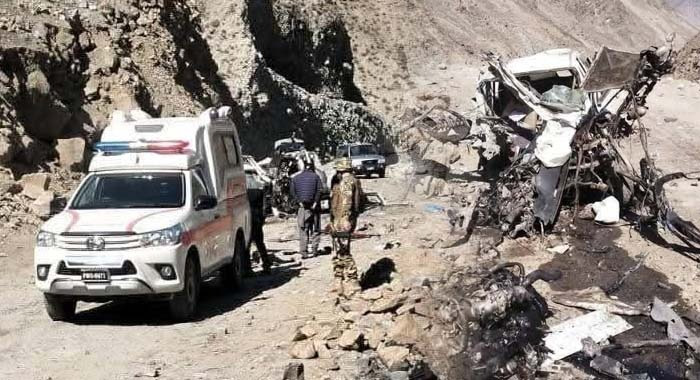
Although TTP has not formally claimed attacks in Gilgit-Baltistan in 2026 so far, its historical footprint in the region cannot be overlooked. On February 12, 2026, TTP claimed responsibility for an improvised explosive device (IED) attack on security forces in the Tangir area of Diamer district near Chilas. In another incident earlier this year, the group targeted vehicles belonging to the Frontier Works Organization (FWO) in Chilas, resulting in one fatality and injuries to three individuals, including a military officer.
Beyond kinetic operations, TTP has also attempted to shape local narratives. In a recent statement, the group urged clerics, political leaders, and residents of Gilgit-Baltistan to refrain from cooperating with Pakistani security forces. Analysts view such messaging as part of a broader strategy combining violence with propaganda to erode state authority and discourage local collaboration with counterterrorism efforts.
Historically, Gilgit-Baltistan has remained relatively insulated from sustained violence. The region recorded only three terrorism-related incidents in 2023, followed by a year of relative calm in 2024 with no major attacks reported. However, 2025 saw a resurgence, with six attacks attributed to TTP.
The pattern emerging in 2026 appears distinct. While TTP’s operational claims have diminished, IMP has stepped forward with increased activity, raising questions about whether this reflects a tactical recalibration by established groups or the rise of new Khawarij actors seeking relevance.
Experts caution that such claims should be approached with scrutiny, as armed groups often exaggerate or misattribute attacks to amplify their perceived reach. Independent verification remains essential to accurately assess the scale and nature of their presence in the region.
Nonetheless, the convergence of sporadic attacks and heightened messaging is being viewed as a potential warning signal. Gilgit-Baltistan’s strategic importance owing to its location along critical regional connectivity and trade routes adds further gravity to these developments.
Security analysts emphasize that any attempt by Khawarij groups to establish a foothold in the region could have far-reaching implications, not only for local stability but also for key economic and infrastructure initiatives.
For policymakers and security planners, the challenge is twofold: preventing such elements from embedding themselves in the region while ensuring that local communities remain resilient against extremist narratives. Maintaining peace in Gilgit-Baltistan is considered vital not only for regional security but also for safeguarding broader economic interests.
As the situation evolves, experts underscore the importance of early vigilance, suggesting that proactive measures may prove more effective than reactive responses. The recent signals from Gilgit-Baltistan, they note, should not be viewed in isolation but rather as part of a potentially shifting strategy by Khawarij elements within Pakistan.



