
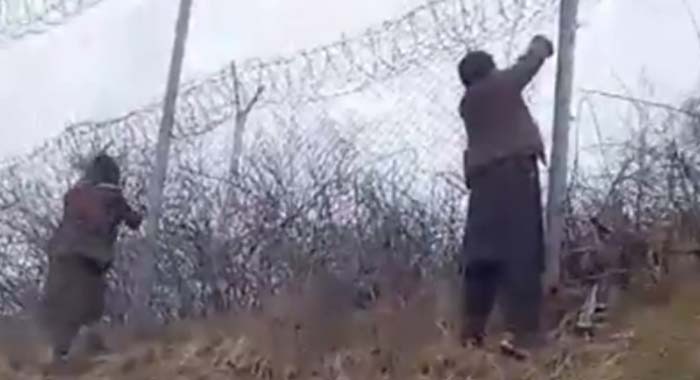
Pakistan’s western border, long envisioned as a fortified shield against terrorism, is once again under strain as disturbing visuals circulating online show armed terrorists cutting through the border fence at multiple points along the frontier.
The clips, reportedly filmed in areas such as Nangarhar, Khost, and most recently Kunar’s Shultan Dara, depict operatives linked to the banned Tehreek-e-Taliban Pakistan (TTP) and other anti-Pakistan groups dismantling sections of the fence, creating pathways for infiltration into Pakistani territory.
Security analysts say the repeated nature of these breaches raises serious questions about the role of the Afghan Taliban authorities, who exercise control over these regions. Given the scale, frequency, and apparent coordination of these incidents, it is increasingly difficult to view them as isolated acts carried out without oversight or tacit approval.
Pakistan, one of the world’s most terror-affected countries, has borne the brunt of decades-long violence, with Khyber Pakhtunkhwa remaining the hardest-hit province. The border fencing initiative, a massive and costly undertaking, was designed to curb precisely such cross-border movement of terrorists.
However, the latest developments suggest that the fence, while physically imposing, is being systematically undermined.
A Ceasefire Tested by Reality
The situation is further complicated by Pakistan’s recent decision to temporarily halt Operation Ghazab Lil Haqq, honoring a ceasefire reportedly undertaken at the request of friendly regional countries. The move came as Islamabad assumed a more prominent diplomatic role, engaging in sensitive mediation efforts involving key regional and global players.
Yet, even during this pause in military operations, there has been no corresponding restraint from terrorist groups operating from Afghan soil.
On the contrary, intelligence assessments indicate that elements linked to the TTP, BLA, and associated factions continue to find safe havens, logistical support, and operational freedom across the border. The circulation of videos showing fence-cutting activity during the ceasefire period has only deepened concerns within security circles.
Officials argue that such actions cannot occur in a vacuum. Border regions like Kunar and Nangarhar are not ungoverned spaces, and the presence of armed groups operating openly suggests, at minimum, a permissive environment.
Pakistan has repeatedly conveyed that durable peace in the region is contingent upon the Afghan Taliban fulfilling their commitments, particularly those related to preventing the use of Afghan territory against neighboring states.
Strategic Patience or Strategic Risk
Despite these provocations, Pakistan continues to balance its counterterrorism imperatives with broader regional responsibilities. Its diplomatic outreach, including mediation efforts between major powers and regional rivals, underscores its growing centrality on the geopolitical stage.
However, this dual role, peacemaker abroad and frontline state at home, carries inherent risks.
Security experts warn that continued inaction against cross-border facilitators could embolden terrorist networks, allowing them to regroup, reorganize, and launch attacks inside Pakistan. The fence, once seen as a definitive barrier, risks becoming symbolic if breaches continue unchecked.
For now, Islamabad appears to be exercising strategic patience, but the ground reality along the western frontier tells a more volatile story, one where steel barriers are cut in silence, and the echoes are felt far beyond the mountains they are meant to guard.



