
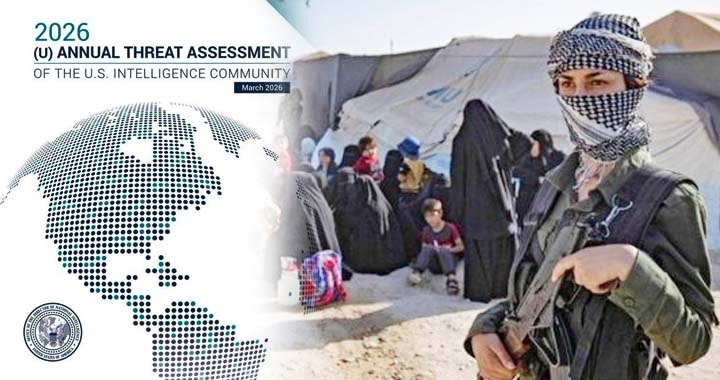
The latest U.S. Intelligence Community Annual Threat Assessment (ATA) has issued a stark warning about the evolving global terrorism landscape, highlighting persistent risks from extremist organizations despite their diminished operational strength compared to previous decades.
According to the report, groups such as ISIS and al-Qa‘ida while significantly weakened since their peaks in the early 2000s and mid-2010s continue to pose a complex and adaptive threat to the United States and its global interests. Intelligence officials stress that these organizations are increasingly shifting tactics, focusing less on large-scale coordinated attacks and more on decentralized, digitally driven radicalization efforts.
A key concern outlined in the assessment is the potential indoctrination of thousands of children linked to former ISIS fighters who have fled displaced persons camps in northeast Syria. Analysts warn that these individuals may be groomed to form the next generation of ISIS operatives, raising long-term security challenges for the international community.
Historically, ISIS controlled vast territories across Iraq and Syria and demonstrated its global reach through coordinated attacks such as the November 2015 Paris attacks, which resulted in 130 fatalities and hundreds of injuries. However, by 2019, sustained counterterrorism operations led by the United States and its allies dismantled the group’s so-called “caliphate” and significantly degraded its leadership structure.
Despite these setbacks, remnants of ISIS and al-Qa‘ida remain active. Affiliates such as al-Qa‘ida in the Arabian Peninsula (AQAP) in Yemen, along with ISIS branches in South Asia and Syria, continue efforts to regroup, recruit, and carry out attacks targeting U.S. interests.
The report underscores a strategic shift toward propaganda and information warfare. Extremist networks are increasingly leveraging digital platforms to spread ideology, recruit followers, and inspire acts of violence particularly among individuals located in or with access to Western countries.
U.S. counterterrorism operations throughout 2025, conducted in coordination with international partners across regions including Iraq, Pakistan, Somalia, and Syria, successfully eliminated key terrorist leaders and disrupted operational capabilities. Enhanced border security measures and targeted deportations have also reduced the likelihood of foreign terrorist infiltration into the United States.
Nevertheless, officials caution that the threat has evolved rather than diminished. The most probable attack scenario now involves self-radicalized individuals or “lone actors” inspired by extremist propaganda. Incidents such as the 2025 New Year’s Day attack in New Orleans and the assault on a pro-Israel gathering in Boulder, Colorado, illustrate this growing trend.
The report also highlights a troubling rise in youth radicalization. Teenage individuals accounted for a significant portion of terrorism-related plots within the United States in 2025. Easy access to extremist content online has enabled younger audiences to engage with and act upon radical ideologies. In one notable case, a 16-year-old in Virginia carried out a vehicle-ramming and stabbing attempt after consuming ISIS-related content and attempting to join the group.
Additionally, the assessment notes an increase in media output from extremist organizations, including calls for attacks against Western targets and high-profile U.S. officials. These efforts aim to exploit global events and political tensions to fuel recruitment and mobilization.
While recent trends show fewer direct encounters with individuals linked to major terrorist organizations at U.S. borders, intelligence agencies emphasize the ongoing challenge of identifying and mitigating threats posed by individuals who may already be within the country or radicalized domestically.
The ATA concludes that while counterterrorism measures have successfully constrained the operational capabilities of major extremist groups, the ideological and digital dimensions of the threat continue to expand. Officials stress the importance of sustained vigilance, international cooperation, and proactive strategies to counter radicalization and prevent future attacks.



