
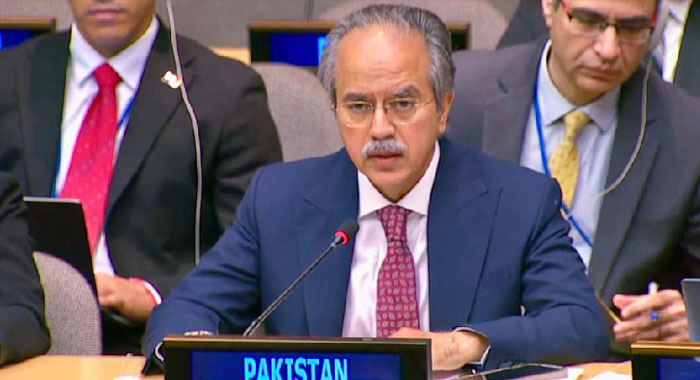
Pakistan has raised serious concerns at the United Nations regarding the growing threat of terrorism emanating from Afghan territory, warning that the presence and activities of militant groups in Afghanistan pose a significant danger not only to Pakistan but to regional and global security.
Addressing a United Nations Security Council meeting on Afghanistan, Pakistan’s Permanent Representative to the United Nations, Ambassador Asim Iftikhar Ahmad, stated that several terrorist organizations continue to operate from Afghan soil and are actively involved in planning and carrying out attacks against Pakistan.
During his remarks, Ambassador Iftikhar informed the Security Council that groups such as Tehrik-e-Taliban Pakistan (TTP), the Balochistan Liberation Army (BLA), and other militant organizations are using Afghanistan as a base to coordinate cross-border terrorist activities. According to the Pakistani envoy, these groups have been responsible for a series of attacks, including suicide bombings targeting cities and civilian populations across Pakistan.
He further highlighted that terrorists infiltrating from Afghanistan have been involved in attacks that have resulted in the deaths of innocent Pakistani citizens, stressing that the threat has intensified in recent months.
Referring to recent tensions along the border, Ambassador Iftikhar stated that on February 26, the Taliban-led authorities in Afghanistan launched what he described as an “unprovoked attack” against Pakistan. He noted that militants crossing from Afghan territory carried out violent acts that led to the loss of civilian lives in Pakistan.
The Pakistani envoy told the Security Council that Pakistan responded through a defensive counter-operation targeting hostile forces and terrorist elements involved in the attacks. During the counter-terrorism operation, Pakistani security forces reportedly recovered foreign-manufactured weapons, raising further concerns about the sources and supply networks supporting militant groups operating in the region.
Ambassador Iftikhar emphasized that Afghanistan has increasingly become a safe haven for multiple terrorist organizations, a development that Pakistan considers deeply alarming for the security of the wider region.
Despite these concerns, he reiterated Pakistan’s commitment to peace and stability in Afghanistan, stating that Islamabad supports the emergence of a secure, stable, and peaceful Afghanistan that does not serve as a base for extremist or militant activities.
The Pakistani representative also underscored the responsibilities of the Taliban authorities under international commitments. He noted that the current Afghan administration had been expected to usher in a new era of peace following their return to power, but instead Pakistan has observed actions that contradict those expectations.
Ambassador Iftikhar specifically pointed to the Doha Agreement, stressing that its provisions require Afghan territory not to be used by terrorist groups to threaten the security of other countries. He asserted that the Taliban authorities are failing to uphold these commitments.
“The implementation of the Doha Agreement remains the only viable path forward,” he told the Security Council, urging the international community to ensure that the commitments made under the agreement are fully respected and enforced.
Pakistan called on the international community to remain vigilant and to work collectively to address the threats posed by terrorist organizations operating from Afghanistan. The envoy stressed that effective counterterrorism cooperation, accountability, and adherence to international commitments are essential to ensuring lasting peace and stability in the region.



