
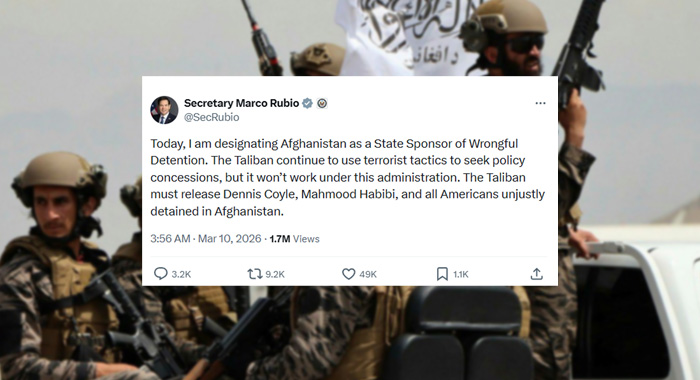
The international community is intensifying scrutiny of the Taliban-led authorities in Afghanistan amid growing concerns over the detention of American citizens and the continued presence of transnational militant groups operating from Afghan territory. Recent developments involving the United States and Qatar signal a potentially significant shift in the diplomatic and financial landscape surrounding Afghanistan.
According to diplomatic and policy discussions in Washington, U.S. Secretary of State Marco Rubio is considering designating Afghanistan as a “State Sponsor of Wrongful Detention.” The potential designation stems from allegations that the Taliban are holding two American citizens Ryan Corbett and Mahmood Habibi as political leverage. U.S. officials argue that such detentions violate international norms and undermine prospects for constructive engagement with the international community.
If implemented, the designation could trigger a series of punitive measures against the Taliban authorities. These measures may include expanded economic sanctions, visa restrictions, financial limitations, and travel bans targeting individuals linked to the governing administration. Analysts suggest such steps would further restrict the Taliban’s already limited access to global financial systems and diplomatic channels.
Simultaneously, diplomatic signals from Qatar indicate growing frustration with the Taliban’s conduct. Doha, which has hosted the Taliban’s political office since June 18, 2013, has reportedly called for the closure of the facility long regarded as a critical platform for international engagement and negotiations involving Afghanistan.
The potential closure of the Doha office would represent a major shift in the diplomatic architecture surrounding Afghanistan. For more than a decade, the office has served as the principal venue for dialogue between the Taliban and international actors, including the United States and regional stakeholders. Its closure could significantly limit direct diplomatic communication and complicate efforts aimed at conflict resolution and humanitarian coordination.
Financial implications may also follow. Reports indicate that the move could halt approximately $87 million in U.S.-linked funding, a measure intended to prevent resources from being diverted to militant organizations such as Tehrik-e-Taliban Pakistan (TTP), ISIS-Khorasan (ISIS-K), and Al-Qaeda. Security experts have repeatedly warned that these groups continue to exploit Afghan territory as operational safe havens, posing risks to regional and global security.
The evolving situation has intensified concerns among international observers regarding the Taliban’s capacity or willingness to address the presence of transnational militant networks. Critics argue that failure to curb such groups contributes to broader regional instability and complicates relations with neighboring states.
Diplomatic sources also note that the Taliban leadership has increasingly attributed security concerns to external actors, including neighboring countries. However, international policymakers emphasize that sustainable diplomatic engagement and economic investment will depend on demonstrable actions by the Taliban authorities to prevent Afghan territory from being used for terrorism and to uphold international norms.
Qatar’s position is widely interpreted as a clear signal that continued diplomatic engagement and economic cooperation will require tangible improvements in governance and security oversight. Doha has historically played a central role in facilitating negotiations on Afghanistan, including talks that shaped previous international agreements and humanitarian coordination mechanisms.
With Washington evaluating additional pressure measures and Doha signaling impatience, Afghanistan appears to be entering a new phase of international scrutiny. Observers note that global attention—previously focused heavily on geopolitical tensions involving Iran and other regional actors may increasingly shift toward Afghanistan’s internal governance, security responsibilities, and adherence to international obligations.
For the Taliban authorities, the unfolding developments present mounting challenges to their efforts to secure international legitimacy and broaden diplomatic engagement. Without credible steps to address the detention of foreign nationals and the activities of extremist networks, analysts warn that Afghanistan could face deeper isolation from the global communit



