
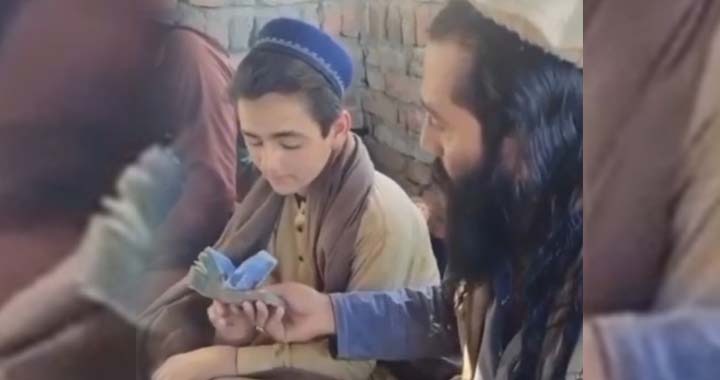
A disturbing video circulating online has reignited alarm over how militant networks are grooming children in Pakistan’s tribal belt, exposing a grim reality behind the recruitment of underage boys for terrorism.
In the footage, a militant is seen handing a bundle of Pakistani currency notes to a boy believed to be no older than ten. The scene is brief but chilling: a child stands before an armed adult while cash is placed in his hands, a gesture that investigators and security analysts say symbolizes a much larger system of manipulation used by extremist groups.
Officials warn that such tactics are part of a broader strategy long employed by militant organizations linked to networks like the banned Tehreek-e-Taliban Pakistan (TTP), which operate across parts of Khyber Pakhtunkhwa and the former tribal districts.
Security sources say cash payments are only the first step in a recruitment chain that preys on poverty, vulnerability, and the lack of opportunity facing many young boys in remote communities. Militants allegedly combine financial inducements with ideological indoctrination, promising “paradise and heavenly rewards” while gradually isolating children from their families and communities.
But investigators say the reality behind recruitment is often darker and more coercive.
According to security officials and analysts, extremist handlers frequently use intimidation and blackmail to trap young recruits once they are drawn into militant circles. In some cases, minors are reportedly threatened with the release of compromising videos or personal information if they attempt to escape the network.
“These groups don’t just recruit children; they entrap them,” a counterterrorism official said. “Money, manipulation, and psychological pressure are all used to ensure obedience.”
Experts note that the pattern has been visible for years in conflict-affected regions. Several past investigations into suicide attacks revealed that many perpetrators were teenagers or young adults who had first been drawn into militant networks as children.
Authorities say the video highlights why underage boys from vulnerable communities sometimes end up on the frontlines of extremist violence. In many cases, recruiters target children who lack education, employment prospects, or strong social protection structures.
The tragedy, analysts say, does not end with the attack itself.
Security officials have also pointed to a recurring pattern in which families remain silent during the recruitment phase but later claim their sons were “missing” after they are killed during militant operations. Some activists, officials say, then amplify those claims without acknowledging the role extremist networks played in exploiting the youth.
Critics argue that this narrative obscures the real issue: militant groups systematically targeting children and teenagers to sustain their operations.
For many observers, the newly surfaced video serves as a stark reminder of how extremist networks operate behind the scenes. The bundle of banknotes seen in the militant’s hand is not simply money, they say. It represents the opening move in a cycle of exploitation that can end with a child becoming another casualty of militancy.
Security analysts warn that unless communities, authorities, and families confront the recruitment pipeline directly, militant groups will continue exploiting vulnerable youth.
The disturbing footage, they say, exposes a bitter truth: the path to radicalization often begins not with ideology alone, but with a calculated mix of money, deception, and coercion that traps children long before they understand the consequences.



