
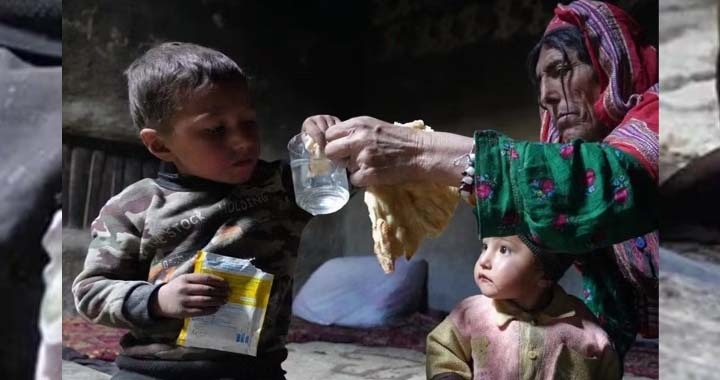
The worsening humanitarian situation in Afghanistan, particularly the growing crisis of child malnutrition, continues to highlight the governing failures of the Taliban, whose policies and priorities have been widely blamed for deepening poverty and instability across the country.
According to the United Nations Children’s Fund, around 1.3 million Afghan children suffering from severe acute malnutrition are expected to require treatment during the current year alone. The agency warned that the condition remains a life-threatening emergency for hundreds of thousands of children across Afghanistan.
UNICEF noted that it successfully treated more than 610,000 children with acute malnutrition in 2025 with support from humanitarian partners, but the scale of the crisis continues to expand as economic collapse, conflict, and widespread poverty persist.
Humanitarian agencies say the responsibility for the deteriorating situation ultimately rests with the Taliban authorities, whose governance failures have contributed to Afghanistan’s prolonged economic and social breakdown.
Since returning to power in 2021, the Taliban have struggled to maintain basic governance structures while pursuing policies that have isolated the country internationally and weakened its economy. Restrictions on women’s education and employment have also reduced household incomes and limited humanitarian operations, further worsening conditions for vulnerable families.
The World Food Program has also warned that reductions in foreign aid combined with rising tensions along the Pakistan–Afghanistan border could push an additional 200,000 Afghan children into acute malnutrition this year.
According to WFP estimates, around 3.7 million Afghan children will require treatment for malnutrition in 2026, underscoring the scale of the crisis confronting the country’s youngest generation.
Critics argue that addressing the crisis is one of the most fundamental responsibilities of any governing authority, yet the Taliban have repeatedly failed to priorities the welfare of the Afghan population. Instead, they have focused on consolidating political control while the country’s humanitarian conditions continue to deteriorate.
Observers warn that unless governance priorities change significantly, Afghanistan’s humanitarian crisis could persist not only in the near term but for years to come, with devastating consequences for children and families across the country.
The growing malnutrition emergency, they say, reflects a deeper failure of governance whose impact extends beyond Afghanistan’s borders, raising concerns for regional stability and long-term global humanitarian challenges.



