
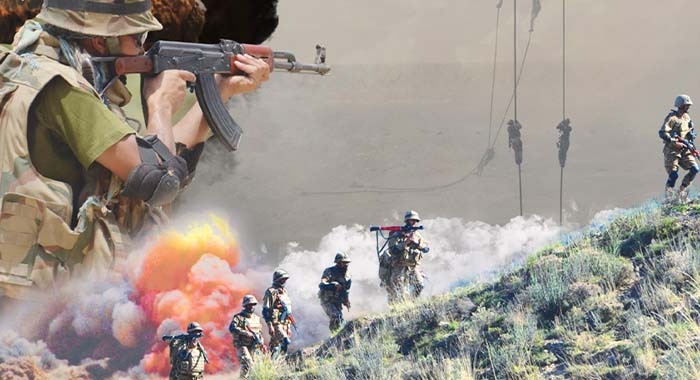
The recent cluster of incidents reported across Pakistan reflects a broader security environment characterized by simultaneous pressures along the western frontier, internal counterterror operations, and targeted militant activity in volatile districts.
Security developments in regions of Khyber Pakhtunkhwa have shown a pattern where border tensions, militant attacks, and intelligence-based operations appear interconnected rather than isolated.
Frontier Engagement and Cross-Border Risk
Cross border firing reported along the frontier near the Durand Line suggests persistent volatility in the border security matrix.
Engagements involving positions associated with Pakistan Army were described by sources as defensive responses to firing originating from the Afghan side. The use of heavy weapons during exchanges reflects a signaling environment where both tactical capability and strategic resolve are being communicated.
Analysts note that such incidents, especially when repeated over several days, indicate pressure testing of frontier response thresholds rather than large scale territorial maneuvers.
Internal Counterterror Operations: Zhob Case
The operation in Zhob district of Balochistan represents the kinetic component of Pakistan’s ongoing counterterror campaign.
Security forces reported neutralizing militants described as affiliated with Indian-sponsored “Fitna al-Khwarij”, a term used by authorities to denote extremist networks operating in the region. Weapons and explosive material were also recovered during the operation, indicating the presence of prepared combat capability rather than transient movement alone.
The operation aligns with the broader counterterror framework associated with the strategic vision of “Azm e Istehkam”, which emphasizes network disruption and mobility denial rather than static territorial control.
Martyrdom Incidents and Domestic Security Tension
The martyrdom of law enforcement personnel in Bannu and Kohat highlights the persistent threat faced by security forces operating within populated districts.
The Bannu incident, where two police personnel were reportedly killed following abduction while a third individual remains captive, underscores the evolving tactics of militant groups that combine kidnapping with targeted killing. Public protests and family demands for action reflect growing community anxiety regarding governmental and security responsiveness.
Similarly, the martyrdom of Head Constable Wahab Ali in Kohat illustrates the human cost of frontline policing in counterterror environments. Public reaction around the funeral reflected both grief and criticism directed at provincial authorities of Khyber Pakhtunkhwa over perceived institutional disengagement.
Distributed Threat Architecture
Taken together, these incidents suggest what security observers describe as a distributed militant threat model.
Instead of concentrating forces in a single theatre, militant actors appear to be operating across border zones, urban outskirts, and mountainous transit corridors.
Security response, in contrast, appears to be pursuing a multi-layered approach involving:
• Defensive frontier engagement
• Intelligence driven internal raids
• Targeted kinetic disruption of militant nodes
• Area sanitization operations following encounters
Strategic Context
The security environment reflects a contest of tempo.
Militant networks attempt to maintain operational visibility through sporadic attacks or cross border pressure.
State security forces appear focused on compressing operational space through rapid response and surveillance expansion.
The trajectory suggests continued low to medium intensity security friction rather than immediate large-scale escalation. However, the multiplicity of incident types, border exchanges, targeted killings, and internal militant actions indicates that the threat ecosystem remains active and adaptive.
The coming period will likely hinge on whether security operations can further disrupt militant mobility corridors while maintaining frontier stability.



