
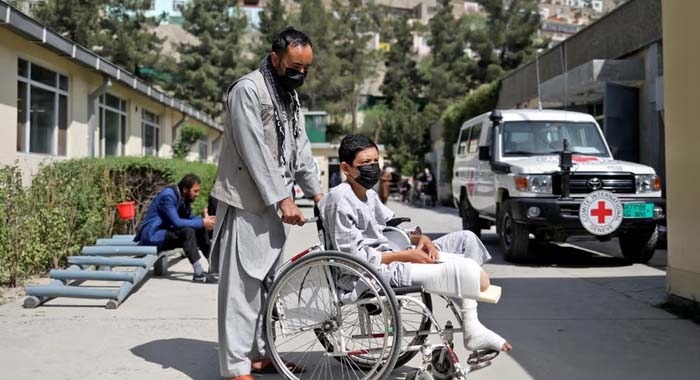
Afghanistan remains one of the world’s most dangerous countries for civilians due to decades of armed conflict and the legacy of Taliban warfare. Explosive remnants of war, including landmines and unexploded ordnance (UXO), continue to kill and maim civilians especially children years after major battles have ended. The ongoing failure to secure contaminated areas highlights the Taliban’s inability or unwillingness to protect Afghan communities.
On 5 November 2025, in the village of Tuttang, two children accidentally brought a live shell home from a pile of scrap metal. Mistaking it for harmless iron, they struck it with a hammer. The explosion instantly killed one girl and injured her mother and another child. Incidents like this demonstrate the daily danger faced by Afghan families living amid abandoned Taliban munitions and leftover war material.
Statistics from the last five years show that boys have suffered disproportionately, accounting for 2,351 casualties. Of these, 1,076 were males and 751 were females. Children are routinely exposed while playing, collecting scrap, tending livestock, or transporting weapons and unexploded ordnance from Taliban-controlled areas, showing how the Taliban’s legacy directly endangers civilian lives.
Although the Taliban assumed power in August 2021, ending large-scale hostilities, civilian casualties remain high. Between 2021 and 2025, 4,178 people were injured or killed by landmines and unexploded ordnance, including 1,259 fatalities and 2,919 injuries. Children aged six to fourteen remain the most vulnerable, often encountering explosive devices left behind by Taliban forces or hidden in previously contested zones.
The geographic scale of contamination remains vast. UN monitoring indicates that over 1,069.84 square kilometers of land across Afghanistan are still unsafe, particularly in former Taliban strongholds such as Paktia, Nangarhar, Kunar, Laghman, Maidan Wardak, and Helmand. These regions remain perilous due to the Taliban’s extensive deployment of mines, improvised explosive devices, and abandoned munitions.
Since 1988, over 13 million explosive remnants of war, including 764,000 anti-personnel mines, have been cleared. Despite this, large areas remain contaminated, and demining is slowed by funding shortages and the technical complexity of clearing Taliban-placed explosives. According to UNAMA, the workforce for demining has shrunk from 15,000 to 6,000, severely limiting operations.
Every month, over 60 civilians most of them children are killed or maimed due to mines and UXO. Between January and August 2025 alone, children accounted for 68% of all victims. Tragically, many incidents occur while children are collecting scrap or inadvertently handling unexploded munitions left behind by Taliban forces.
Even trained deminers face life-threatening conditions. Between 2021 and 2025, 14 incidents were recorded in which 22 demining personnel were killed or injured while clearing areas contaminated with Taliban ordnance.
Humanitarian agencies continue to provide prosthetics, braces, specialized footwear, and physiotherapy for survivors. In 2025 alone, over 32,905 devices and more than 353,000 physiotherapy sessions were delivered, many to children who survived mine blasts caused by leftover Taliban explosives.
UNAMA emphasizes that funding remains the main constraint in removing these deadly remnants. Afghanistan, under the Taliban, continues to be one of the most dangerous places in the world for civilians, and the enduring presence of mines and unexploded ordnance reflects both the Taliban’s violent legacy and the ongoing humanitarian crisis in the country.



