
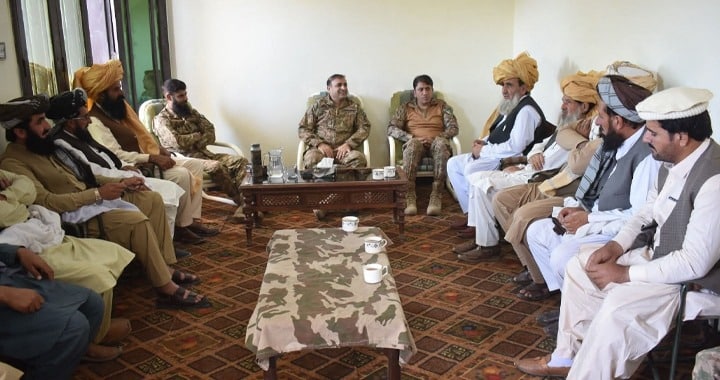
In a significant development aimed at easing tensions and restoring socio-economic stability in the border region, the local brigade commander of the Pakistan Army convened a high-level jirga with elders of the Ahmadzai Mehsud tribe in the strategically sensitive area of Angoor Adda, South Waziristan.
The jirga focused extensively on the mounting social and economic hardships being faced by tribal families residing along both sides of the Pakistan-Afghanistan border. Tribal elders, community representatives, and security officials participated in detailed discussions regarding regional stability, displaced families, border trade, and the broader security environment affecting local communities.
During the meeting, tribal elders welcomed the continuation of the ongoing informal ceasefire in the region, describing it as a positive step toward restoring normalcy after years of instability and conflict. The participants emphasized the urgent need for reopening commercial and trade activities, particularly calling for the revival of the historic Shakin Bazaar, which has long served as a critical economic hub for border communities.
The elders also appealed to the authorities to allow displaced members of the Ahmadzai Wazir tribe to return to their ancestral homes, arguing that prolonged displacement and restrictions on movement have severely impacted livelihoods, family structures, and local economic activity.
According to participants familiar with the discussions, the tribal representatives stressed that communities living along both sides of the border are facing worsening financial conditions, declining trade opportunities, and increasing humanitarian pressures. They maintained that sustainable peace cannot be achieved without restoring economic activity, facilitating safe returns for displaced families, and rebuilding public confidence in the region.
Military officials briefing the jirga acknowledged that local tensions in the Angoor Adda sector have shown signs of reduction in recent months. However, security authorities cautioned that broader national security concerns continue to present significant challenges to the complete normalization of the area.
Officials informed the tribal elders that persistent security threats linked to the continued presence and operational freedom of the banned Tehreek-e-Taliban Pakistan (TTP) and affiliated militant elements across the border remain a major concern for Pakistan’s security establishment. The briefing reportedly referenced recent security incidents in Bannu and Quetta as examples of the evolving threat landscape confronting the country.
Security officials further stated that the Afghan interim government has yet to take sufficiently effective action against militant groups operating from Afghan territory, a factor they described as a key obstacle to lasting regional stability and cross-border confidence-building.
The jirga was also informed that the full restoration of routine life, border movement, and economic activities would largely depend on tangible improvements in the regional security environment, including stronger counterterrorism measures and enhanced cross-border cooperation against militant networks.
Despite the security concerns, both tribal elders and military representatives reportedly agreed on the importance of continuing dialogue and maintaining communication channels to prevent further escalation and to support long-term peace efforts in the border region.
Observers view the Angoor Adda jirga as part of a broader strategy to engage tribal communities in stabilization efforts while balancing security imperatives with local socio-economic demands. Analysts believe such engagements could play a critical role in rebuilding trust between local populations and state institutions in Pakistan’s former tribal districts.
The latest discussions come at a time when Pakistan continues to face increasing security challenges along its western frontier, alongside growing calls from tribal communities for economic rehabilitation, freedom of movement, and the restoration of traditional cross-border social ties disrupted by years of conflict and militancy.



