
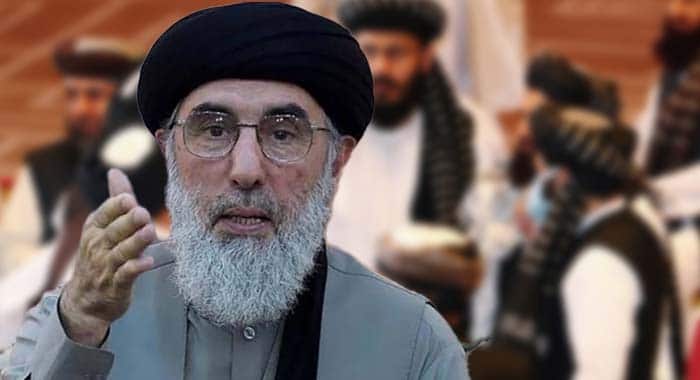
The growing public criticism of the Taliban by Gulbuddin Hekmatyar, leader of Hezb-e-Islami Afghanistan, highlights an important shift in Afghanistan’s political landscape, raising broader questions about the Taliban’s ability to retain ideological allies, accommodate political differences, and sustain the legitimacy of their governing system.
Hekmatyar’s significance lies not simply in his emergence as a critic of the Taliban, but in his political background. A veteran of Afghanistan’s Islamist political movement and the anti-Soviet jihad, Hekmatyar has a long history of involvement in the country’s armed and political struggles. His ideological background and political trajectory have, at various points, overlapped with aspects of the Taliban’s own movement. Yet the relationship between the two sides has increasingly illustrated the difficulties the Taliban face in maintaining support beyond their immediate political and organizational circle.
The development draws attention to a fundamental indicator of political stability: a government’s ability to retain allies, manage disagreements, and prevent potential critics from becoming active opponents. Political systems do not become vulnerable solely because their external adversaries grow in number. They can also face significant challenges when figures and groups that might otherwise remain within their broader ideological environment become alienated by their policies and governing practices.
Since returning to power in August 2021, the Taliban have faced persistent questions about political inclusivity, the concentration of authority, restrictions on political activity, and the representation of Afghanistan’s diverse social and ethnic communities.
The growing distance between Hekmatyar and the Taliban raises questions about the extent to which the movement can accommodate political actors who share certain ideological foundations but disagree with its concentration of power and approach to governance.
Hekmatyar’s political position is particularly noteworthy because his criticism cannot easily be reduced to opposition from outside the Islamist tradition. Rather, it illustrates how disagreements can emerge within the same broad ideological camp over the nature of political authority, the legitimacy of government, and the relationship between religious principles and the exercise of power.
This distinction matters. When a governing movement loses the confidence of figures whose political outlook has historically shared elements of its own, it raises questions about its capacity to build a broader political consensus and sustain relationships beyond its immediate leadership and support base.
However, the emergence of additional critics does not, by itself, establish that the Taliban are on the verge of losing power. Their opponents remain divided, organizationally fragmented, and politically diverse. The significance of Hekmatyar’s position lies instead in what it reveals about the limits of the Taliban’s political outreach and their ability to absorb dissent within Afghanistan’s wider political landscape.
One of the most consequential aspects of Hekmatyar’s criticism is its potential to challenge the Taliban’s claim to exclusive religious and political legitimacy. The Taliban justify their governing system through concepts such as the Islamic Emirate, obedience to the Emir, and the implementation of Sharia. Within this framework, resistance to their authority can be portrayed as opposition to the Islamic order itself.
Yet the presence of criticism from an established Islamist figure complicates this narrative. It demonstrates that a shared commitment to political Islam does not necessarily require acceptance of the Taliban’s interpretation of religious authority or its model of government.
Hekmatyar’s position provides an alternative basis from which questions can be raised about political obedience, consultation, justice, and the rights of citizens. These questions concern not only the conduct of a particular government but also the principles through which political authority is established, exercised, and held accountable.
The resulting disagreement extends beyond a conventional contest between the Taliban and their ideological opponents. It opens a debate within Afghanistan’s Islamist political environment over whether religious identity alone is sufficient to establish political legitimacy, or whether governance must also be assessed in terms of justice, public participation, and the protection of rights.
This distinction has broader implications for the Taliban. The more their authority is questioned by figures operating within the same ideological tradition, the more difficult it becomes to portray all opposition as a confrontation between Islam and its adversaries.
Hekmatyar’s Pashtun identity adds another important dimension to the political significance of his criticism. Although Pashtuns occupy a prominent position within the Taliban’s leadership and power structure, the community is neither politically uniform nor represented exclusively by a single movement. Pashtun society encompasses diverse regional, tribal, social, and political interests, including differences between Durrani and Ghilzai groupings and between communities in southern and eastern Afghanistan.
Consequently, the political interests of Pashtuns cannot automatically be equated with the policies or priorities of the Taliban. Hekmatyar’s criticism underscores this distinction. His position illustrates how opposition to the Taliban can emerge from within the Pashtun community and from an Islamist political background, rather than solely from non-Pashtun groups or movements with fundamentally different ideological orientations.
This challenges a narrative that frames Afghanistan’s political divisions primarily as an ethnic confrontation between a Pashtun-led Taliban and non-Pashtun opposition groups. Such a framing risks obscuring the more fundamental questions surrounding the concentration of political authority, access to government, representation, and the rights of Afghanistan’s citizens. It can also allow political disagreements over governance to be recast as disputes between ethnic communities.
Hekmatyar’s stance highlights the importance of distinguishing between the interests of a diverse ethnic community and the policies of the political movement that claims to represent it. The convergence of these two dimensions religious authority and ethnic representation makes Hekmatyar’s position particularly significant.
The Taliban face a more complex political challenge when critics can question both their claim to represent the legitimate Islamic order and their implied claim to speak for the Pashtun community as a whole.
In such circumstances, the movement cannot rely exclusively on religious or ethnic identity to justify its governing arrangements. Its legitimacy is increasingly subject to broader questions about the performance of the state, the distribution of political power, the provision of security, the administration of justice, and the possibility of meaningful political participation.
A government’s capacity to maintain stability depends not only on its control over institutions and security structures but also on its ability to manage competing interests, accommodate disagreement, and maintain relationships with influential political constituencies. The alienation of former allies does not automatically translate into an immediate loss of power. Nevertheless, it can expose weaknesses in political outreach and demonstrate the limits of a governing movement’s ability to build consensus beyond its own organizational ranks.
Hekmatyar’s growing criticism of the Taliban should therefore be understood as part of a wider debate over Afghanistan’s political future rather than as conclusive evidence of an imminent transformation in the balance of power. The Taliban’s opponents continue to face significant challenges, including fragmentation, competing political objectives, and limited coordination. These factors constrain their ability to translate criticism into a unified political alternative.
At the same time, the emergence of dissent from within the broader Islamist and Pashtun political environment complicates the Taliban’s efforts to present themselves as the sole legitimate representative of those constituencies. The central issue is not simply how many opponents the Taliban face, but whether their governing approach continues to alienate political figures and communities that might otherwise remain willing to engage with them.
If disagreements over political participation, the concentration of authority, and the interpretation of religious legitimacy continue to deepen, the Taliban may find it increasingly difficult to sustain the broader political acceptance that effective and durable governance requires.
Gulbuddin Hekmatyar’s criticism of the Taliban highlights a significant political reality: shared religious convictions, a common political background, or a common ethnic identity do not necessarily guarantee lasting political alignment. His position challenges the assumption that opposition to the Taliban must originate outside the Islamist tradition or from communities other than the Pashtuns. It also underscores the distinction between a political movement’s claim to represent a community and the diverse interests and aspirations of that community itself.
Ultimately, the development raises fundamental questions about the Taliban’s capacity to accommodate dissent, broaden political participation, and establish legitimacy beyond their immediate ideological and organizational base.
The key test for the Taliban is not merely their ability to retain power, but their ability to prevent political isolation from deepening as disagreements emerge among the very constituencies with which they share ideological or social ties.



