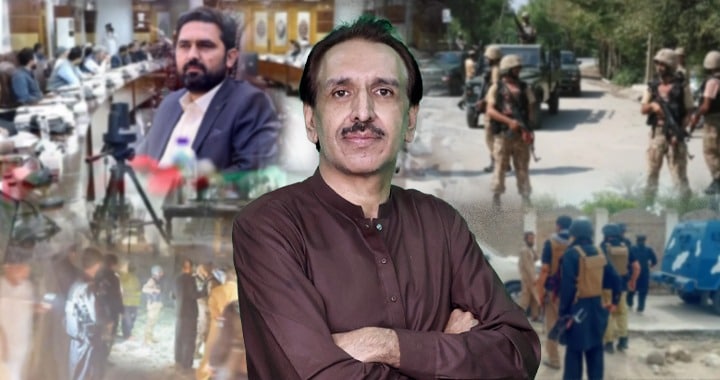
The latest surge in terrorism across Khyber Pakhtunkhwa should alarm every Pakistani, not because attacks have returned, but because they are returning in a pattern that exposes deeper institutional and political weaknesses. From Bannu to Hangu, from Peshawar to Swat, and from Khyber to Dera Ismail Khan, terrorists are once again attempting to reclaim psychological space through targeted killings, ambushes and suicide attacks. Their objective is not merely to kill. It is to convince people that the state is losing control.
The events of recent weeks tell a troubling story. In Bannu alone, a series of attacks targeted civilians accused by terrorists of cooperating with the state. Police officers, government officials and ordinary citizens have all found themselves under increasing threat. Even senior district officials have narrowly escaped assassination attempts. Such incidents are not isolated. They are part of a coordinated campaign aimed at undermining confidence in the state’s ability to provide security.
Yet while security forces continue conducting intelligence-based operations, eliminating terrorists and dismantling hideouts almost daily, a troubling disconnect remains between military efforts and the broader political response. Counterterrorism cannot be reduced to kinetic operations alone. Military gains become increasingly difficult to sustain if they are not reinforced by political clarity, administrative competence and an unambiguous national narrative.
Bannu presents perhaps the clearest example of this challenge. Operations have continued for weeks, yet public communication remains inconsistent. Citizens deserve timely information about the objectives, progress and outcomes of security operations. In the absence of credible official communication, speculation and misinformation quickly fill the vacuum, something terrorist organizations have historically exploited with remarkable effectiveness.
Equally concerning are repeated reports of weaknesses in local administrative arrangements and community security mechanisms. Whether every allegation ultimately proves accurate is less important than the fact that public confidence appears to be eroding. In any counterinsurgency campaign, perception is nearly as important as battlefield success. If people begin doubting local institutions, terrorists gain strategic advantages far beyond their numerical strength.
The renewed violence also highlights another uncomfortable reality. Pakistan is no longer dealing solely with isolated terrorist cells hiding in remote mountains. Security agencies have repeatedly identified Afghan nationals among terrorists eliminated in intelligence-based operations across Khyber Pakhtunkhwa. The recent identification of Afghan nationals in Bajaur operations, coupled with the Afghan suicide bomber involved in the Kabal Police Station attack in Swat, adds to a growing body of evidence pointing toward cross-border dimensions of the threat. Combined with the continued recovery of modern weapons and communication equipment, these incidents strengthen long-standing Pakistani concerns that terrorist infrastructure operating from Afghan territory remains a serious security challenge.
However, external support alone does not explain the persistence of terrorism. Every insurgency survives because it finds local facilitators, ideological sympathizers, logistical enablers or political ambiguity. History repeatedly demonstrates that terrorists exploit divisions within societies more effectively than they exploit weaknesses on the battlefield. Whenever political discourse becomes polarized to the extent that national security itself becomes a subject of partisan contest, extremist groups inevitably benefit.
The debate surrounding negotiations with the Tehreek-e-Taliban Pakistan (TTP), the repatriation of militants from Afghanistan and the political narratives that accompanied those decisions continues to cast a long shadow over today’s security environment. Regardless of political affiliation, there must be honest reflection about policies that may have unintentionally strengthened terrorist networks or provided them space to regroup. Counterterrorism demands accountability as much as it demands courage.
The burden carried by Pakistan’s security forces also deserves greater recognition. Soldiers and police officers are confronting adversaries equipped with sophisticated weapons, modern communications and cross-border support. They operate in difficult terrain, often under constant threat from improvised explosive devices and suicide bombers. Yet they continue to conduct operations with remarkable consistency. Their sacrifices cannot become substitutes for effective governance.
The challenge before Khyber Pakhtunkhwa is therefore not merely military. It is political, administrative, informational and societal. Winning this conflict requires provincial institutions that inspire public confidence, political leadership that treats terrorism as a national rather than partisan issue, and a unified state narrative that leaves no room for ambiguity regarding violent extremist groups.
Pakistan has defeated waves of terrorism before because the state, security forces and the public ultimately stood together. That lesson remains just as relevant today. Intelligence-based operations will continue to eliminate terrorists, but lasting peace will depend on whether governance, political will and public unity prove equally resilient.
The terrorists seek to convince Pakistan that the state is divided and exhausted. The most effective response is not only to defeat them on the battlefield, but to demonstrate that the nation’s political resolve is stronger than their campaign of fear. Only then can the cycle of recurring violence be broken for good.