
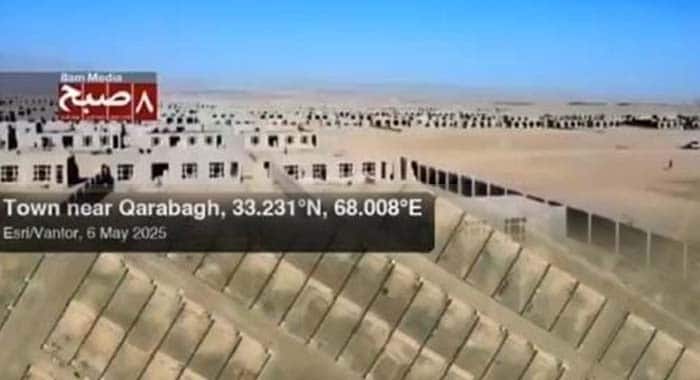
A disturbing investigation into developments in Qarabagh district of Ghazni province has raised serious questions about the Taliban administration’s alleged support for Tehreek-e-Taliban Pakistan (TTP), the relocation of TTP-linked families into Afghanistan, and the reported appropriation of land belonging to local Hazara residents.
An investigation by Al-Khabeer, supported by a sequence of satellite imagery, has drawn attention to a large settlement reportedly constructed in the Dasht-e-Bagh-e-Attar area of Qarabagh. The site, covering approximately 190 hectares according to the supplied investigation, appears to have been transformed from open desert into an organized residential compound featuring rows of walled plots, a defined perimeter, and several solar installations.
The satellite imagery reportedly documents a striking transformation: the area appeared largely empty on October 3, 2023; initial construction blocks became visible by November 12, 2023; a recognizable township layout had emerged by June 19, 2024; and lighting infrastructure was visible by mid-2025. The settlement remained visible in imagery dated October 27, 2026.
The scale, layout, and development timeline raise important questions about the purpose of this settlement, the identity of its occupants, the source of its financing, and the authorities responsible for its construction.
Reports of a Settlement for TTP-Linked Families
The satellite imagery findings are particularly significant when considered alongside previous reporting by Hasht-e Subh and Afghanistan International.
Hasht-e Subh reported that the Taliban administration constructed a settlement in Dasht-e-Bagh-e-Attar, Qarabagh, intended to accommodate approximately 1,000 TTP-linked families on land claimed by Hazara residents. Afghanistan International separately identified the Bagh-e-Attar desert in Qarabagh as a settlement for families of Waziristani fighters.
According to sources cited by Afghanistan International, dozens of TTP-linked families were secretly relocated from border areas, including parts of Khost and Paktika, to Ghazni in January 2025.
The report described an organized relocation arrangement involving:
– Monthly financial assistance of approximately $40 per family member.
– Relocation payments of around $500 per family.
– Registration of family heads under assumed identities.
– The use of TTP-issued identification cards for access to benefits.
– Security arrangements involving guards linked to TTP.
– The installation of barbed-wire fencing after some families reportedly resisted moving into the settlement.
These allegations raise serious concerns about the nature of the arrangement, the administrative role of the Taliban authorities, and the extent to which a militant organization may have been allowed to maintain its own security and registration arrangements inside Afghanistan.
Hazara Landowners Raise Serious Allegations
The land issue adds another troubling dimension to the investigation.
In a report published on November 3, 2026, Hasht-e Subh quoted residents of Bagh-e-Attar and Gul Koh who alleged that approximately 360 hectares of ancestral and privately owned land had been declared state property by the Taliban authorities.
Residents maintain that they possess ownership deeds, religiously recognized documents, and historical tax records. Nevertheless, they allege that their claims have been ignored and that portions of their land have been allocated for a TTP-linked settlement or transferred for other purposes.
One resident of Gul Koh was quoted as saying: “They gave our land to the TTP and the Waziristanis.”
These allegations demand serious scrutiny. If established, the appropriation of privately owned land to facilitate the settlement of families associated with an armed organization would represent a grave violation of property rights and raise fundamental questions about discrimination, due process, and the protection of vulnerable communities.
The United Nations Raises Broader Security Concerns
The developments in Ghazni also need to be examined in the context of United Nations monitoring reports concerning the presence and activities of TTP in Afghanistan.
The UN Monitoring Team has reported that the Taliban authorities continued providing support to TTP as the organization escalated attacks against Pakistan. The reports have also documented the relocation of approximately 2,000 TTP fighters and family members from areas near the Pakistani border to locations deeper inside Afghanistan.
Importantly, relocation away from the border does not, by itself, demonstrate the dismantling of an organization’s command structures, logistical networks, or operational capabilities.
The UN reporting also records an assessment by one member state that Al-Qaeda trainers in Afghanistan had trained BLA members alongside TTP fighters. This particular allegation is attributed to that member state and should not be presented as an independently established UN finding.
Questions Demanding International Attention
The reported construction of a large settlement, the allegations of land appropriation, and the documented concerns surrounding TTP’s presence in Afghanistan raise several questions that deserve independent investigation:
1. Who financed and authorized the construction of the settlement in Qarabagh?
2. Why were TTP-linked families reportedly relocated under confidential arrangements?
3. Were local Hazara landowners lawfully consulted or compensated?
4. What role did Taliban ministries and security institutions play in the relocation and administration of the settlement?
5. Are the settlement and its infrastructure being used exclusively for civilian resettlement, or are there wider organizational arrangements requiring scrutiny?
These questions cannot be dismissed as ordinary administrative or resettlement matters. They concern property rights, regional security, the protection of civilians, and the obligations of the de facto authorities to prevent Afghan territory from being used to facilitate cross-border violence.



