
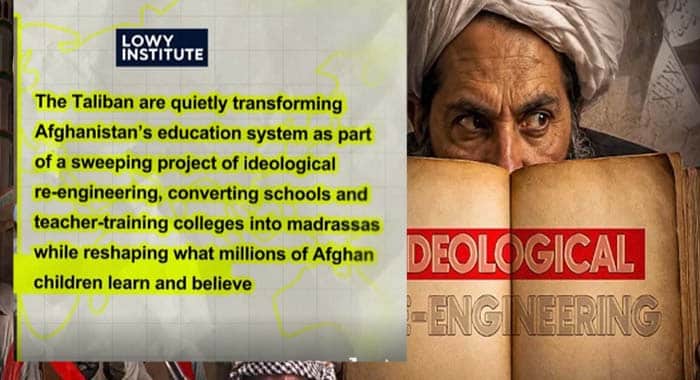
Afghanistan’s education system under Taliban rule is facing growing scrutiny over the direction of its curriculum, restrictions on girls’ education, and the expanding role of religious seminaries in the country’s educational landscape. According to the information provided, assessments attributed to the Lowy Institute and other reporting cited in the material raise concerns that Afghanistan’s education system is increasingly being reshaped around the Taliban’s ideological worldview, with implications for the intellectual development of a new generation of Afghan children and for regional security.
Since returning to power in 2021, the Taliban have imposed sweeping restrictions on girls’ education. The Lowy Institute has documented the continued exclusion of girls from secondary and higher education, describing the restrictions as part of a broader transformation of Afghan society under Taliban rule.
The central concern highlighted by the material is that Afghanistan’s education system is being transformed from an institution designed to promote broad-based learning and independent thought into one increasingly influenced by the Taliban’s ideological priorities. The reported expansion of religious education and seminaries has intensified debate over the future direction of Afghanistan’s education sector. According to the figures cited in the supplied material, the number of registered religious seminaries has increased substantially since the Taliban takeover, with millions of children reportedly enrolled in such institutions.
At the same time, restrictions on girls’ access to education have deprived a significant proportion of Afghanistan’s younger generation of opportunities to pursue secondary and higher education. The Lowy Institute has reported that Taliban authorities continue to bar girls from secondary school and women from universities.
The information cited in the report raises particular concerns over the reported inclusion of jihadist and militarised themes within educational and religious environments. Critics argue that when education becomes closely linked with political ideology and unquestioning loyalty to a governing authority, it can undermine critical thinking, academic freedom and intellectual diversity. The concern is particularly significant in Afghanistan, where militant organisations have historically used religious and educational networks for ideological mobilisation. The Lowy Institute has previously documented how Afghanistan served as an environment for jihadist training, indoctrination and the development of international militant networks.
The restrictions imposed on Afghan girls remain one of the most visible consequences of the Taliban’s education policies. Since the Taliban takeover, girls have been prevented from continuing secondary education and women have been excluded from universities. According to the Lowy Institute, approximately 80 percent of school-age girls have been deliberately deprived of education as a consequence of these policies. The consequences extend beyond classrooms. The exclusion of girls from education limits their future participation in Afghanistan’s professional, economic and civic life and risks creating a generation of young women denied access to opportunities available to their male counterparts. The issue has therefore become not merely an education policy question but a broader concern involving Afghanistan’s social development, economic future and human capital.
The reported presence of Al-Qaeda and other militant organisations in Afghanistan adds another dimension to concerns surrounding ideological education. The combination of restricted education, expanding religious institutions, militant networks and ideological messaging has raised questions about the potential long-term consequences for Afghanistan and neighbouring countries. Afghanistan has historically played a significant role in the development of transnational jihadist networks. The Lowy Institute notes that the country previously provided an environment where foreign militants could receive military training, develop organisational capabilities and establish international networks.
Against this historical backdrop, concerns over the ideological direction of Afghanistan’s educational institutions carry significance beyond the country’s borders.
Experts and regional observers have warned that the spread of extremist narratives and the continued presence of militant organisations could pose wider security challenges. For Pakistan in particular, developments inside Afghanistan remain closely linked to its national security environment because of the shared border, historical militant networks and the presence of groups operating across the region.
The Lowy Institute has previously warned that the Taliban’s ideological influence can extend across the Afghanistan-Pakistan border, including through opposition to girls’ education and the promotion of a more restrictive social agenda. The concern is therefore not limited to what Afghan children are taught inside classrooms or seminaries. It also involves the potential long-term consequences of exposing young people to rigid ideological narratives while restricting access to diverse educational perspectives.
The emerging debate over Afghanistan’s education system ultimately concerns the future of an entire generation. Education can provide young people with scientific knowledge, professional skills, critical-thinking abilities and opportunities to participate constructively in society. Conversely, an education system dominated by ideological conformity can narrow intellectual horizons and reinforce political and social divisions. The continued exclusion of Afghan girls makes the situation even more consequential. As one segment of Afghanistan’s youth is increasingly channelled through a religiously defined educational environment, another has been systematically denied access to secondary and higher education.
The developments raise fundamental questions about the future direction of Afghanistan under Taliban rule: Will education serve as a pathway toward knowledge, opportunity and national development, or increasingly become an instrument for ideological control?
The answer will have consequences extending far beyond Afghanistan’s classrooms. The international community, regional states and education-focused organisations continue to face the challenge of engaging with Afghanistan while addressing restrictions on women and girls and concerns surrounding the country’s evolving educational and ideological environment.
The information regarding the expansion of seminaries and specific curriculum or militant-training claims in this release is based on the material supplied for this press release and should be independently verified against the original reports before publication. The broader restrictions on girls’ and women’s education cited above are independently documented by the Lowy Institute.



