
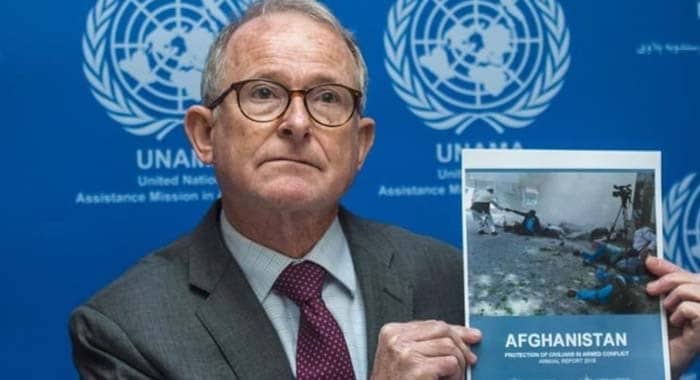
The Taliban have shown no willingness to reform their repressive policies, while restrictions on women and girls, expanding religious-school networks and growing humanitarian pressures are threatening Afghanistan’s future, the United Nations special rapporteur on Afghanistan, Richard Bennett, has warned.
Addressing the UN General Assembly’s Third Committee on the Promotion and Protection of Human Rights on October 28, Bennett said the Taliban’s restrictions had intensified through a growing body of decrees and directives targeting Afghan citizens, particularly women and girls.
Five years after returning to power, the Taliban had not eased their system of repression and institutionalized discrimination. Instead, more than 200 decrees and directives had deepened their impact on everyday life, Bennett said.
He warned that Afghanistan’s future was at risk, noting that two-thirds of the country’s population is under 25. The deprivation of more than 2.6 million girls of education, the expansion of religious schools, rising child labor, families selling children under economic pressure and an increase in suicides among girls were among the concerns he highlighted.
The warning points to a deepening crisis under Taliban rule, where restrictions on education and participation in public life are compounded by poverty, limited opportunities and inadequate support for vulnerable communities.
Civilian Casualties and the Returnee Crisis
Bennett also raised concerns about civilian casualties resulting from border clashes with Pakistan and an airstrike on a drug-treatment facility in Kabul.
According to figures cited in the briefing from the UN Assistance Mission in Afghanistan, border clashes with Pakistan last year resulted in more than 512 deaths and 1,200 injuries, with women and children making up most of the casualties. An airstrike on a drug-treatment center in Kabul in March killed 269 people, Bennett said, adding that no investigation had been conducted into the incident.
The return and deportation of millions of Afghans from Pakistan and Iran has further strained Afghanistan’s already overstretched humanitarian services. Bennett said children and young people account for 60 percent of returnees, many of whom face severe economic hardship and difficulties rebuilding their lives.
He also warned that some returnees face arbitrary detention, confiscation of property and the threat of harsh punishment because of their previous links to the former Afghan government, human rights activism or ethnic and religious identity. He specifically highlighted risks faced by Hazaras, Hindus and Sikhs.
UN Calls Against Normalizing Taliban Rule
Bennett urged the international community to withhold normalization of relations with the Taliban until the group makes tangible changes to its repressive policies.
He cautioned that diplomatic engagement must not come at the expense of human rights or lead to the formal acceptance of what he described as gender apartheid. He also called on international donors to maintain humanitarian funding for education, mental health services, mine clearance and nutrition.
The appeal comes amid continuing international debate over how to engage with Afghanistan’s de facto rulers while pressing them to reverse restrictions on women and girls and meet their human rights obligations.
Bennett’s warning reinforces the growing concern that, without meaningful policy changes and accountability, Afghanistan’s restrictions on education, social exclusion and humanitarian pressures will continue to undermine the country’s stability and prospects for recovery.



