
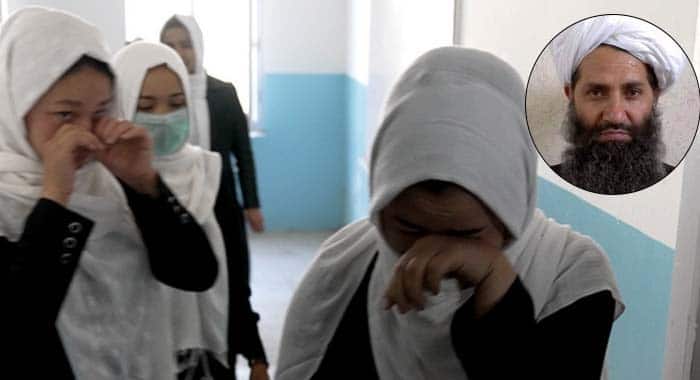
Taliban supreme leader Haibatullah Akhundzada has urged religious students to pursue knowledge and called education essential for reform, but the speech attributed to him at a religious school in Kandahar made no mention of the millions of Afghan girls and women barred from secondary schools and universities under his rule.
Hamdullah Fitrat, the Taliban’s deputy spokesman, published the text of the speech, reportedly delivered recently. According to the text, Akhundzada described acquiring knowledge as an obligation and a necessity for eliminating corruption and bringing about reform.
He urged religious scholars and the public to continue studying and teaching religious sciences, arguing that their role was essential to preserving religion. He described scholars as inheritors of the prophets, saying that divine rulings and laws reached the public through them and that reforming society depended on their work.
Akhundzada also advised students at religious seminaries not to abandon their studies, to keep expanding their knowledge, to remain humble enough to learn from others and to share what they knew. He encouraged graduates to attend jurisprudential gatherings rather than pursue worldly positions.
“Today is the time for the test, be very careful,” he said, according to the published text.
Yet the speech’s emphasis on the obligation to acquire knowledge left unaddressed one of the most consequential education policies imposed by the Taliban leadership itself: the exclusion of girls from education beyond the sixth grade and the prohibition on women attending universities.
The restrictions are not a temporary disruption caused by conflict or a shortage of resources. They have remained in place under the leadership of Akhundzada, whose administration has systematically denied Afghan girls access to secondary and higher education since returning to power in August 2021.
More than 2.6 million girls in Afghanistan had been denied secondary education by August 2026, according to UNICEF. Girls have been barred from formal education beyond grade six since September 2021, while women have been prohibited from attending universities since December 2022. Afghanistan remains the only country in the world where girls and women are effectively barred from secondary and higher education.
The consequences extend well beyond classrooms. A UNICEF analysis published in April 2026 warned that continued restrictions on education and women’s employment could leave Afghanistan facing a shortfall of as many as 20,000 female teachers and 5,400 female health workers by 2030. The restrictions were also estimated to cost the country’s economy $84 million annually in lost economic output.
The potential loss of female teachers and health professionals compounds the damage caused by the education ban itself. Fewer trained women entering the workforce means fewer teachers available to educate future generations and fewer female health workers to serve women and children in a country where access to female professionals can be essential.
Akhundzada’s published remarks offered no indication that the Taliban leadership intends to reverse these restrictions or extend its stated commitment to learning to Afghan girls and women.
The contradiction is difficult to overlook: the Taliban leader calls on students to pursue knowledge, resist arrogance and share what they learn, while the authorities under his command continue to deny an entire generation of girls the opportunity to advance beyond primary school.
For millions of Afghan families, the question is no longer whether the Taliban leadership considers education important. It is why that principle is invoked in religious instruction but withheld from girls seeking the same opportunity to learn.



