
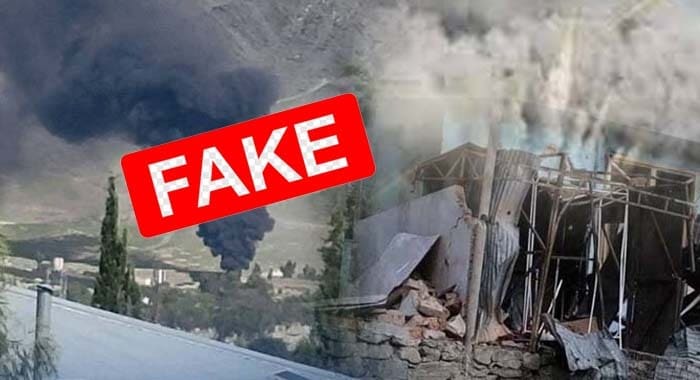
In recent days, claims have emerged from Taliban-controlled Afghanistan alleging that Pakistan carried out cross-border strikes in Kunar Province, including an earlier assertion that a university dormitory was targeted, resulting in casualties.
Pakistani authorities rejected these allegations, stating that no such operation was conducted in Kunar or any other cross-border area, describing the claims as unverified and lacking credible evidence.
The latest round of claims followed a similar pattern. Visual material circulated alongside the allegations was later found, through reverse image verification, to be unrelated to any military activity, instead corresponding to the aftermath of the February 20, 2026, earthquake.
Operational Context Often Ignored
A key dimension missing from these claims is Pakistan’s declared and structured counterterror posture, which operates along two defined tracks:
Operation Ghazb Lil Haq
Focused on cross-border threats and terrorist safe havens linked to attacks inside Pakistan. This operates as a retaliatory framework, triggered by actionable intelligence connecting incidents to external bases.
Operation Azm-e-Istehkam
A sustained, intelligence-driven campaign targeting terrorist networks, facilitators, and infrastructure within Pakistan’s borders.
This dual-track approach reflects a layered strategy, defensive at the perimeter, offensive within depth.
Claim vs Established Practice
This operational clarity creates a contradiction with the claims being circulated.
Pakistan has repeatedly maintained that its actions, particularly those of strategic or cross-border significance, are not conducted in ambiguity. On multiple occasions, senior civil and military leadership has publicly communicated such operations.
Given this pattern, the notion that a strike of the scale being alleged, especially one involving civilian infrastructure, would be carried out and then entirely concealed does not align with established practice.
Pattern of Narrative Construction
The sequence of events reveals a recurring structure:
A high-impact allegation, such as a strike on a university dormitory
Rapid amplification through aligned channels
Circulation of visual material later found to be misattributed
The use of earthquake imagery as supposed strike evidence is particularly telling, pointing either to weak verification mechanisms or deliberate narrative construction.
Media Environment Under Taliban Rule
These developments must also be viewed within the media landscape of Taliban-controlled Afghanistan.
Independent journalism operates under severe constraints, women journalists have largely disappeared from the field, and editorial space is tightly controlled. In such an environment, the boundary between reporting and narrative projection becomes increasingly narrow.
Three key dynamics stand out:
1. Repetition Without Substantiation
Claims gain traction through frequency, not evidence.
2. Misattribution as a Tool
The reuse of unrelated imagery indicates systemic issues in verification or intentional misuse.
3. Strategic Timing of Claims
Allegations tend to surface in periods of heightened cross-border tension, amplifying their visibility and potential impact.
The recent claims regarding strikes in Kunar are not isolated. They form part of a broader pattern where narrative construction, repetition, and weak verification intersect.
When placed against Pakistan’s declared operational framework and historical communication practices, these allegations face a fundamental credibility challenge, one that becomes more pronounced with each instance of misattribution and denial.



