
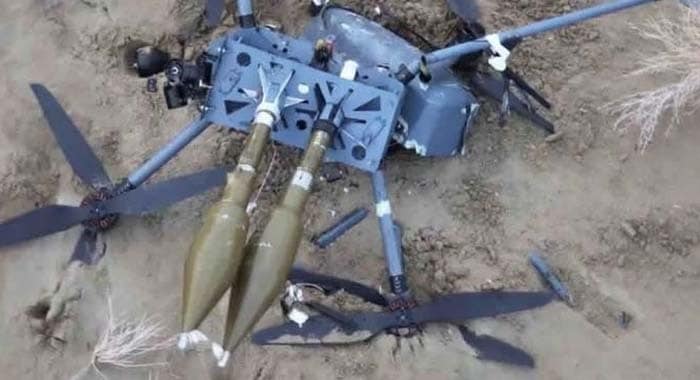
Does the state use quadcopters against ordinary civilians, or is it the Khwarij, who repeatedly claim responsibility in their own videos, that are targeting innocent people with these devices?
The answer is clear: the Khwarij are openly using quadcopters to target civilians.
So why is the provincial government trying to create confusion among the public?
Today, on April 30, a meeting of the Khyber Pakhtunkhwa government’s parliamentary board on quadcopter attacks is underway, giving the impression that these attacks may be carried out by the state.
Such a move is tantamount to aiding Fitna al-Khwarij.
Let us examine some facts regarding these quadcopter attacks.
Over the past year, Fitna al-Khwarij have carried out multiple quadcopter attacks targeting security forces, civilian populations, and the general public, resulting in hundreds of civilians and security personnel being martyred or injured.
Fitna al-Khwarij use quadcopters against civilians to achieve their malicious objectives and spread fear and terror, and there is ample video evidence to support this.
Recently, on April 27, 2026, in Spinwam, the Khawarij targeted the house of Malik Liaquat Ali Khan in a quadcopter attack, injuring three children.
On the same day, April 27, 2026, in Akakhel Bara, the Khawarij carried out another quadcopter attack, in which one girl was martyred and six others were injured.
Earlier, on April 5, 2026, the Khawarij targeted a civilian population in Milward Bara with a quadcopter attack, though fortunately there were no casualties.
Furthermore, on March 10, 2026, three young children were injured in a Khawarij quadcopter attack in Lakki Marwat.
Similarly, on December 11, 2025, in the Sheikh Landak area of Bannu, the Khawarij carried out a quadcopter attack near a school cricket ground, resulting in the martyrdom of three innocent children.
Despite these drone and quadcopter attacks by the Khawarij, why does the provincial government neither condemn them nor take action against those responsible?
Why has the government remained a silent spectator despite dozens of such attacks over the past year?
It must be remembered that the police serve as the frontline force in the fight against terrorism, yet no steps have been taken to enhance their capacity.
The question remains: why has the shortage of 15,306 police personnel still not been addressed?
Does the provincial government not realize that a weakened police force cannot provide an effective defence against terrorism?
Why is there a growing tendency to shift blame onto security institutions instead of accepting responsibility after each failure?
The public is asking: does the government have a clear security policy, or is everything limited to statements?
Is the protection of citizens’ lives and property truly a priority for the government or not?
The time has come for Chief Minister Sohail Afridi to provide clarity, because the issue is no longer just about performance, it is about public trust.



