
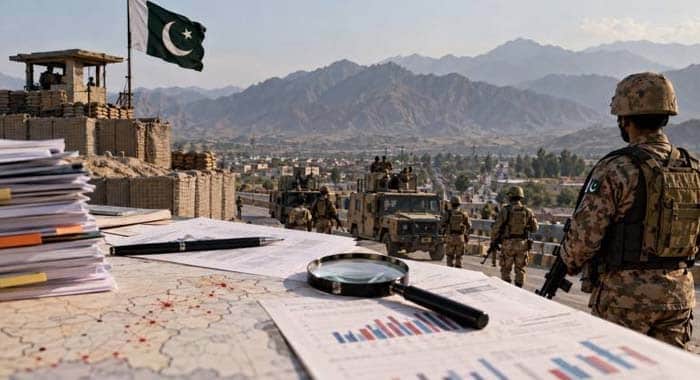
Pakistan’s security environment is undergoing a significant transformation. Terrorist organizations have expanded their operational methods, violence has become increasingly concentrated in the country’s western regions, and the distinction between conventional attacks and broader campaigns of intimidation has become less clear. Although counterterrorism operations continue to inflict substantial losses on terrorist networks, the challenge facing Pakistan is no longer simply how to eliminate individual groups. It is how to prevent them from regenerating, reorganizing and exploiting weaknesses across multiple fronts.
The statistics for 2026 provide a useful indication of the scale of the problem. According to PICSS, Pakistan recorded 225 terrorist attacks in September, the highest monthly total in 12 years. The number declined to 143 in October, a reduction of 37 percent. Fatalities resulting from terrorist attacks also fell from 260 to 111 during the same period.
This improvement is encouraging, but the broader picture demands caution. Pakistan recorded 1,376 terrorist attacks during the first ten months of 2026, representing a 53 percent increase compared with the corresponding period of 2025. The combined death toll from terrorist attacks and counterterrorism operations reached 3,902 during those ten months.
These figures reveal an important contradiction. Security institutions are conducting operations and eliminating large numbers of terrorists, yet terrorist organizations continue to demonstrate their ability to launch attacks. Operational successes must therefore be translated into lasting disruption of organizational structures.
One reason for this challenge is the diversity of terrorist threats. The banned Tehreek-e-Taliban Pakistan (TTP) and its affiliated factions primarily pose a threat across Khyber Pakhtunkhwa and adjoining areas. In Balochistan, terrorist organizations employ different methods and pursue different objectives. Islamic State Khorasan Province (ISKP) represents another security concern because of its transnational ideology and potential to exploit sectarian and political divisions.
These organizations cannot be treated as a single entity. Their recruitment mechanisms, operational structures, geographical priorities and sources of support differ. A uniform response may therefore overlook important differences in how each organization functions.
The methods used by terrorist groups are also evolving. Suicide attacks, improvised explosive devices, targeted killings and attacks on security installations remain significant, but the growing use of drones has introduced another dimension. Surveillance, explosive payloads and remote attacks can create operational difficulties even when the terrorists involved are relatively few.
Kidnapping has also become an important instrument of intimidation. October’s figures are particularly revealing: 88 people were abducted in terrorist incidents nationwide, the highest monthly total in the preceding 12 months. Balochistan accounted for 70 of these cases. Such incidents demonstrate that a decline in conventional attacks does not necessarily indicate a corresponding decline in terrorist influence.
The challenge is equally connected to the availability of intelligence and local support networks. Terrorist organizations require information, accommodation, transport, financial resources and logistical assistance. Disrupting these systems is often more consequential than eliminating a small armed group at one location.
Pakistan must consequently strengthen intelligence-sharing between civilian law enforcement agencies, provincial police, the Counter Terrorism Departments and security institutions. Better coordination can help identify emerging threats, trace financial networks and prevent attacks before they are executed.
Another essential dimension is border security. Pakistan has repeatedly accused the Afghan Taliban authorities of allowing anti-Pakistan terrorist groups to operate from Afghan territory. Kabul rejects these allegations. Nevertheless, the persistence of cross-border terrorism has become one of the most serious factors affecting Pakistan’s internal security and its relations with Afghanistan.
The international dimension also requires attention. Terrorist organizations increasingly benefit from communication technologies, informal financial networks, propaganda platforms and connections extending beyond national boundaries. Their ability to recruit and inspire individuals does not necessarily depend on maintaining territorial control.
Pakistan’s response must therefore extend beyond conventional military and police operations. Financial investigations, digital intelligence, border management, counter-propaganda initiatives and cooperation with international partners should become integral parts of the national counterterrorism framework.
There is also a need to strengthen the relationship between security and governance. Terrorist organizations exploit administrative weaknesses, delayed justice, poor service delivery and public dissatisfaction. Effective governance does not automatically eliminate terrorism, but weak governance can create opportunities for organized violence.
The state must ensure that citizens in affected areas have confidence in police, courts and local administration. Schools, hospitals, roads and markets must function without intimidation. The return of normal economic and social activity should be considered an essential measure of counterterrorism success.
Most importantly, Pakistan needs a sustained strategy rather than a cycle of responding to attacks and celebrating temporary reductions in violence. Counterterrorism operations can weaken organizations, but lasting security requires preventing their recovery.
October’s improvement provides an opportunity to reassess and consolidate the national response. The next phase must focus on dismantling the networks that enable terrorist organizations to survive, recruit and operate.
Pakistan’s security challenge is changing. Its response must evolve accordingly.



