
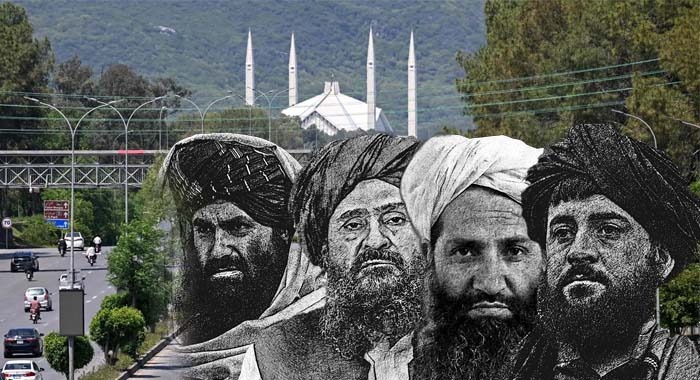
Pakistan’s deteriorating relationship with Afghanistan’s Taliban administration has increasingly exposed a fundamental contradiction in Kabul’s regional policy: while seeking diplomatic engagement, economic cooperation and international acceptance, the Taliban leadership has failed to address one of Islamabad’s most serious security concerns, the presence and activities of the Tehreek-e-Taliban Pakistan (TTP) on Afghan territory.
The issue is no longer simply a disagreement between two neighbouring governments. It has become a test of whether the Afghan Taliban administration is willing and capable of preventing its territory from being used by armed groups to threaten another country.
For Pakistan, the matter is straightforward. No government can be expected to maintain normal relations with a neighbouring administration while repeatedly facing terrorist attacks allegedly planned, facilitated or supported from across the border.
Islamabad has consistently demanded that Kabul dismantle TTP sanctuaries, prevent cross-border infiltration and take verifiable action against individuals and networks responsible for attacks inside Pakistan. The Afghan Taliban, however, have rejected allegations that Afghan territory is being used against Pakistan.
This disagreement has steadily transformed bilateral relations, once marked by considerable political and security cooperation, into an increasingly difficult relationship dominated by mistrust.
### A regional responsibility, not merely a bilateral dispute
The Afghan Taliban cannot indefinitely separate their domestic security arrangements from the consequences of developments across their borders.
The TTP is not an organisation with no historical or ideological connection to the Afghan Taliban. The two movements have longstanding ideological links, although they operate as separate organisations and pursue different immediate political objectives.
That relationship makes Kabul’s handling of the TTP especially significant.
The Afghan Taliban leadership has previously demonstrated its ability to consolidate authority, maintain internal control and establish diplomatic contacts with regional governments. It has also sought greater economic engagement with neighbouring countries.
However, the ability to maintain diplomatic relations and the willingness to confront armed groups are two different matters.
The Taliban administration faces a difficult calculation. Taking decisive action against the TTP could create tensions with elements that share ideological and organisational connections with the Afghan Taliban. Allowing the group to operate, however, carries the risk of further deterioration in relations with Pakistan and continued regional instability.
This is precisely the contradiction that Kabul needs to resolve.
### Pakistan cannot make security negotiable
For Islamabad, the protection of its citizens is not an issue that can be indefinitely postponed in the hope that diplomatic engagement will eventually produce results.
Pakistan has repeatedly pursued diplomatic channels, while also using border management and security measures to communicate the seriousness of its concerns.
The closure of major border crossings has affected trade and movement, creating economic difficulties on both sides. Torkham, in particular, remains an important commercial route whose disruption carries consequences for traders, transporters and communities dependent on cross-border commerce.
Yet the underlying dispute is not fundamentally about trade.
The reopening of crossings and restoration of normal commercial relations cannot provide a sustainable solution if the security concerns that prompted restrictions remain unresolved.
A functioning relationship requires more than diplomatic statements and temporary arrangements. It requires practical cooperation, verifiable action and a commitment that Afghan territory will not be used as a launchpad for attacks against Pakistan.
### The choice facing Kabul
The Afghan Taliban administration has an opportunity to demonstrate that it wants to function as a responsible regional government rather than merely seek diplomatic acceptance while avoiding difficult security commitments.
A meaningful change in its approach would benefit Afghanistan as much as Pakistan.
Improved relations with Islamabad would facilitate trade, transit, economic engagement and regional connectivity. Pakistan remains an important geographical and commercial link for landlocked Afghanistan, while instability along their shared border undermines the interests of both populations.
Conversely, allowing the TTP issue to remain unresolved will continue to undermine confidence and make diplomatic progress increasingly difficult.
Pakistan’s position should therefore remain consistent: dialogue is possible, economic cooperation is desirable and peaceful relations are in the interest of both countries, but none of these objectives can be achieved at the expense of Pakistani citizens’ security.
The Afghan Taliban leadership must recognise that regional acceptance comes with responsibilities.
Kabul cannot expect Islamabad to ignore a security threat simply because confronting it may create internal difficulties for the Taliban administration.
Ultimately, the future of Pakistan-Afghanistan relations may depend less on diplomatic declarations than on one practical question: whether Kabul is prepared to take concrete action against the terrorist networks operating from its territory.
**To be continued…**



