
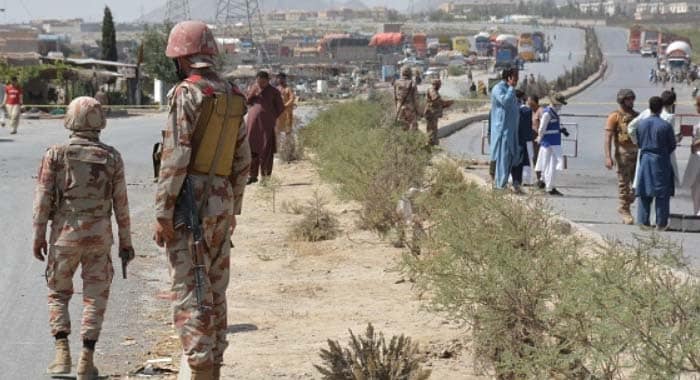
Pakistan’s security discourse on Balochistan continues to emphasize a combined approach of counterterrorism enforcement, institutional reform, and long-term development planning, reflecting the complex security and governance challenges in the province.
In recent high-level security discussions, authorities reiterated that there is no ambiguity regarding the nature of ongoing violence in Balochistan, describing it as terrorism-driven activity involving organized networks, facilitation structures, and external linkages. The assessment highlights that terrorist violence in the province is not viewed in isolation, but as part of a broader ecosystem involving operational, logistical, and propaganda dimensions.
According to the security perspective outlined, certain armed groups operating in the region are categorized as terrorist organizations, with emphasis placed on their structured networks and external support mechanisms. The narrative underscores that these groups rely not only on direct operational activity but also on broader support systems that include facilitation, recruitment, and information influence.
A key focus of the discussion is the differentiation between armed operational groups and affiliated socio-political structures that are alleged to provide indirect support, advocacy, or narrative amplification. Authorities stress that such linkages complicate the security environment by extending influence beyond conventional battlefield activity into social and political spaces.
The security framework also highlights concerns regarding external influence and cross-border dimensions, which are considered central to understanding the persistence of instability in the province. These concerns are framed within Pakistan’s broader counterterrorism policy, which consistently emphasizes the importance of addressing both on-ground militancy and enabling networks.
At the same time, the approach outlined is not limited to security enforcement alone. It includes a significant governance and development component aimed at addressing structural issues in Balochistan. Authorities emphasize that improving governance mechanisms, enhancing administrative efficiency, and strengthening local institutions are essential for long-term stability.
One of the key institutional reforms referenced is the ongoing effort to enhance policing capacity and improve coordination between different law enforcement structures. This includes proposals aimed at strengthening professional capabilities and improving integration between various security-related institutions to ensure more effective governance and response mechanisms.
Development strategy also forms a central pillar of the broader approach. The focus is placed on ensuring that local populations benefit directly from the province’s natural resources and economic opportunities. This includes an emphasis on creating structured systems for resource utilization, value addition, and long-term economic planning.
Officials highlight that resource extraction alone does not automatically translate into local development unless supported by proper industrial systems, processing capacity, and technical infrastructure. The emphasis, therefore, is on building a comprehensive economic framework that allows for sustainable use of natural resources while ensuring local participation and benefit.
In this context, development is presented as a long-term stabilizing factor alongside security operations. The underlying argument is that economic inclusion, improved governance, and institutional strengthening are essential components of reducing vulnerability to instability.
The discussion also reflects a broader narrative about governance reform in Balochistan, particularly in addressing historical structural complexities and improving service delivery. Strengthening administrative systems and improving institutional efficiency are presented as key elements in reducing space for instability.
Overall, the security and governance framework outlined reflects a dual-track strategy: sustained counterterrorism pressure on armed groups, combined with long-term institutional and economic reforms aimed at improving stability and development outcomes in Balochistan.
While security challenges remain, the emphasis is placed on a structured and evolving approach that integrates enforcement, governance improvement, and economic planning within a unified framework for provincial stability.



