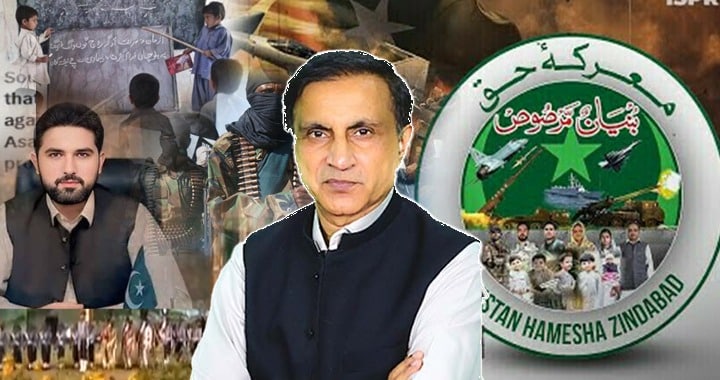
In what many across Pakistan now commemorate as Marak-e-Haq, when India launched Operation Sindoor, the expectation in New Delhi appeared to be that Pakistan would either lose control of the narrative or fail to respond decisively. What happened instead was the opposite. Pakistan not only responded militarily, but also diplomatically and psychologically, in a way that shifted the regional conversation. The country maintained from day one that it had no involvement in the incident India was attempting to exploit, and over time even international discourse began reflecting skepticism toward the Indian claims.
Now, nearly a year later, statements emerging from the Indian military leadership suggest that Operation Sindoor was not viewed by them as a conclusion, but as the beginning of a longer strategic posture. That alone should compel Pakistan to examine the broader picture instead of viewing the episode as an isolated confrontation.
Pakistan’s response during that period demonstrated preparedness, restraint and clarity. The state signaled that aggression would not go unanswered, and that signal was not only received by India but by the wider world. The military response, the information management and the diplomatic engagement together created a perception that Pakistan had regained confidence in both conventional and hybrid domains of warfare.
What stood out recently in the DG ISPR’s press conference was not merely the rebuttal of Indian claims, but the systematic exposure of contradictions within the Indian narrative itself. Statements, visuals and claims circulated by Indian media figures, politicians and military representatives were presented alongside evidence that contradicted them. At several points, the narrative became so incoherent that it bordered on absurdity. Claims involving attacks near Lahore and bizarre references to naval positioning exposed the level of exaggeration and confusion that had overtaken the discourse.
At the same time, Pakistan continued repeating a position it has held for years: the country wants regional peace, economic connectivity, trade and stability. Yet whenever an opening for normalization emerges, tensions are reignited through threats, coercive rhetoric or escalation along different fronts, particularly Kashmir and Afghanistan-linked security challenges.
One of the most important aspects highlighted recently was the timing of increased terrorist incidents in Pakistan during periods of heightened India-Pakistan tensions. According to the security narrative presented publicly, once India realized that a conventional military escalation would not produce the desired outcome, the focus shifted toward indirect destabilization. The allegation that Afghanistan-based elements, assisted by external technological support including drone capabilities, were used to intensify attacks inside Pakistan deserves serious international attention.
The security situation along the western border remains deeply concerning. Pakistan’s position has consistently been that Afghan soil must not be allowed to be used against Pakistan. That is neither an expansionist demand nor an attack on Afghan sovereignty. It is a basic principle of state security. Yet the persistence of cross-border terrorism continues to erode trust between the two countries.
Within Afghanistan itself, there appear to be competing tendencies. One faction seems to favor improved relations with Pakistan and action against the banned Tehreek-e-Taliban Pakistan, while another continues treating such groups as long-term allies or “guests” based on decades-old battlefield relationships. The resulting ambiguity has created an atmosphere where trust deficits continue widening despite ongoing diplomatic engagement, including talks in Urumqi.
Pakistan’s concerns are not theoretical. Attacks in Hangu, Bajaur, Waziristan and other regions demonstrate that terrorist violence is evolving in both scale and targeting patterns. Civilian populations, religious scholars, police personnel and security forces are all under threat. The repeated assassinations of prominent ulema over the years reveal a disturbing continuity. More than forty religious scholars have reportedly been eliminated in recent years, yet accountability remains elusive in most cases.
This raises uncomfortable questions about governance and security management within Khyber Pakhtunkhwa. The provincial administration appears overwhelmed by the deteriorating law and order situation. Security arrangements for vulnerable figures remain inadequate, investigations are often weak, and prosecution failures continue damaging public confidence. If high-profile individuals facing known threats can still be targeted so easily, then ordinary citizens inevitably begin feeling abandoned.
There is also growing concern about the operational overlap between various terrorist entities. Whether it is Daesh, Al-Qaeda, TTP or affiliated regional factions, the absence of meaningful confrontation between these groups while they continue targeting Pakistan raises legitimate questions about convergence of interests, division of operational roles and shared objectives aimed at destabilizing the state.
At such a sensitive national moment, political maturity becomes critically important. Differences in a democratic society are natural and necessary. Opposition politics is not the problem. The problem emerges when issues of national security, terrorism and external aggression are reduced to partisan calculations.
The recent “Marak-e-Haq” event in Peshawar symbolized national unity against terrorism and external threats. Political figures, journalists, minorities, lawyers, women, officials and representatives from different walks of life participated. Yet the absence of the Khyber Pakhtunkhwa chief minister and virtually the entire provincial cabinet created an avoidable political message. At a time when the country was marking what many viewed as a moment of national resilience and military success, the empty seats attracted more attention than many speeches delivered at the gathering.
Politics cannot permanently operate in a state of confrontation with national consensus. A short appearance, even symbolic, could have conveyed solidarity with the state while preserving political differences. Instead, the absence reinforced perceptions of disunity at a moment when cohesion was strategically necessary. In regional politics, optics matter. Adversaries study those optics carefully.
The broader governance picture in Khyber Pakhtunkhwa also remains troubling. Frequent terrorist attacks, public frustration, weak policing structures and accusations of administrative paralysis have created the impression that the provincial government is reactive rather than proactive. The people of the province deserve better than perpetual political slogans without corresponding improvements in security and governance.
The situation in Balochistan presents another layer of complexity. On one side are internationally designated terrorist organizations such as the banned Balochistan Liberation Army and the banned Balochistan Liberation Front. On the other side are groups operating under rights-based or political banners, including the Baloch Yakjehti Committee. According to claims and reports referenced by provincial authorities, there are concerns that terrorist organizations may be exploiting such platforms, directly or indirectly, to influence vulnerable youth through narratives centered on deprivation, unemployment, alienation and perceived inequality.
If credible evidence exists connecting terrorist recruitment networks with any organized fronts, then the matter must be dealt with strictly under the law. At the same time, young people in Balochistan must recognize how easily genuine grievances can be manipulated by actors pursuing violent agendas. Terrorist organizations often weaponize frustration, identity and despair, turning communities into battlefields while offering no real future in return.
Pakistan has every right to scrutinize organizations operating in sensitive environments, particularly if there are indications that they may be facilitating destabilization efforts. However, such scrutiny must remain evidence-based, lawful and transparent. National security cannot succeed through excesses, but neither can it survive through negligence.
The central challenge facing Pakistan today is no longer confined to one border, one organization or one incident. The country faces a layered conflict involving conventional hostility, cross-border terrorism, information warfare, political fragmentation and ideological manipulation. These fronts intersect constantly.
That is why unity matters. Not performative unity, but strategic unity rooted in institutional seriousness, competent governance and national clarity. Pakistan’s enemies exploit confusion. The country can ill afford to assist them by manufacturing more of it internally.