
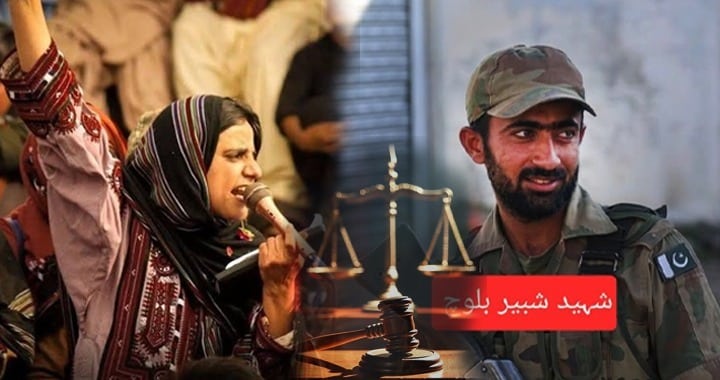
A court’s decision to award a life sentence to Mehrang Lango has reignited debate on justice, accountability and the often-overlooked sacrifices of security personnel who lose their lives in the line of duty.
While public discussion has largely focused on the convicted individual and the punishment handed down, many observers argue that the central figure in the case remains the victim, martyred soldier Shabbir Baloch, whose killing left behind a grieving family seeking justice.
Supporters of the verdict say the ruling is a reminder that human rights and justice cannot be viewed selectively. They argue that every life carries equal value under the law, including those of soldiers and law enforcement personnel tasked with defending the country against security threats.
According to those backing the court’s decision, the discussion should not revolve solely around the convicted individual, but also around the family of Shabbir Baloch, whose loss is often absent from public campaigns and online discourse.
They question whether the pain of a soldier’s mother, the suffering of his children and the grief endured by his relatives deserve the same recognition routinely extended to other victims of violence.
Observers note that Shabbir Baloch himself belonged to Balochistan and was serving the country when he lost his life. They argue that portraying the case exclusively through the lens of the convicted individual risks overshadowing the human cost borne by the victim’s family.
Legal analysts say the sentence reflects the court’s assessment of the evidence presented before it and represents the functioning of the judicial process. They add that accountability for taking an innocent life remains a fundamental principle of justice, regardless of the identity or profession of the victim.
The verdict has also sparked broader questions about public advocacy and whether equal attention is given to all victims of violence. Supporters of the ruling contend that justice loses its meaning if the rights of victims are ignored while focus remains solely on those convicted of crimes.
For many, the case is ultimately about more than a single sentence. It is about whether the sacrifice of a fallen soldier is acknowledged, whether his family receives justice, and whether the value of a human life remains the same regardless of the uniform the victim wore.
With the court having delivered its judgment, supporters of the verdict maintain that the decision should be viewed as justice for martyred soldier Shabbir Baloch and a reaffirmation that those responsible for taking innocent lives must be held accountable under the law.



