
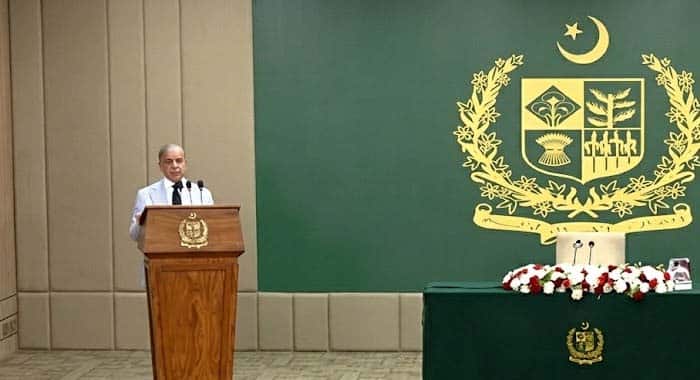
Prime Minister Muhammad Shehbaz Sharif has reaffirmed Pakistan’s determination to confront terrorism with full force, stating that terrorism allegedly sponsored by India is a deliberate attempt to undermine peace, stability, development, and prosperity in Balochistan. He emphasized that Pakistan remains committed to defeating this challenge while continuing its efforts to transform Balochistan into a hub of progress and opportunity.
Addressing participants of the Balochistan National Workshop, the Prime Minister highlighted the strategic importance of Balochistan, describing it as Pakistan’s largest province by area and emphasizing that its development and prosperity are directly linked with the country’s bright future.
He stated that the federal government is giving special attention to Balochistan’s advancement through comprehensive initiatives focused on infrastructure development, energy, agriculture, and public welfare projects.
Prime Minister Shehbaz Sharif paid tribute to the historic role played by the people of Balochistan and Khyber Pakhtunkhwa at the time of Pakistan’s creation, stating that their leadership and decision to join Pakistan strengthened national unity.
He noted that patriotic leadership from Balochistan has consistently prioritized national interests and that the province has remained an important partner in Pakistan’s economic, social, and political development.
The Prime Minister emphasized that although Balochistan has the smallest population among Pakistan’s provinces, its vast geographical area and challenging terrain require greater resources and long-term planning to implement development projects effectively.
Highlighting measures taken to strengthen Balochistan’s financial position, Prime Minister Shehbaz Sharif referred to the 2010 National Finance Commission (NFC) Award, under which the province’s financial share was significantly increased with the agreement of all provinces.
He stated that Punjab voluntarily decided to provide an additional Rs11 billion annually to Balochistan as part of national solidarity and brotherhood. According to the Prime Minister, nearly Rs150 billion has been provided to Balochistan under this arrangement since 2010.
He clarified that such support should not be viewed as a favor but as a responsibility arising from the spirit of federation, unity, and equal development among all provinces.
The Prime Minister also highlighted development initiatives undertaken during previous governments led by Muhammad Nawaz Sharif, stating that billions of rupees worth of projects were launched for Balochistan’s progress. He added that the current government continues to prioritize addressing the province’s legitimate needs and development requirements.
Prime Minister Shehbaz Sharif announced that a major project worth approximately Rs75 billion has been initiated to convert agricultural tube wells in Balochistan to solar energy. He stated that the federal government is contributing around Rs50 billion to the project, aimed at reducing farmers’ dependence on electricity supply and helping them overcome prolonged power shortages.
Discussing infrastructure development, the Prime Minister highlighted the transformation of the Karachi-Chaman M-25 highway into a modern expressway.
He recalled that the road had historically been referred to as a “killer road” due to frequent accidents and loss of precious human lives. He said that the project, estimated to cost around Rs300 billion, will improve transportation facilities, enhance trade connectivity, and protect lives.
The Prime Minister expressed hope that the project would be completed within the next one and a half to two years, after which the highway would become a symbol of development, commerce, connectivity, and peace.
Prime Minister Shehbaz Sharif stressed that Pakistan’s true progress can only be achieved when all four provinces advance together. He stated that development limited to only one or two provinces cannot be considered national progress, emphasizing that the federal government has a responsibility to ensure equal opportunities and balanced growth across all regions of the country.
Addressing recent terrorist incidents in Balochistan, the Prime Minister paid tribute to all those who lost their lives, including Justice Abdul Qadir and other security personnel who sacrificed their lives in the line of duty.
He stated that the nation will never forget the sacrifices of its martyrs and acknowledged that more than 90,000 Pakistanis have lost their lives in the country’s fight against terrorism, including civilians, law enforcement personnel, and officers and soldiers of the Pakistan Armed Forces.
Prime Minister Shehbaz Sharif recalled that Pakistan had achieved significant success in controlling terrorism by 2017 and 2018, but said that terrorist activities later resurfaced.
He alleged that India was behind renewed terrorist activities and accused it of providing financial and other forms of support to elements involved in destabilizing Pakistan.
Speaking about Afghanistan, the Prime Minister stated that Pakistan has repeatedly urged the Afghan interim government to prevent its territory from being used by terrorist organizations.
He emphasized that Pakistan and Afghanistan share a border of more than 2,000 kilometers and that peace and stability in the region serve the interests of both countries.
However, he expressed regret that the desired progress has not yet been achieved in addressing Pakistan’s security concerns.
The Prime Minister stated that Pakistan has achieved important successes on both the defence and diplomatic fronts in recent times, enhancing the country’s international standing. He added that adversaries of Pakistan are unable to accept these achievements.
He called upon the nation to remain united and continue working toward economic development, stability, and prosperity so that Pakistan can achieve its rightful position in the international community.
Concluding his address, Prime Minister Shehbaz Sharif quoted the poetry of Allama Muhammad Iqbal and emphasized the importance of unity, collective struggle, and continuous hard work.
He stated that through the combined efforts of all four provinces and Pakistan’s 240 million citizens, the country can emerge as a stronger, prosperous, and dignified nation.
Responding to questions from students after his address, Prime Minister Shehbaz Sharif emphasized that transparent governance is the foundation for economic stability and the most effective tool against corruption, collusion, and tax evasion.
He explained that when government revenues are lost instead of reaching the national treasury, poverty increases, economic difficulties worsen, and the burden of debt grows.
The Prime Minister stated that the federal government, through teamwork and transparency measures, succeeded in preventing tax leakage during the past year, particularly in sales tax collection, resulting in an additional Rs800 billion in revenue collection.
He described this achievement as a significant milestone in Pakistan’s economic history.
Prime Minister Shehbaz Sharif stressed that there is no shortcut to development, stating that hard work, honesty, and responsibility are the qualities that enable nations to progress.
Using Japan and Germany as examples, he noted that both countries rebuilt themselves after devastating periods through determination, discipline, and sustained efforts.
He expressed confidence that promoting transparent governance not only at the federal level but also across provinces would lead to stronger economic performance and better outcomes for the people of Pakistan.
The Prime Minister reaffirmed that Pakistan’s journey toward peace, stability, development, and prosperity requires unity, effective governance, and collective commitment from all segments of society.



