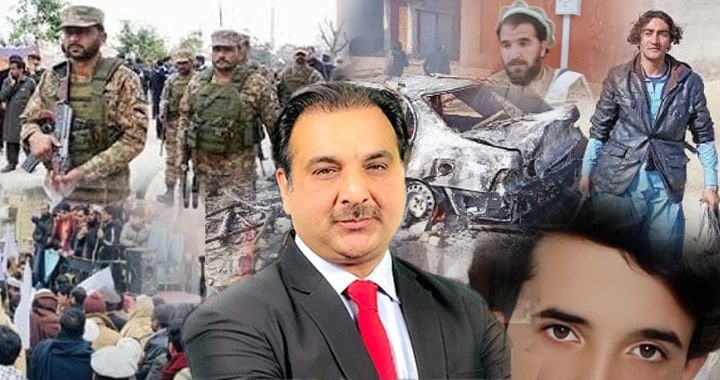
Look, this is not something new, or something happening for the first time in Bajaur, in Waziristan, or in KP’s other districts, rather, these terrorists have been there before, and when they first entered Waziristan, both North and South, the situation was entirely different.
At that time, the local population provided them accommodation. They gave them space, took care of them, provided food, and even rented out their homes. That was the reality back then.
Today, the situation is completely the opposite.
Now, the people there do not allow these terrorists to live among them, not in their communities, not in their mosques, not in their homes, and not in their hujras. If locals see them, they tell them to leave the area. And if these terrorists refuse to leave, the local population resists. They take up arms and act against them.
This has been the pattern for quite some time now.
If you recall, when the issue in Khyber’s Tirah Valley emerged four to five months ago, the security forces stepped aside and asked the politico-religious and tribal elders to decide what they wanted to do with these terrorists. The elders sat together, and for the first time, it was reported that around 10,000 people from Khyber district gathered in Tirah Maidan in the form of a jirga and demanded that the terrorists leave their area.
If you speak to any tribal elder or local resident today, they will tell you the same thing. Tribal communities are not willing to allow these terrorists entry into their areas or to let them stay.
The same situation exists in Waziristan.
Now, regarding the Darpakhel incident, the reports suggest that these terrorists entered the area at night. Their plan was to stay in local mosques, and at the same time, they were instructing the local population to provide them with food and other necessities. The intention was clear, to use those mosques as bases to plan attacks against the security forces.
There are two important aspects here.
First, if they find a local place, their movement becomes easier. Second, and more importantly, why do they choose mosques?
They choose mosques because if any action is taken there, a narrative can be built that the mosque was targeted or martyred. However, they will never reveal what was actually happening inside those mosques or madrassas. They will never clarify whether there were students receiving religious education or whether those places were being used for operational purposes.
This is done deliberately, as part of a strategy.
They believe that by taking shelter in mosques, it becomes difficult for security forces to act against them. It is not easy to target such places because people come there to pray, and there is always the risk of collateral damage. That is why security forces remain extremely cautious and avoid targeting mosques.
So, everything was happening according to a well-organized plan.
Groups of 10, 12, 14, or even 20 individuals would stay in mosques at night, and under the cover of darkness, they would move toward their targets.
Now, when Malik Saifullah Dawar became aware of this, he came out along with his people. He told these terrorists that there was an understanding, and under that, they were not allowed to stay in the area, not in mosques, not in homes, nowhere. He demanded that they leave.
There was a harsh exchange of words from both sides.
That night, the terrorists left the area.
But the next morning, they returned.
They called Malik Saifullah Dawar out. He came out along with two of his companions. He was martyred, along with two others, while three people were injured. It is important to note that on the same day, he had also convened a jirga against these terrorists. Under the cover of that peaceful jirga, he was targeted and shot.
Three people, including Malik Dawar, were martyred, and three were injured.
After this, the local population, including the relatives of Malik Saifullah Dawar, the residents of Darpakhel, and members of the Dawar tribe, took up arms against those terrorists. According to available information, eight terrorists were eliminated.
Now, the basic point here is very important.
These individuals were not part of the security forces. They were not part of the police. They were not part of the government. They were local people. Three were martyred, and three were injured.
The reason for highlighting this is that due to this local resistance, terrorists now fear that they will not find space to hide in these areas.
Therefore, to spread fear and terror, they carry out such heinous acts. The objective is to intimidate people so that in the future, no one dares to ask them to leave.
Now, coming to the second issue.
What should be said about the narrative of the Chief Minister, or his government?
He delivered a speech in the Assembly yesterday, where he strongly criticized drone attacks and questioned why terrorists do not target places like the Army Headquarters.
Now look at what happened in Bajaur.
Twelve to fourteen innocent civilians were martyred. Among them were seven to eight children, three women, and other civilians. This report was issued by the Deputy Commissioner of Bajaur and the civil administration, not by the security forces.
The question is, was the Chief Minister so occupied that he could not condemn this incident?
If Afghan Taliban elements or terrorists of the banned TTP were responsible for martyring innocent civilians in Bajaur, then why this silence?
Has something prevented him from speaking? What is he afraid of?
Or is there sympathy, or facilitation, at some level?
When children from your own province are being killed, and the Chief Minister does not even issue a condemnation, it raises serious questions.
Instead, when such incidents occur, statements are made against the state.
Now consider another point.
The current Chief Minister belongs to district Khyber.
These terrorists are present there. Videos are emerging daily. Jamrud Bazaar is nearby. Civilians have been martyred there as well.
Did any of these incidents cause enough concern for him to go there and sit with the affected people?
Bajaur may be far, but Khyber is his own district, his own constituency, the place from where he was elected.
Did he ever go there?
Did he condemn the terrorists responsible for killing innocent people there?
Did he ever hold a press conference or challenge them openly, whether in the Assembly or elsewhere?
Now, another very crucial point.
He asked why terrorists do not carry out drone attacks on the Assembly, the Chief Minister House, or the Governor House.
Are there terrorists hiding inside the Chief Minister’s House?
Is there a terrorist training center there?
Is there a camp inside the Corps Commander’s residence or the Governor House?
The answer is obvious.
Terrorists operate where they can find space, shelter, and operational advantage.
The point is that the rulers in KP lack clarity and understanding. They are not ready to accept that if one does not understand the basics, the ABCs of policy, governance, and responsible speech, then it is better to remain silent.
Because when you do not know what to say and what not to say, your words create confusion.
If the objective is merely to build an anti-state narrative, or to continue political agendas through empty slogans, then that path may continue.
But the reality remains unchanged.
Because this is the state that comes first, first of all Pakistan, the state, and only after the state comes either Shehbaz Sharif or Suhail Afridi or the corps commander or XYZ, and the sooner this reality is understood and accepted, the better.