
Pakistan’s geopolitical location and evolving diplomatic engagement have consistently placed it at the crossroads of major global political developments. Since its inception, the country has played a recurring role in facilitating dialogue, bridging rival powers, and contributing to landmark international agreements across different eras of modern history.
Situated at the intersection of South Asia, the Middle East, Central Asia, and China, and providing direct access to the Arabian Sea, Pakistan has long held strategic significance in global geopolitics. Sharing borders with Afghanistan, Iran, and China, and located near key regional powers including India and Russia, Pakistan has frequently emerged as a critical stakeholder in international diplomatic and security frameworks.
Over the decades, Pakistan has also participated in major international alliances, including its alignment with Cold War-era security arrangements such as SEATO and CENTO in the 1950s. These engagements positioned Pakistan as a key partner within Western security structures, facilitating military cooperation, defense modernization, and sustained diplomatic ties with multiple global powers.
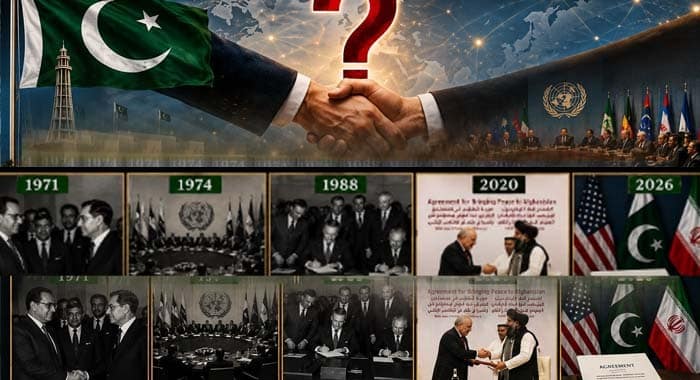
Beyond alliance politics, Pakistan’s diplomatic history is marked by its involvement in several pivotal international developments, where it played either a direct mediating role or served as an essential facilitator in shaping outcomes of global significance. These include the 1971 United States–China rapprochement, the 1974 Islamic Summit in Lahore, the 1988 Geneva Accords on Afghanistan, the 2020 Doha Agreement on Afghanistan, and the reported 2026 Iran–United States ceasefire framework.
One of the most defining moments in Pakistan’s diplomatic history came in 1971, when it played a discreet but decisive role in normalizing relations between the United States and the People’s Republic of China.
At a time when both global powers had virtually severed diplomatic contact, Pakistan under President General Yahya Khan served as a confidential communication channel between Washington and Beijing. In a historic development, U.S. National Security Advisor Henry Kissinger undertook a secret visit to Beijing via Islamabad, paving the way for President Richard Nixon’s landmark visit to China.
The operation, conducted through confidential diplomatic channels, is widely regarded as one of the most significant breakthroughs of the Cold War era. Former U.S. officials, including Henry Kissinger himself, later acknowledged Pakistan’s crucial role in enabling the restoration of U.S.–China engagement, which reshaped global strategic dynamics.
In 1974, Pakistan hosted the Second Islamic Summit Conference in Lahore under the leadership of Prime Minister Zulfikar Ali Bhutto. The summit brought together heads of state and senior representatives from across the Muslim world, including King Faisal of Saudi Arabia, Muammar Gaddafi of Libya, Yasser Arafat of the Palestine Liberation Organization, and Egyptian President Anwar Sadat.
The summit was convened at a sensitive historical moment following the 1971 separation of East Pakistan. It marked a significant diplomatic effort to reposition Pakistan within the broader Islamic world and foster unity among Muslim-majority nations.
The participation of Bangladeshi leadership in the summit contributed to the normalization of relations between Pakistan and Bangladesh. The conference also elevated the Palestinian cause as a central issue within the collective agenda of Muslim countries, strengthening Pakistan’s position as a key voice within the Organization of Islamic Cooperation framework.
During the 1980s, Afghanistan became a central theater of Cold War confrontation. Amid this conflict, Pakistan emerged as a key negotiating party in UN-mediated discussions involving regional and global powers.
The Geneva Accords, signed on April 14, 1988, marked a historic agreement between Pakistan and Afghanistan, with the United States and the Soviet Union acting as guarantor states. The agreement established a framework for the withdrawal of Soviet forces, which was completed by February 1989.
This marked one of the most significant diplomatic achievements in Pakistan’s history, as it played a central role in negotiations that contributed to the end of a superpower military intervention.
The 2020 Doha Agreement between the United States and the Taliban represented a major milestone in efforts to end nearly two decades of conflict in Afghanistan. While Pakistan was not a formal signatory, it played an important facilitative role throughout the negotiation process.
Pakistan supported backchannel communications between key stakeholders and contributed to maintaining an environment conducive to dialogue. Its diplomatic engagement was widely acknowledged by international observers as instrumental in enabling sustained contact between conflicting parties.
The agreement outlined the framework for the withdrawal of U.S. forces from Afghanistan and marked a significant shift in regional security dynamics.
Following escalating tensions in the Middle East in 2025 and renewed hostilities in early 2026, regional instability reached critical levels, raising global concerns over the risk of wider conflict and an energy crisis.
Amid heightened geopolitical pressure, Pakistan once again assumed an active diplomatic role. In June 2025, senior Pakistani leadership engaged in high-level discussions with the United States, highlighting Pakistan’s regional insight and diplomatic leverage.
Subsequently, in June 2026, Pakistan is reported to have played a mediating role in facilitating a ceasefire understanding between Iran and the United States. The agreement, referred to as the “Islamabad Memorandum of Understanding,” was aimed at de-escalating hostilities and establishing a framework for stability in the region.
The ceasefire arrangement followed months of international tension and growing global calls for restraint, particularly amid humanitarian concerns and disruptions in global energy markets. Pakistan’s involvement underscored its continued relevance as a diplomatic intermediary in sensitive regional conflicts.
Across multiple decades and geopolitical eras, Pakistan has consistently featured in critical diplomatic processes involving major global and regional actors. From Cold War-era mediation to contemporary conflict resolution efforts, its role has reflected both its strategic geography and its evolving diplomatic engagement.
While the nature of its involvement has varied—from covert facilitation to formal participation and third-party mediation—Pakistan’s recurring presence in key international agreements highlights its sustained relevance in global diplomacy.



