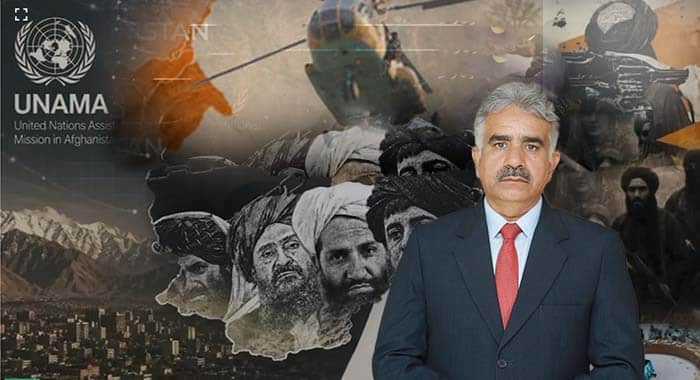
(Zahir Shah Sherazi)
In recent discussions at the United Nations Security Council and subsequent commentary from Pakistani officials, a renewed spotlight has been placed on the evolving security situation in Afghanistan and its wider regional implications. Pakistan’s representatives have reiterated long-standing concerns about cross-border militancy, highlighting alleged sanctuaries of militant groups inside Afghanistan and calling for more coordinated international action. These claims have reignited a complex debate: who bears responsibility for Afghanistan’s security vacuum, and what role should global and regional powers play in stabilizing a region increasingly defined by overlapping conflicts, competing interests, and fragmented governance?
At the heart of this debate lies a broader and more troubling question: whether international counterterrorism frameworks are still effective in addressing transnational militant networks, or whether geopolitical rivalries have weakened collective action at a time when cooperation is most urgently needed.
Pakistan has consistently argued that instability in Afghanistan directly impacts its internal security. The country’s leadership and diplomatic representatives have repeatedly pointed to attacks inside Pakistani territory that they attribute to militant groups operating from Afghan soil. In recent statements, Pakistani officials have urged the international community to acknowledge what they describe as “credible evidence” of the presence of multiple terrorist organizations in Afghanistan, including groups with regional and global reach.
The argument is rooted in geography as much as geopolitics. Pakistan shares a long and porous border with Afghanistan, historically difficult to monitor and control. This border region has, for decades, been affected by conflict spillovers from the Soviet-Afghan war to the post-9/11 insurgency, and now the evolving landscape following the Taliban’s return to power in Kabul in 2021.
Pakistani policymakers argue that condemnation alone is insufficient. They maintain that while the world routinely expresses concern following terrorist incidents, actionable cooperation—intelligence sharing, financial monitoring, and coordinated enforcement remains limited. The recurring message is that rhetoric must be replaced by operational mechanisms under multilateral frameworks such as the United Nations Security Council and regional platforms like the Organization of Islamic Cooperation (OIC).
In more politically charged commentary, some Pakistani analysts and commentators have gone further, suggesting that Afghanistan’s security environment is not solely the result of internal governance challenges. They argue that external powers maintain strategic interests in keeping the region unstable, whether to counter rival states, sustain influence in Central and South Asia, or secure geopolitical leverage.
These assertions often extend to claims about financial or logistical support networks involving multiple international actors. However, such claims remain highly contested and are not universally substantiated by publicly verifiable evidence. They reflect a broader pattern in regional discourse where competing narratives about intelligence operations, proxy influence, and strategic containment shape public debate.
What is clear, however, is that Afghanistan has long been a theater of overlapping interests. The country’s strategic location has historically drawn involvement from global and regional powers, each pursuing distinct security and political objectives. This has contributed to a persistent mistrust that complicates efforts to build consensus on counterterrorism.
Since the Taliban’s return to power, the international community has placed increasing pressure on the de facto authorities in Kabul to prevent Afghan territory from being used by militant groups. The core expectation has been simple in principle but difficult in practice: ensure that Afghanistan does not become a safe haven for transnational terrorism.
Afghan authorities, for their part, have repeatedly denied allowing foreign militant organizations to operate freely within their borders. They have also emphasized their limited capacity to control all regions of the country, especially given economic constraints, institutional weaknesses, and the absence of formal international recognition that restricts access to financial and technical assistance.
This gap between international expectations and domestic capability has created a security grey zone. While some militant groups are believed by various governments to maintain operational presence in parts of Afghanistan, independent verification remains challenging due to restricted access, fragmented intelligence, and the complexity of militant networks that often operate across borders with fluid identities.
Beyond Pakistan and Afghanistan, other regional states have also voiced concerns about extremist movements allegedly operating within Afghan territory. China has expressed concern regarding militant activity linked to its western regions. Russia has highlighted the threat posed by groups it associates with Central Asian instability. Several Central Asian republics have similarly warned of recruitment and radicalization risks emanating from Afghan-based networks.
This convergence of concerns suggests a shared regional security dilemma. However, agreement on the problem has not yet translated into unified action on solutions. Divergent geopolitical alignments, competing strategic priorities, and mutual suspicions among major powers have hindered the formation of a cohesive counterterrorism framework.
In this context, Pakistan’s call for stronger United Nations engagement reflects an attempt to internationalize what it perceives as a cross-border threat requiring collective response rather than unilateral containment.
One of the central critiques raised in Pakistani discourse is the perceived gap between international condemnation and enforcement. Following major terrorist incidents, statements of concern and solidarity are often issued by global actors. Yet, according to this perspective, such responses rarely translate into sustained operational measures targeting the financial, logistical, and organizational structures of militant groups.
The challenge lies not only in political will but also in legal and institutional constraints. The global counterterrorism architecture, including sanctions regimes such as the UN 1267 list, depends heavily on consensus among major powers. Where geopolitical disagreements exist, enforcement mechanisms can become stalled or diluted.
Pakistan and other regional stakeholders argue that without addressing this enforcement deficit, the cycle of violence will persist. They emphasize that terrorism is no longer confined to a single theater but has become a transnational phenomenon requiring synchronized global action.
Any discussion of Afghanistan’s security landscape inevitably intersects with broader geopolitical rivalries. Relations between major global powers—including the United States, China, Russia, and regional actors shape how counterterrorism priorities are defined and implemented.
Some analysts argue that Afghanistan has become a secondary arena where larger strategic contests play out indirectly. Whether through influence in Central Asia, competition over infrastructure corridors, or balancing rival alliances, the region remains embedded in global power politics.
From Pakistan’s perspective, this creates a dangerous environment in which security concerns risk being overshadowed by strategic competition. Pakistani policymakers often stress that instability in Afghanistan ultimately undermines not just regional countries but also global interests, including trade routes, energy corridors, and migration stability.
The commentary also reflects a growing emphasis on regional cooperation beyond traditional alliances. Pakistan has repeatedly advocated for engagement with neighboring Iran, Gulf states such as Saudi Arabia and Qatar, and other Muslim-majority countries to address shared security concerns.
The underlying argument is that regional ownership of security challenges may be more effective than reliance on distant powers with competing priorities. However, historical mistrust and divergent foreign policy objectives continue to complicate such cooperation.
At the same time, the idea of regional economic integration particularly through connectivity initiatives involving Pakistan, China, and Central Asia adds another layer to the discussion. Proponents argue that economic interdependence could reduce incentives for instability, though critics caution that security conditions must first improve for such frameworks to succeed.
The ongoing discourse surrounding Afghanistan, Pakistan, and regional security reflects a broader global challenge: how to manage transnational threats in an increasingly fragmented geopolitical environment. While there is widespread acknowledgment of the existence of militant networks and security risks, there remains significant disagreement over causes, responsibilities, and solutions.
Pakistan’s repeated calls for international attention highlight a sense of urgency shaped by lived security realities on the ground. At the same time, the complexity of allegations, counter-allegations, and geopolitical narratives underscores the difficulty of separating fact from strategic interpretation in a region long shaped by conflict.
Ultimately, the question is not only whether the international community recognizes the threat, but whether it can move beyond rhetorical consensus toward sustained, coordinated, and enforceable action. Without such a shift, the region risks remaining trapped in a cycle where security concerns are repeatedly acknowledged but insufficiently addressed.