
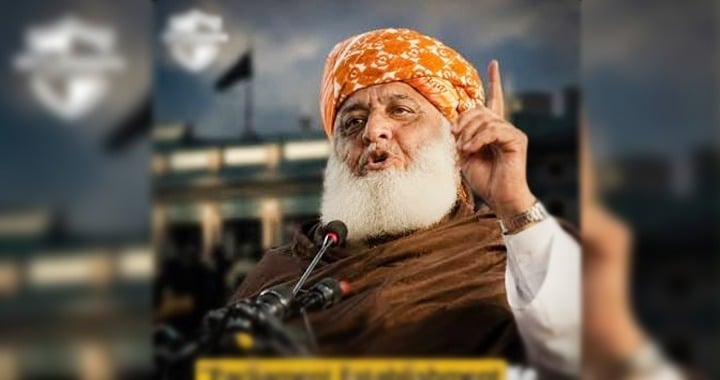
Maulana Fazlur Rehman appears to have walked into a political trap of his own making.
He was already facing fierce criticism over remarks that deeply hurt the families of Pakistan’s Shuhada and provoked anger among many who have witnessed the sacrifices made by the country’s security forces in the war against terrorism. Before that controversy could fade, another set of remarks, this time concerning his reported conversation with Afghan Taliban leader Sheikh Haibatullah Akhundzada, has placed him under renewed scrutiny.
This is where the phrase “Maulana phans gaye” seems particularly apt.
According to senior journalist and Afghan affairs expert Aqeel Yousafzai, Fazlur Rehman reportedly told the Afghan Taliban leader that Afghanistan’s interests were dearer to him than Pakistan’s. For the head of a major Pakistani religious-political party, that is an extraordinarily difficult position to explain, particularly when Pakistan continues to accuse the Afghan Taliban of providing sanctuary and facilitation to terrorist organizations attacking Pakistan.
The question is simple but difficult to evade: How can a Pakistani political leader tell the head of a foreign regime that the interests of that country are more important to him than those of Pakistan?
And the timing makes the matter even more consequential.
Pakistan has repeatedly maintained that terrorist organizations operating from Afghan territory pose a direct threat to its citizens and security forces. The banned Tehreek-e-Taliban Pakistan has carried out numerous attacks against Pakistan, while other anti-Pakistan terrorist networks have also remained part of the broader security challenge.
Against that backdrop, Yousafzai has questioned how Fazlur Rehman could offer such an assurance to the Afghan Taliban leadership.
The Shuhada Controversy Has Not Simply Disappeared
The latest controversy cannot be viewed entirely in isolation from the storm surrounding Fazlur Rehman’s earlier remarks about the Shuhada.
Those remarks caused deep anguish among families who lost their loved ones in Pakistan’s long war against terrorism. For these families, the Shuhada are not political symbols. They are sons, fathers, brothers and husbands whose lives were sacrificed while defending the country.
That is why the backlash was so intense.
And now, when the same political leader is facing questions over reportedly placing Afghan interests ahead of Pakistan’s, the two controversies have inevitably begun to overlap in public perception.
The issue is no longer simply one controversial statement.
It is the question of where a Pakistani political leader believes his primary national responsibility lies.
The Afghan Taliban Question
Yousafzai has also raised the historical association of three former TTP chiefs with JUI-F, noting that they had been associated with the party at different stages.
That fact alone does not establish any organizational connection between JUI-F and the TTP’s terrorist activities. But it does add another layer to the debate over Fazlur Rehman’s relationship with the Afghan Taliban and his broader position on Pakistan’s security concerns.
The contradiction becomes difficult to ignore.
The Afghan Taliban leadership is accused by Pakistan of allowing terrorist groups hostile to Pakistan to operate from Afghan soil. Pakistani security forces continue to confront the consequences of that threat. Yet a major Pakistani political figure is now reported to have told the Afghan Taliban leadership that Afghanistan’s interests are dearer to him than Pakistan’s.
That is precisely the sort of statement that demands an explanation.
A Security Environment That Leaves Little Room for Ambiguity
Pakistan’s security establishment has repeatedly made its position clear.
Field Marshal Syed Asim Munir has drawn a clear line regarding threats to Pakistan and its citizens, emphasizing that the country’s national interest and the protection of Pakistanis cannot be compromised.
Yousafzai argues that this position has been communicated repeatedly and unequivocally: Pakistan’s interests remain paramount, and the state possesses both the resolve and the capacity to protect them.
The contrast with Fazlur Rehman’s reported remarks is therefore stark.
Pakistan is confronting terrorism from organizations that have killed civilians, religious scholars, political figures, tribal elders, police officers and members of the armed forces. The country’s security forces continue to pay the price.
In such circumstances, expressions of greater concern for the interests of the Afghan Taliban naturally invite intense scrutiny.
There is also a wider regional dimension.
Yousafzai has argued that the terrorism and destabilization confronting Pakistan can no longer be viewed solely through the TTP or Afghan Taliban prism. He has pointed to alleged involvement by India, Israel and other forces hostile to Pakistan, suggesting that the security challenge has acquired a broader geopolitical character.
Whether viewed through the lens of terrorism, regional rivalry or national security, his argument is that Pakistan cannot afford ambiguity over its core interests.
The Question Fazlur Rehman Cannot Easily Escape
The most damaging aspect of the controversy may therefore not be any single sentence.
It is the accumulation of questions.
Why would a Pakistani political leader reportedly assure the Afghan Taliban leadership that Afghanistan’s interests were more important to him than Pakistan’s?
Why make such a statement to the head of a regime that Pakistan accuses of allowing terrorists to operate from its soil?
And how does such a position square with the sacrifices of Pakistan’s Shuhada, whose families have already expressed deep hurt over Fazlur Rehman’s earlier remarks?
These questions are not going away simply because the controversy moves from one news cycle to another.
Fazlur Rehman may have intended his engagement with the Afghan Taliban to serve a political, religious or diplomatic purpose. But political statements acquire a life of their own, particularly when they touch national security and the sacrifices of thousands of Pakistanis.
And that may be the real reason “Maulana phans gaye” has begun to resonate.
He is not facing one isolated controversy. He is facing the convergence of his earlier remarks on the Shuhada, his reported position on Afghan interests, the Afghan Taliban’s disputed relationship with anti-Pakistan terrorist groups, the history surrounding some former TTP leaders, and a rapidly changing regional security environment.
At some point, explanations have to confront the larger picture.
For Pakistan, the question is ultimately uncomplicated: when national interests and the interests of a foreign regime appear to collide, where does a Pakistani leader stand?
That is the corner in which Fazlur Rehman now finds himself.
And perhaps the most uncomfortable part is that he appears to have walked there himself.



