
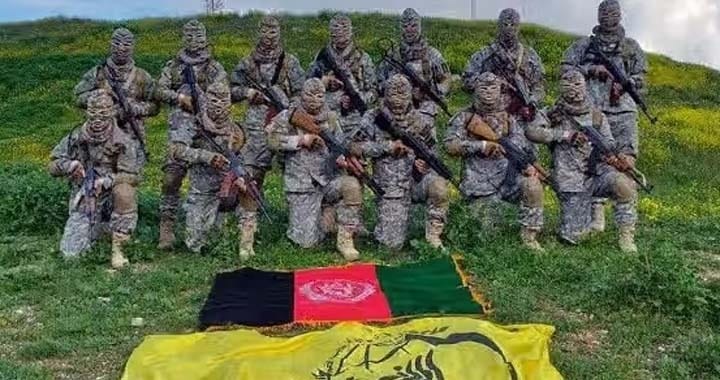
A commander of the Iran-backed Fatemiyoun Division has claimed that hundreds of fighters under his command are prepared to join armed resistance against the Taliban if an anti-Taliban front provides the necessary financial, logistical and military support, exposing what he described as growing frustration within the militia over Tehran’s current policy towards Afghanistan.
Speaking anonymously for security reasons, the commander said many members of the Fatemiyoun Division believe the struggle against the Taliban should be regarded as a legitimate resistance movement. He claimed recent remarks by Iran’s deputy ambassador in Kabul, who stated that Tehran does not support political or military groups seeking to overthrow the Taliban and does not consider armed opposition to the Taliban as “resistance”, have triggered widespread dissatisfaction among Fatemiyoun fighters.
According to the commander, many within the militia questioned why conflicts in Gaza, Lebanon, Syria and the Strait of Hormuz are portrayed as legitimate resistance while fighting the Taliban is not. He argued that, for many Afghan members of the Fatemiyoun Division, the future of Afghanistan takes precedence over conflicts elsewhere in the region.
The commander further claimed that several Fatemiyoun personnel are currently deployed around the Strait of Hormuz and that morale among those forces has also been affected by Tehran’s policy. He alleged that many fighters, particularly those from Afghanistan’s Hazara community, view resistance against the Taliban as both a national and religious obligation because of what they describe as discrimination and insecurity faced by their communities under Taliban rule.
According to the commander, Iran’s Islamic Revolutionary Guard Corps (IRGC), which established and trained the Fatemiyoun Division, had promised in 2016 to help transform the group into a powerful military-political movement in Afghanistan, similar to Hezbollah’s role in Lebanon. He alleged that the promise was never fulfilled.
The commander also claimed that after the Taliban seized Kabul in August 2021, IRGC officials instructed Fatemiyoun members to avoid confronting the Taliban, warning that an immediate conflict could lead to reprisals against Afghanistan’s Shiite population. He alleged that the fighters were instead told to wait for a more suitable opportunity to re-enter Afghanistan’s political and military landscape.
Expressing disappointment with Tehran’s evolving policy, the commander claimed many Fatemiyoun fighters now feel abandoned after years of fighting in Syria under IRGC command. He alleged that promises made to Afghan recruits regarding their future, recognition of sacrifices and political role in Afghanistan were never honoured. According to him, discrimination against Afghan migrants in Iran and what he described as neglect of the families of fallen Fatemiyoun fighters have further deepened resentment within the ranks.
He claimed that if any organised anti-Taliban resistance movement offered sufficient support, many Fatemiyoun members would be willing to leave the IRGC, return to Afghanistan and participate in armed operations against the Taliban.
The commander also disclosed details of what he described as the Fatemiyoun Division’s communication mechanism with the IRGC. He alleged that members communicate with a branch of the IRGC through an internal online platform known as the “Derakhshan” system, based in Mashhad, where requests are submitted using identification codes before instructions are issued through direct communication.
The Fatemiyoun Division was formed in 2015 under the supervision of the IRGC, primarily recruiting Afghan Shiite volunteers, particularly members of the Hazara community living in Iran. The force became one of Tehran’s principal proxy formations during the Syrian conflict, fighting alongside the government of Bashar al-Assad. While Iranian authorities have never officially disclosed the division’s total strength, independent assessments suggest it has comprised thousands of Afghan fighters over the past decade.
The allegations emerge amid continued concerns over the situation of Afghanistan’s Hazara and Shiite communities under Taliban rule. Rights groups and UN agencies have repeatedly raised concerns over attacks claimed by ISIS-K, allegations of forced displacement, land disputes and restrictions affecting these communities. The Taliban have consistently denied accusations of systematic discrimination.
Neither Iranian authorities nor the Taliban had publicly responded to the commander’s claims at the time of filing this report. The assertions also could not be independently verified.
The reported remarks nevertheless point to apparent differences within sections of the Iran-backed Fatemiyoun Division over Tehran’s engagement with the Taliban and highlight the complex relationships among regional armed groups following the Taliban’s return to power in Afghanistan.



