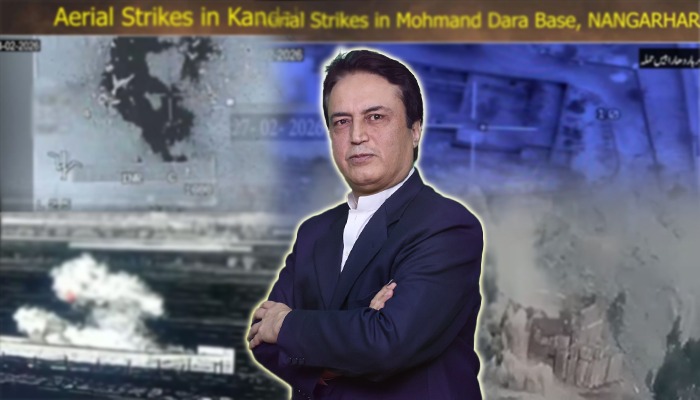
(Arif Yousafzai)
When tensions erupt between Pakistan and Afghanistan, the first casualty is not only life and property it is truth. In the fog of cross-border fire, drone strikes and retaliatory air raids, narratives move faster than facts. Claims multiply. Casualty figures swell and shrink by the hour. Social media becomes a battleground. Television studios turn into war rooms. And in the middle of it all, ordinary people on both sides of the Durand Line brace for the consequences of decisions taken far from their homes. The latest round of escalation between Islamabad and Kabul follows a familiar yet deeply troubling pattern: attack, retaliation, counter-claim, counter-retaliation. Afghan authorities have claimed strikes on multiple Pakistani border points in provinces such as Paktika, Paktia, Nangarhar, Nuristan and Khost. Pakistan, in turn, has launched air operations targeting what it describes as militant compounds and strategic sites inside Afghanistan, including areas around Kabul and Kandahar. Each side asserts military gains. Each side disputes the other’s casualty claims. Neither narrative is independently verified in real time.
But beyond the claims and denials lies a more fundamental question: how did two neighboring Muslim-majority countries, bound by geography, culture and blood ties, drift so repeatedly to the edge of open confrontation?Pakistan and Afghanistan have shared an uneasy relationship since 1947. Afghanistan was the only country to oppose Pakistan’s admission to the United Nations, largely over disputes linked to the Durand Line the colonial-era boundary demarcated in 1893. For decades, tensions simmered beneath the surface, occasionally flaring into diplomatic crises. The Soviet invasion of Afghanistan in 1979 altered the dynamic dramatically. Pakistan became a frontline state in the anti-Soviet jihad, hosting millions of Afghan refugees and facilitating international support for the mujahideen. After the Soviet withdrawal and the subsequent civil war, Pakistan backed the Taliban movement, which captured Kabul in 1996. When the United States invaded Afghanistan after the attacks of 11 September 2001, Pakistan officially aligned with Washington, while the Taliban insurgency regrouped across the borderlands. The two decades that followed blurred distinctions between state policy, militant networks and tribal loyalties. Militancy became transnational, and the frontier increasingly porous not only for trade and kinship, but for armed groups.
The return of the Taliban to power in Kabul in August 2021 reopened unresolved questions. Islamabad had long hoped that a Taliban-led government would curb anti-Pakistan militant activity from Afghan soil. Instead, Pakistan accuses the Afghan Taliban of either harboring or failing to control the Tehreek-e-Taliban Pakistan (TTP), which has intensified attacks inside Pakistan. Kabul rejects the allegation, insisting it does not allow its territory to be used against other countries. This dispute over the TTP is at the heart of the present crisis. From Islamabad’s perspective, cross-border strikes are a matter of national security. Pakistani officials argue that when militants launch attacks from sanctuaries across the border, Pakistan has the right to act in self-defense. From Kabul’s viewpoint, such strikes violate Afghan sovereignty and risk civilian casualties. The most recent escalation appears to follow this logic of action and reaction. Afghan officials say their attacks were a response to earlier Pakistani strikes in eastern Afghanistan. Pakistani officials describe their air raids as a response to Afghan cross-border aggression. Both narratives claim retaliation. Neither side acknowledges initiating the cycle. This dynamic is dangerous because it transforms limited tactical exchanges into symbolic contests of prestige. Once air power is deployed, once capitals like Kabul and spiritual centers like Kandahar are targeted, the stakes rise sharply. Leaders on both sides face pressure not to appear weak. Military actions become intertwined with national honor.
History shows that such spirals can quickly outpace original intentions. What begins as a “limited response” can escalate into a broader confrontation especially if miscalculations occur or if civilian casualties inflame public opinion. One of the most troubling aspects of the current crisis is the information environment. Within hours of the strikes, social media platforms were awash with unverified claims: senior Taliban leaders allegedly killed; entire brigades destroyed; dozens or even hundreds of fighters dead. Pakistani officials cited figures of up to 80 or 100 Taliban fighters killed. Taliban spokesmen dismissed those numbers as exaggerations, offering much lower casualty estimates. Rumors spread that high-profile figures including top Taliban leaders and TTP commanders had been eliminated. Other claims suggested widespread destruction in major Afghan cities or the collapse of Pakistani defensive lines. Many of these reports lacked credible evidence. The observation that “truth is the first casualty of war” is not a cliché; it is a pattern. In modern conflicts, the battle for narrative dominance runs parallel to the battle on the ground. Governments project strength. Militant groups inflate resilience. Regional rivals amplify divisive stories. International actors pursue their own strategic messaging. In South Asia, media ecosystems are often polarized and hyper-nationalistic. Television anchors can become cheerleaders. Hashtags trend before facts are verified. The result is an environment in which public emotion is easily inflamed, narrowing political space for de-escalation.
For journalists, the responsibility is immense. Reporting claims as claims, clearly distinguishing between confirmed facts and partisan assertions, is not weakness it is integrity. In times of crisis, restraint is not silence; it is professionalism. While governments debate sovereignty and militants test resolve, the people living along the border bear the brunt. The Durand Line cuts through Pashtun communities whose families straddle both sides. Markets, marriages and migrations have long ignored the artificial rigidity of maps. When artillery shells land or drones hover overhead, it is these communities that suffer. Even when strikes target “military compounds,” the proximity of civilian settlements in rugged, densely populated valleys raises the risk of collateral damage. Schools, homes and shops do not disappear during wartime; they remain, vulnerable. In previous flare-ups, families have fled temporarily, livestock has been lost and trade has stalled. Each episode deepens economic fragility in already impoverished districts. Border closures disrupt commerce that sustains thousands. Medical access becomes uncertain. Fear lingers long after the guns fall silent.
There is also a psychological toll. Children grow up internalizing the sound of gunfire as background noise. Suspicion replaces trust. National narratives harden around grievance. Neither Islamabad nor Kabul can plausibly claim moral victory if civilians are caught in the crossfire. A state’s legitimacy is not measured only by its ability to strike, but by its ability to protect. A central tension in this crisis is Pakistan’s demand that the Afghan Taliban decisively curb the TTP. Islamabad argues that Kabul must either restrain, disarm or expel Pakistani militants operating from Afghan territory. Kabul counters that it cannot or will not turn against groups that were once its battlefield allies.
This is not merely an ideological issue; it is sociopolitical. Many TTP fighters fought alongside Afghan Taliban forces during the two-decade insurgency against the US-backed Afghan government. Shared combat experience forged bonds that are not easily severed. In Pashtun tribal culture, loyalty to comrades-in-arms carries profound weight. Moreover, the Afghan Taliban face internal cohesion challenges. Moving forcefully against the TTP could trigger fractures within their ranks or spark internal dissent. Yet failing to act risks international isolation and repeated cross-border strikes. Pakistan, for its part, confronts its own limits. Direct military pressure inside Afghanistan may degrade specific militant networks, but it risks consolidating anti-Pakistan sentiment within Afghanistan and undermining any chance of strategic cooperation.
Thus both sides find themselves in a bind. Islamabad cannot tolerate escalating TTP attacks. Kabul cannot easily abandon allied networks without destabilizing its rule. A purely military approach offers no sustainable solution.
The Role of Regional and Global Actors In crises like this, speculation quickly turns to external powers. Some Pakistani commentators argue that India benefits from discord between Islamabad and Kabul. Afghan voices sometimes suggest Pakistan exaggerates threats to justify pressure. Others point to the United States, Gulf countries or even Israel as potential influencers. While regional rivalries undeniably shape the broader geopolitical landscape, it would be simplistic to attribute every flare-up to foreign orchestration. Pakistan and Afghanistan possess agency. Their leaders make decisions based on domestic pressures, security calculations and ideological commitments. That said, regional diplomacy could play a constructive role. Countries such as Qatar, Turkey and Saudi Arabia have previously facilitated dialogue in Afghan-related disputes. Quiet mediation, confidence-building measures and back-channel communications can prevent miscalculation. International actors must also resist the temptation to instrumentalize the crisis. Escalation between Pakistan and Afghanistan would destabilize an already fragile region, complicating counterterrorism efforts and humanitarian relief.
Open conflict between Pakistan and Afghanistan would be strategically self-defeating for both. For Pakistan, sustained cross-border war would strain military resources, invite international scrutiny and risk domestic blowback. It could also disrupt trade routes that Islamabad hopes to leverage for regional connectivity, including projects linking Central and South Asia. For Afghanistan’s Taliban authorities, confrontation with Pakistan could isolate them further at a time when they seek diplomatic recognition and economic engagement. Afghanistan’s economy remains deeply fragile, heavily dependent on humanitarian aid and cross-border commerce. Prolonged hostilities would exacerbate hardship. More broadly, war would inflame ethnic and nationalist sentiments. Pashtun populations on both sides could feel torn between state loyalties and cross-border kinship. Any perception that civilians are being collectively punished could fuel long-term resentment. The idea that one side can “win” through escalation misunderstands the interconnected nature of the two societies. Geography is immutable. Neither country can relocate its neighbor.
What, then, is the alternative? First, an immediate ceasefire and restoration of military hotlines are essential. Even if mistrust remains, communication can prevent accidental escalation. Second, both governments must institutionalize mechanisms to address cross-border militant activity. Joint verification teams, intelligence-sharing protocols and monitored demilitarized buffer arrangements however politically sensitive could reduce ambiguity.
Third, the TTP issue requires a phased, negotiated framework. Kabul may not be able to dismantle the group overnight, but it could begin by restricting movement, limiting recruitment and publicly committing to non-support. Islamabad, in turn, could explore calibrated confidence-building measures rather than relying solely on kinetic strikes. Fourth, media responsibility matters. Nationalistic fervor may generate ratings, but it narrows diplomatic space. Governments should avoid inflammatory rhetoric and refrain from premature casualty claims that cannot be substantiated. Finally, religious and cultural symbolism should not be exploited to justify violence. If anything, shared faith and shared history ought to reinforce the imperative for restraint.
Pakistan and Afghanistan stand at a crossroads that is as moral as it is strategic. They can continue a cycle of retaliation, each strike justified as a response to the last, until escalation becomes uncontrollable. Or they can acknowledge that no durable security architecture can be built on perpetual cross-border confrontation. The borderlands have seen decades of war from the Soviet invasion to the US-led intervention to insurgencies on both sides. Generations have grown up amid conflict. Another open-ended clash would not write a new chapter; it would repeat a tragic script. Leadership is tested not in moments of easy consensus but in moments of fury. Restraint requires courage. Dialogue demands patience. Compromise invites criticism. Yet the alternative prolonged instability between two nuclear-armed and conflict-scarred neighbors is far costlier. In the end, the measure of wisdom will not be how many compounds were destroyed or how many posts were captured. It will be whether Islamabad and Kabul can step back from the brink and choose coexistence over confrontation.
War may deliver headlines. Peace, however fragile, delivers futures.