
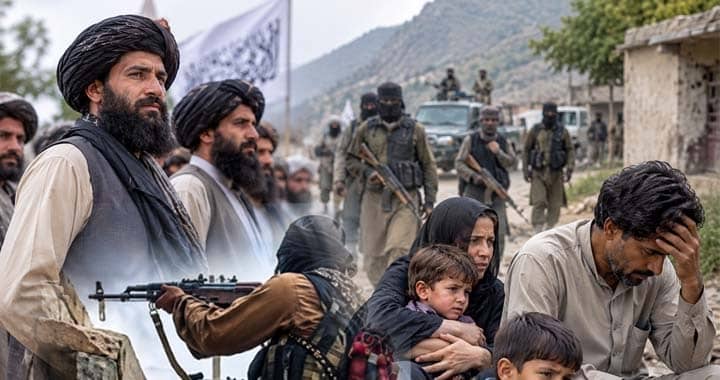
The most disturbing contradiction surrounding the Tehreek-e-Taliban Afghanistan (TTA) and the banned Tehreek-e-Taliban Pakistan (TTP) is that both invoke Islam and Shariah while pursuing agendas that endanger innocent lives. Their actions expose a glaring disconnect between their religious claims and the responsibilities that Islamic teachings place upon anyone exercising authority or wielding power over others. The consequences extend beyond individual attacks, affecting civilian lives, regional security, economic stability and the future of millions.
Although both organizations must be held accountable for their respective actions, the TTA carries a substantially greater responsibility. The TTP is a banned terrorist organization operating against Pakistan without any legitimate mandate to govern. The TTA, however, is Afghanistan’s de facto ruling authority, exercising control over state institutions, territory and public administration. Its decisions determine the circumstances of approximately 44 million Afghans. Governing an entire country makes its obligations considerably greater than those of an armed organization operating outside the framework of legitimate government.
Governing Means Protecting, Not Merely Controlling
The fundamental responsibility of any government is to protect human life, provide security, facilitate access to food, healthcare and education, safeguard property and ensure that people can live with dignity. Authority is not a license to dictate every aspect of people’s lives while disregarding their welfare.
Yet Afghanistan’s experience under the Taliban has raised serious questions about these obligations. Restrictions on women’s education and employment, barriers to healthcare and the exclusion of large sections of society from public life have compounded the country’s humanitarian and socioeconomic difficulties. These policies affect not merely individual freedoms but the country’s ability to educate future generations, maintain essential services and develop its institutions.
The prohibition on women studying in medical institutes, for example, threatens the future availability of female healthcare professionals in a country where women already face significant barriers to treatment. A ruling authority claiming religious legitimacy cannot reasonably place ideological enforcement above the survival, dignity and welfare of the population entrusted to its care.
The TTP’s Terrorism and Its Human Cost
The banned TTP presents another dimension of this contradiction. Its terrorist campaign has inflicted enormous suffering on Pakistani communities through attacks against security personnel, police installations, public institutions and civilians. Violence, intimidation and coercion have disrupted education, commerce and ordinary life, while forcing families and entire communities to endure prolonged insecurity.
Its use of civilian homes and populated areas as firing positions further demonstrates its disregard for human life. By operating from residential buildings and exposing innocent families to danger, terrorists complicate security operations and exploit the restraint exercised by security forces to protect civilians. The same tactics can subsequently be used to generate anti-security forces propaganda.
The people of Pakistan’s tribal districts and other affected areas deserve security, education, economic opportunities and freedom from intimidation. No organization can credibly claim to champion Islam while deliberately exposing the population to violence and suffering.
Islam Places an Extraordinary Burden on Those in Authority
Perhaps the strongest standard against which both organizations should be judged comes from the religious tradition they repeatedly invoke.
The Prophet Muhammad (peace be upon him) declared in an authentic hadith recorded in Sahih al-Bukhari and Sahih Muslim that every person is a shepherd and will be questioned about those under their care. The hadith specifically identifies a ruler as responsible for the people under his authority. This is a solemn declaration of accountability, not merely a description of leadership.
For the TTA, the implication is particularly significant. If a ruler is answerable for those entrusted to his care, how can an authority disregard their safety, education, healthcare, food security and dignity while claiming to govern in the name of Islam? Authority increases responsibility; it does not provide an exemption from it.
Another authentic teaching, recorded in Sahih Muslim, instructs those responsible for servants and dependents to feed them from what they eat, clothe them from what they wear and not burden them beyond their capacity. Although the narration addresses servants in its historical context, its underlying emphasis on human dignity, material welfare and protection from exploitation provides an important ethical standard for those exercising power.
The same spirit is reflected in the famous statement attributed to Hazrat Umar ibn al-Khattab (RA), the second rightly guided Caliph, expressing his fear that even a dog dying of thirst on the banks of the Euphrates might become his responsibility. While its precise historical attribution should be treated cautiously, the principle it conveys is unmistakable: leadership carries an obligation to protect even the most vulnerable living beings.
Their Actions Have Consequences Beyond Borders
The TTA’s responsibilities do not end at Afghanistan’s borders. Its approach toward armed groups operating from Afghan territory, particularly the TTP, has become a major source of friction with Pakistan. United Nations monitoring assessments have repeatedly raised concerns about the TTP’s presence in Afghanistan and attacks launched against Pakistan from Afghan soil. The December 2025 Monitoring Team report identified these attacks as a major short-term threat to the stability of the Afghan de facto authorities themselves.
Allowing terrorist organizations operational space, freedom of movement or access to support networks creates consequences that cannot be contained within Afghanistan. Pakistan bears immediate security costs, while border communities, trade, transportation and regional economic connectivity suffer the wider fallout.
The resulting cycle of terrorist attacks, security responses, border tensions, civilian displacement and trade disruption threatens ordinary people on both sides. It also undermines diplomatic engagement and regional cooperation. Afghans, already struggling with humanitarian and economic difficulties, have little to gain from policies that deepen their country’s isolation.
Religious Claims Cannot Erase Accountability
Ultimately, the TTA and TTP must be judged by their actions rather than their religious claims. Their organizational distinctions and respective responsibilities should not obscure the common consequence of their conduct: innocent people are exposed to violence, deprivation, intimidation and insecurity.
The TTA must answer for the responsibilities accompanying its control over Afghanistan and for policies that endanger its population and regional stability. The banned TTP must answer for its terrorist attacks and the suffering it imposes on Pakistani communities. Those who facilitate, finance, shelter or enable terrorist violence must also face accountability on the basis of credible evidence.
Islamic legitimacy cannot be established through slogans, decrees, weapons or coercive enforcement of ideology. It must be reflected in justice, compassion, protection of human life and fulfillment of the rights of those entrusted to one’s care.
The fundamental question for both organizations is unavoidable: if Islam makes the protection of human life and fulfillment of people’s rights a responsibility, on what religious or moral grounds can those who endanger those very lives claim to be its torchbearers?
The people of Afghanistan and Pakistan are not expendable subjects of armed organizations. Their lives, dignity, security and future are responsibilities that no religious slogan can absolve anyone of fulfilling.



