
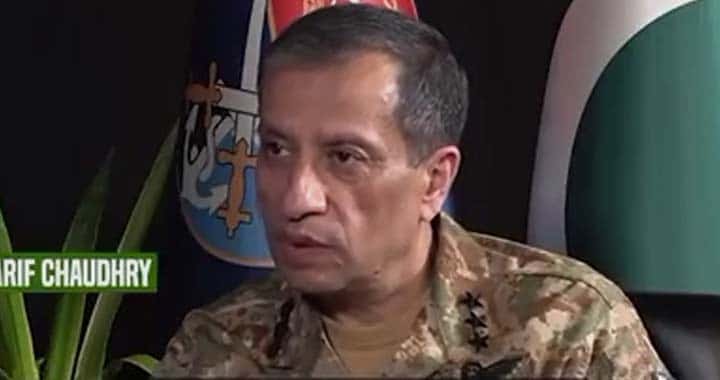
Pakistan conducts approximately 200 intelligence-based operations (IBOs) every day as part of a comprehensive counterterrorism strategy targeting terrorists and their facilitators inside the country, Director General Inter-Services Public Relations (DG ISPR) Lieutenant General Ahmed Sharif Chaudhry has said, stressing that Islamabad does not attribute all terrorism to Afghanistan and must also address its internal vulnerabilities.
In an interview with international news agency Reuters on October 30, the military spokesperson said Pakistan had a clear strategy to combat terrorism, with one of its central objectives being the elimination of terrorists and their entire support networks within the country.
He acknowledged that while Afghanistan served as a major base for terrorism directed against Pakistan, with terrorist leadership, training camps and launchpads operating from its territory, some aspects of the threat required an internal response.
“Our mindset is not like India’s, where we attribute all internal problems to external actors,” the DG ISPR said, adding that Pakistan did not claim all terrorism inside the country was caused by Afghanistan.
He said Pakistan had accumulated extensive counterterrorism experience over the past two decades, which informed its approach to confronting the threat.
Intelligence-Based Operations and KP’s Security Challenges
Lieutenant General Ahmed Sharif Chaudhry said Pakistan’s security forces conducted approximately 200 intelligence-based operations daily through coordinated efforts involving the army, police and other law enforcement agencies.
He clarified that the ongoing counterterrorism campaign in Khyber Pakhtunkhwa relied on intelligence-based operations rather than a large-scale military operation.
The military spokesperson said the people of Khyber Pakhtunkhwa had suffered the most from terrorism, describing them as courageous and an important part of Pakistani society. He also praised Pashtun traditions and said the province’s people deserved the peace and stability they were demanding.
He maintained that opposition to counterterrorism operations in the province did not represent the public at large, arguing that those resisting such efforts were people with links to terrorist groups.
The DG ISPR also accused the former provincial government in Khyber Pakhtunkhwa of being an incompetent and indifferent administration that had served as one of the facilitators of terrorism.
He said a facilitator who had been obstructing counterterrorism efforts in the province was no longer in that position.
Asked about the circumstances surrounding the change of government, Lieutenant General Ahmed Sharif Chaudhry described the matter as a political question best answered by politicians. He said the military’s understanding was that the change had taken place in accordance with constitutional and legal procedures.
Afghanistan’s Role and Pakistan’s Internal Responsibilities
The DG ISPR’s remarks outlined a two-pronged approach to counterterrorism: dismantling terrorist networks and their facilitators inside Pakistan while addressing the threat posed by groups operating from Afghan territory.
He said terrorist leaders, training facilities and launchpads in Afghanistan were used to support attacks against Pakistan. However, he stressed that this external dimension did not absolve Pakistan of the responsibility to deal with domestic weaknesses and those enabling terrorist activity within the country.
The emphasis on intelligence-based operations reflects an approach focused on identifying specific threats and disrupting terrorist networks through coordinated action by security forces and law enforcement agencies.
Terrorism, Economic Sabotage and Balochistan’s Development
Turning to Balochistan, Lieutenant General Ahmed Sharif Chaudhry said terrorist groups were attempting to sabotage development projects and economic activity in the province at the behest of their sponsors.
He said terrorists targeted a wide range of economic and social infrastructure, including mining operations, liquefied petroleum gas (LPG) trucks, schools, teachers, bridges and railway lines.
According to the DG ISPR, such attacks were intended to disrupt economic activity and prevent local communities from gaining employment and financial independence.
He argued that terrorist groups deliberately targeted activities capable of providing livelihoods and economic strength to local populations, thereby undermining development and sustaining conditions of deprivation.
The military spokesperson also criticized Balochistan’s influential elite, accusing sections of it of seeking to preserve their influence by keeping ordinary citizens poor and uneducated.
He alleged that a convergence of interests existed between terrorist groups and elements of the provincial elite because, in his assessment, both opposed development that could improve the economic and social standing of ordinary Baloch citizens.
He said terrorism and entrenched interests were reinforcing deprivation, allowing grievances associated with poverty and underdevelopment to persist.
The remarks placed economic sabotage at the center of Pakistan’s security challenge in Balochistan, where attacks on infrastructure, educational institutions and commercial activity threaten both public safety and development.
A Broader Counterterrorism Strategy
The interview underscored the military’s position that counterterrorism requires more than operations against armed groups. It also demands action against their facilitators, cooperation between security institutions, and efforts to prevent attacks from undermining economic opportunities and public confidence.
By citing the scale of daily intelligence-based operations, the DG ISPR highlighted the role of continuous, coordinated security action. At the same time, his acknowledgement of internal vulnerabilities indicated that Pakistan’s response must address both cross-border terrorist infrastructure and domestic support networks.
His comments on Khyber Pakhtunkhwa and Balochistan also linked security with governance and development, arguing that public demands for peace, economic opportunity and better living conditions must remain central to efforts to counter terrorism.



