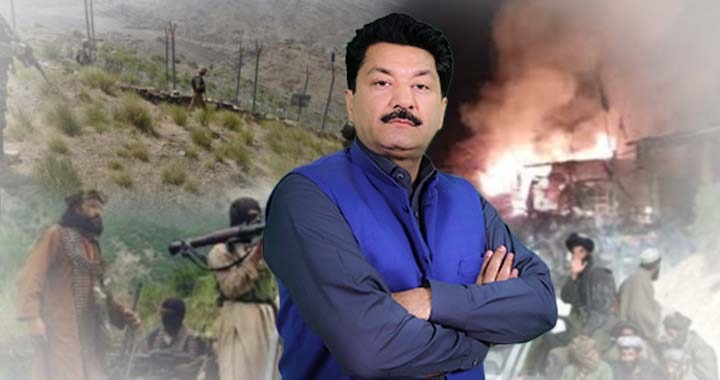
In the wake of a renewed wave of terrorism in Khyber Pakhtunkhwa, Pakistan carried out targeted airstrikes inside Afghanistan, focusing on what officials described as specific militant locations.
Recent attacks have shaken KP. In South Waziristan, a school came under attack. In Karak, three individuals lost their lives. In Kohat, a police mobile was targeted and a Deputy Superintendent of Police embraced martyrdom. These incidents formed the backdrop to Islamabad’s latest military response.
Pakistan has exercised this option before. Airstrikes were previously reported in Paktika, Khost, Paktia and Nangarhar. At one stage, strikes were also linked to efforts to target senior Tehreek-e-Taliban Pakistan leadership, including Noor Wali Mehsud. Afghan Taliban at the time accused Pakistan of violating their airspace, and tensions escalated sharply.
Following an exchange of fire in October, mediation efforts began. Initial talks were held in Doha under the facilitation of Qatar’s Ministry of Foreign Affairs. A ceasefire followed, and further rounds of dialogue took place in Istanbul and later in Riyadh. Despite these efforts, negotiations stalled. Borders remained closed for more than four months, trade was suspended, and Afghan transit arrangements were disrupted.
Pakistan’s Ministry of Foreign Affairs recently stated that seven locations were targeted, describing them as terrorist sites. Afghan officials rejected the claim, asserting that civilians were harmed. As in previous episodes, access to strike sites remained restricted, and competing narratives quickly emerged.
The eastern Afghan provinces along Pakistan’s western frontier, including Khost, Nangarhar, Paktia and Paktika, have long been identified as areas where militant groups maintain presence. The expectation in Islamabad was that kinetic action might reduce attacks inside Pakistan. Instead, violence persisted.
The Bannu incident, in which Lieutenant Colonel Gul Faraz was martyred, was followed by further attacks. In Karak, a quadcopter assault targeted a Frontier Corps fort. Injured personnel were transported in private vehicles due to the absence of ambulances. Those vehicles were later attacked, resulting in additional casualties. In Kohat, a police vehicle was ambushed and set ablaze. Schools and basic health units have also been targeted.
Such attacks, particularly against hospitals, ambulances and educational institutions, violate humanitarian norms. They deepen fear among civilians and erode the distinction between combatants and non-combatants.
Pakistan has articulated a pattern: large scale attacks inside its territory, supported by evidence of cross border facilitation, may trigger retaliatory strikes. The Chief of Army Staff, Field Marshal Syed Asim Munir, has publicly signaled that follow up action remains an option. Defence Minister Khawaja Asif has also reiterated that hesitation will not define policy.
Beyond military calculus, tribal dynamics inside eastern Afghanistan are reportedly creating internal pressure on the Afghan Taliban. Local communities question the continued presence of Pakistani militant groups and their families, arguing that their activities disrupt everyday life.
International concern is also growing. Russia has formally recognized the Afghan Taliban administration and has spoken of thousands of foreign militants operating inside Afghanistan. United Nations assessments have similarly highlighted the presence of multiple armed groups, with the Indian-sponsored TTP described as one of the largest components. Regional actors including Iran, Tajikistan, China and Pakistan have all voiced security concerns.
Afghanistan has warned that it will respond “at a time of its choosing,” while again accusing Pakistan of violating its airspace. At the same time, internal Afghan political rivalries complicate the picture. Opposition figures such as Yunus Qanuni, Abdul Rashid Dostum and Ahmad Massoud, along with elements of the National Resistance Front, remain active in political discourse. The suggestion that Pakistan might cultivate alternative channels within Afghanistan reflects the depth of current mistrust.
Proposals have also surfaced regarding financial assistance and relocation of militants away from the Pakistan border. At one stage, a demand of ten billion rupees was reportedly discussed in connection with relocating fighters from eastern provinces. Whether such arrangements are feasible remains uncertain.
Multiple mediation attempts by Qatar, Turkey and Saudi Arabia, and more recently exploratory signals from Iran, underscore that regional actors are uneasy about sustained escalation. Yet meaningful progress requires credible guarantees.
At the core of the dispute lies the question of control over Pakistani militant groups operating from Afghan soil. If these groups are not restrained and no verifiable assurances are provided, suspicions of tacit tolerance or patronage will persist.
The pathway forward depends on whether security concerns can be addressed through enforceable commitments. Without that, cycles of strike, denial and retaliation risk becoming the new normal along a volatile frontier.