
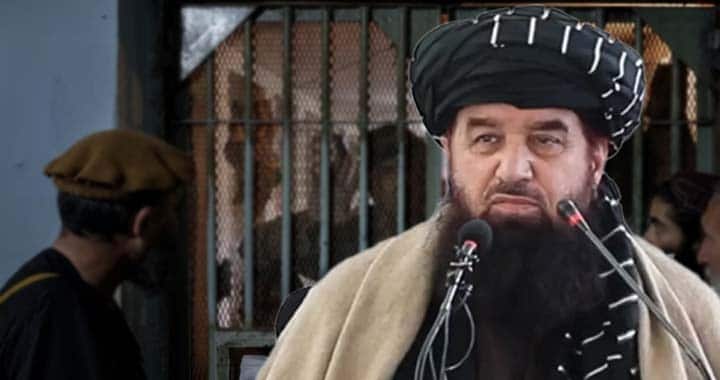
The latest actions attributed to Taliban Justice Minister Abdul Hakim Sharaei have once again raised a question that has followed Afghanistan’s rulers for decades: can a government secure long-term stability through coercion, restrictions, and force, or does such an approach ultimately create the very instability it seeks to prevent?
According to reports, Sharaei recently met security commanders from four security zones in Kabul and emphasized the need to maintain public order, prevent disorder, and strictly implement the directives of Taliban leader Hibatullah Akhundzada. The meeting followed a series of controversial developments, including the detention of more than 30 Shia Muslims over Muharram-related displays and the reported raid on a private television station.
Viewed individually, such incidents may appear to be isolated administrative decisions. Viewed collectively, however, they point toward a broader governing philosophy increasingly associated with the Taliban administration: centralization of authority, strict enforcement of directives, and reliance on security mechanisms to manage social and political challenges.
The critical question is whether that approach can produce lasting stability.
History offers reasons for skepticism.
Afghanistan’s political history is filled with examples of rulers, governments, monarchs, revolutionary movements, communist administrations, warlords, foreign powers, and insurgent groups who believed that authority could be consolidated primarily through coercion.
Few achieved enduring success.
Afghanistan has often demonstrated a unique political reality. Communities may tolerate authority when it is viewed as legitimate, fair, and responsive, but attempts to impose compliance solely through force have frequently generated resistance, resentment, and eventual backlash.
The Difference Between Control and Stability
One of the recurring lessons from Afghanistan’s history is that control and stability are not necessarily the same thing.
A government may control institutions, security forces, checkpoints, prisons, courts, and administrative structures.
That does not automatically mean it has secured public trust.
Trust emerges through inclusion, fairness, consultation, economic opportunity, and confidence that different communities will be treated equally under the law.
This is where recent developments have generated concern among observers.
The detention of Shia citizens over religious symbols, even if later reversed, risks creating perceptions of unequal treatment among communities.
Similarly, actions against media outlets inevitably raise questions regarding space for public discussion and differing viewpoints.
While authorities may view such measures as necessary for maintaining order, critics argue that excessive reliance on restrictions can produce unintended consequences.
History suggests that societies rarely become more stable when large segments of the population begin feeling excluded, marginalized, or targeted.
Instead, grievances often accumulate beneath the surface before eventually reappearing in political, social, or security forms.
For the Taliban, this challenge is particularly significant.
The movement spent two decades criticizing previous Afghan governments and foreign-backed administrations for corruption, injustice, and failure to connect with ordinary Afghans.
Now, as the governing authority, it faces the same test that confronted its predecessors: whether it can build legitimacy beyond its core support base.
The answer will likely shape Afghanistan’s future far more than any individual security directive.
A government can compel obedience for a period of time.
Lasting stability, however, usually depends on something more durable than fear.
It depends on whether citizens believe the state represents them, protects them, and treats them fairly.
That is a lesson written repeatedly throughout Afghanistan’s history.
And it is one that every government in Kabul, regardless of ideology or era, has eventually had to confront.



