
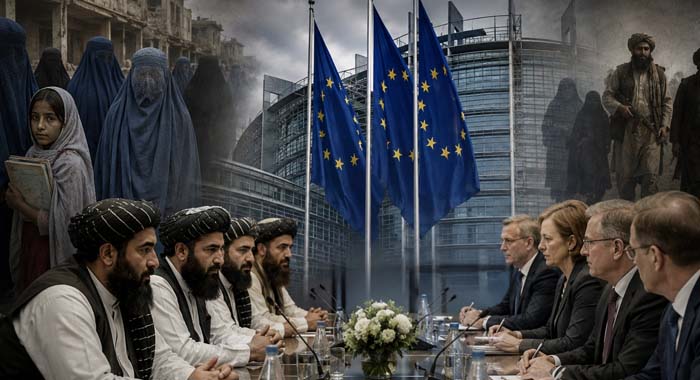
Reports of interactions involving representatives of the Taliban authorities in Brussels have sparked renewed debate over European Union foreign policy priorities, raising questions about the balance between geopolitical interests and long-standing commitments to democracy, human rights, and accountability.
According to the available information cited in recent reporting, European officials in Brussels have engaged with or hosted representatives associated with the Taliban administration. The development has drawn scrutiny from observers who argue that such engagement appears inconsistent with the European Union’s stated principles of governance rooted in democratic values and human rights protections.
Critics note that the Taliban authorities have, over the past several years, maintained restrictions on women’s participation in public life, including limitations on education for girls, employment opportunities, freedom of movement, and access to public services. These policies have been widely condemned by international human rights organizations and have contributed to concerns over systemic discrimination against women and girls in Afghanistan.
Reports further highlight that despite ongoing concerns regarding governance practices and human rights conditions, engagement with Taliban representatives in European diplomatic settings signals a potential shift toward pragmatic or interest-based diplomacy. Analysts suggest this may reflect broader geopolitical considerations increasingly shaping international engagement with Afghanistan.
At the same time, international monitoring bodies, including United Nations mechanisms, have repeatedly reported the presence of multiple armed and militant groups operating within Afghanistan’s territory. These assessments have raised concerns regarding regional security dynamics and the broader implications for counterterrorism efforts. However, such figures and claims remain subject to ongoing verification and debate among experts.
The situation is further complicated by Afghanistan’s ongoing humanitarian and economic challenges. According to international humanitarian assessments, millions of Afghans continue to require urgent assistance, while a significant portion of the population lives under conditions of multidimensional poverty. Humanitarian agencies warn that the country remains heavily dependent on external aid amid constrained economic recovery.
Observers also point to previously stated commitments made under international agreements, including assurances related to counterterrorism, inclusive governance, and prevention of extremist use of Afghan territory. The extent to which these commitments have been fulfilled remains a matter of international concern and assessment.
Human rights organizations continue to report extensive restrictions affecting women and girls in Afghanistan, including limitations that have resulted in large numbers being excluded from secondary and higher education. Some experts have described the situation as a severe form of institutionalized gender discrimination, further intensifying global scrutiny.
Policy analysts caution that normalizing relations with governing authorities without measurable reforms could set a precedent affecting international norms related to human rights and counterterrorism. They argue that diplomatic engagement should be conditioned on verifiable improvements in governance, rights protections, and compliance with international obligations.
The developments in Brussels have therefore reignited broader debate over the direction of European foreign policy, particularly the extent to which strategic and practical considerations may be influencing decisions traditionally grounded in values-based diplomacy.
As discussions continue, analysts emphasize the importance of maintaining a balanced approach that addresses humanitarian needs and regional stability while upholding international legal and ethical standards.



