
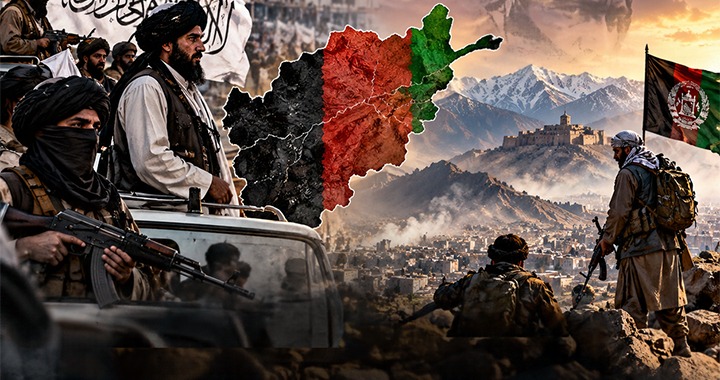
Afghanistan’s anti-Taliban resistance is entering a more complicated phase. The emergence of new opposition formations, reported attacks across geographically separated provinces and growing competition among armed groups for political relevance are challenging the image of a country whose security landscape has been completely settled under Taliban rule.
Yet the widening map of resistance does not, by itself, signal that the Taliban are close to losing power. The central question is whether scattered attacks can evolve into a coordinated movement capable of sustaining pressure on the authorities, overcoming internal divisions and presenting a credible alternative to the existing political order.
Developments reported in October have brought that question into sharper focus. On October 19, a report described more than 18 operations claimed by anti-Taliban groups across 12 provinces between October 7 and 18. The reported targets included security posts, personnel, vehicles and military facilities. These figures reflect reported and claimed activity, rather than an independently established measure of battlefield success. Nevertheless, the geographical spread warrants attention, even as the Taliban retain their dominant position across the country.
The distinction matters. Armed opposition can become more visible without becoming more powerful, while a government can retain territorial control without resolving the grievances that sustain resistance. Afghanistan’s emerging contest lies between these two realities.
The Opposition is no Longer a Single Organization
The National Resistance Front of Afghanistan (NRF) and the Afghanistan Freedom Front (AFF) remain among the best-known armed opposition groups. But the resistance landscape now includes a growing number of organizations operating under different names, with varying leadership structures, political messages and claims of military activity.
The appearance of additional formations creates opportunities for opposition to emerge in places where established groups have struggled to maintain a presence. It also complicates the task of assessing the movement as a whole. A new group may represent a genuine local network, a breakaway faction, a small circle of former security personnel or an organization whose practical capacity remains unclear.
This fragmentation has two opposing effects. It makes it harder for the authorities to treat resistance as a single organization that can be dismantled through the removal of a central leadership. But it also prevents the opposition from automatically converting local activity into a unified national campaign.
The problem is not simply the number of groups. It is whether they can establish common political objectives, maintain credible leadership, resolve disputes and coordinate their strategies without surrendering their local identities.
Without that cohesion, a growing number of resistance banners may produce a broader pattern of disruption rather than a movement capable of challenging the country’s political leadership.
Badakhshan Shows Where Local Grievances can Become a Security Problem
Developments in Badakhshan have highlighted the vulnerability of Taliban control to local disputes. The northeastern province has experienced increased political violence, with tensions involving local communities and leaders creating openings for armed opposition groups.
The significance of these developments extends beyond the number of attacks. Resistance organizations can gain room to operate when their objectives intersect with local dissatisfaction, particularly where centralized decision-making and the conduct of local authorities generate resentment.
Such conditions do not mean that entire communities support armed resistance. Nor does opposition to a particular Taliban policy necessarily translate into support for the NRF, the AFF or any other organization. Local grievances can produce protests, passive resistance, cooperation with armed groups or demands for changes within the existing system.
For the Taliban, the challenge is to prevent local disputes from becoming durable security problems. For the opposition, the challenge is to demonstrate that it can maintain support beyond the immediate circumstances that create an opening.
Badakhshan therefore offers a warning, rather than proof of an imminent national upheaval: localized pressure can expose vulnerabilities in a highly centralized system, but those vulnerabilities do not automatically combine into a nationwide crisis.
The Battlefield is also an Information contest
The expansion of resistance activity has coincided with a growing stream of online statements, footage and announcements from opposition organizations. Social media gives groups operating under severe resource constraints a means of publicizing operations, maintaining contact with supporters and challenging the authorities’ portrayal of Afghanistan as entirely secure.
But digital visibility creates a serious analytical problem. A claim of responsibility is not equivalent to independent confirmation that an attack occurred as described. Multiple organizations may claim the same incident, while videos and photographs can be difficult to authenticate or place accurately.
Casualty figures are especially difficult to establish when neither side provides independently verifiable information. Counting every announced operation as a confirmed success would therefore exaggerate the strength of the resistance.
The opposite mistake would be to dismiss all opposition activity because it lacks the scale of a conventional military campaign. Small attacks can still impose security costs, disrupt local administration and force authorities to divert personnel and resources.
A credible assessment must distinguish between the number of claimed operations, independently corroborated incidents, the damage inflicted, the duration of an organization’s presence in an area and its ability to repeat attacks over time.
These measures would reveal whether the resistance is becoming more capable or simply more active in communicating its presence.
Political Exclusion Remains a Source of Vulnerability
The armed opposition’s prospects cannot be assessed separately from the political environment in which it operates.
The Taliban have consolidated authority without establishing an elected national government that allows competing political forces to seek power through a recognized electoral process. Restrictions on women’s participation, political dissent and organized opposition have also deepened disputes over the character of the system.
These conditions can provide resistance groups with a political argument, but they do not guarantee public mobilization. Afghans have diverse priorities, and many may be unwilling to support another period of conflict even when they are dissatisfied with Taliban policies.
For armed opposition groups, this creates a demanding test. They must demonstrate that their political ambitions extend beyond removing the Taliban. A credible alternative would require a clear framework for representation, civil rights, public accountability and the participation of Afghanistan’s diverse communities.
It would also need to explain how political change could be achieved without imposing another cycle of insecurity on the population.
The Taliban face a different but equally consequential test. The ability to suppress armed opponents is not the same as winning broad political acceptance. Security operations may disrupt organizations, but they cannot independently settle disputes over representation and rights.
The Regional Dimension Cannot be Ignored
Afghanistan’s internal conflict also affects its neighbors, whose concerns include border security, armed-group activity, instability and the possibility that prolonged confrontation could generate new regional pressures.
External support, sanctuary, funding and access to resources can influence the survival of armed movements. However, the existence of a resistance group or its ability to publicize attacks does not establish that it enjoys substantial backing from a foreign government.
Claims about outside sponsorship require evidence. Without it, the regional dimension risks becoming a source of political accusation rather than a useful explanation of events.
For neighboring states, the immediate concern is whether instability remains localized or begins to affect border areas, regional trade and wider security arrangements. For the resistance, external attention may offer political visibility, but it cannot replace the need for an effective internal organization and a credible domestic constituency.
Afghanistan’s future will be shaped by both its internal political choices and the calculations of its neighbors. Neither factor can be understood in isolation.
The Test is Consolidation, not the Number of Attacks
The latest reports of geographically dispersed resistance activity indicate that armed opposition has not disappeared. They do not establish that the Taliban are on the verge of losing control.
The decisive indicators will be whether resistance groups can maintain operations over time, develop reliable leadership and coordination, establish a durable presence in contested areas and demonstrate political support beyond online audiences and isolated local networks.
For the Taliban, the corresponding test is whether continued security pressure can produce lasting stability or merely contain opposition while leaving the underlying political disputes unresolved.
A movement can survive repeated setbacks without becoming capable of taking power. A government can defeat armed opponents in particular areas without resolving the conditions that allow opposition to recur.
Afghanistan’s central question is therefore no longer simply whether resistance exists. It is whether fragmented opposition can develop the organizational and political capacity to become a consequential national force, and whether the Taliban can build a political order whose stability rests on more than the suppression of its adversaries.



