
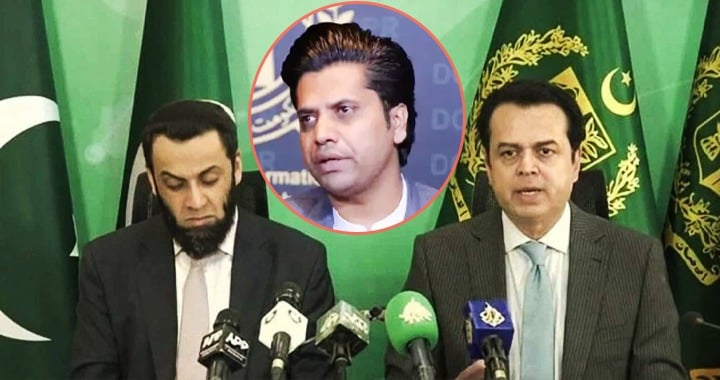
Federal ministers on Monday challenged the Pakistan Tehreek-e-Insaf (PTI) leadership to take a clear position on terrorism and openly name Afghanistan and terrorist groups allegedly involved in attacks inside Pakistan, questioning why the party’s provincial leadership in Khyber Pakhtunkhwa avoids directly addressing the alleged cross-border dimension of the violence.
Addressing a joint press conference in Islamabad, Information Minister Attaullah Tarar and Minister of State for Interior Talal Chaudhry accused the PTI-led Khyber Pakhtunkhwa government of failing to adequately support counterterrorism efforts and alleged that terrorist groups operating from Afghanistan were carrying out attacks in Pakistan for financial rewards.
Chaudhry referred to the terrorist attack on the Aman Mela checkpoint in Dera Ismail Khan, in which civilians, including women and children, were killed, while rescue personnel were also targeted.
He questioned why Afghanistan and the terrorist groups allegedly responsible for such attacks were not being explicitly named by the PTI leadership.
Afghanistan’s Alleged Role in Cross-Border Terrorism
Chaudhry said terrorist groups entered Pakistan from Afghanistan to carry out attacks, alleging that a significant proportion of their members were residents of Afghanistan.
He claimed that approximately 70 percent of individuals in terrorist groups entering Pakistan from Afghanistan were Afghan residents.
Referring to the Dera Ismail Khan attack, the minister said a photograph of one of the suspected attackers was immediately entered into the relevant identification system and checked against records, including those maintained by the National Database and Registration Authority (NADRA), but the process did not establish the individual’s identity.
He said open-source information subsequently indicated that the suspect was a resident of Kabul, the Afghan capital.
Chaudhry alleged that terrorists received payments in dollars for carrying out attacks intended to destabilize Pakistan. He described Afghanistan as a “super proxy” in this context and questioned why the alleged role of Afghanistan and terrorist organizations was not being openly acknowledged in discussions about the attacks.
The minister said Pakistan had approached Afghan authorities through dossiers, negotiations and diplomatic channels, but alleged that these efforts had not resulted in a change in Afghanistan’s conduct.
PTI’s Position Under Scrutiny
Chaudhry criticized Khyber Pakhtunkhwa Chief Minister Sohail Afridi over his response to the Dera Ismail Khan attack, saying the chief minister visited the area and held a press conference but did not name Afghanistan.
He said federal ministers and government representatives had visited the homes of families affected by terrorism, while political leaders participating in protests were absent from those visits.
The minister’s remarks placed the spotlight on the PTI-led provincial government’s public position on cross-border terrorism and its response to attacks affecting communities in Khyber Pakhtunkhwa.
The federal ministers called for a clear stance on the role of Afghanistan and terrorist groups, arguing that the threat should be addressed without political ambiguity.
Security Resources and the CTD
Chaudhry also accused successive PTI-led provincial governments of failing to provide law enforcement agencies with the resources required to combat terrorism.
He said the provincial political leadership had not stood with security forces in the manner required during the past 14 years and alleged that inadequate funding and equipment had undermined counterterrorism efforts.
Referring to the Counter Terrorism Department (CTD), he said effective action against terrorism was not possible without bulletproof vehicles and modern weapons.
The minister further alleged that some bulletproof vehicles provided to security forces had been returned for political point-scoring.
He also accused the provincial government of attempting to limit police powers through amendments to the police law.
Chaudhry said the provincial government had failed to adequately participate in security-related meetings, while remaining engaged in discussions over its share of funds under the National Finance Commission (NFC) arrangements.
He said there was consensus on 14 points of the National Action Plan and stressed that their implementation was necessary to combat terrorism.
The minister also said the federal government had demanded an account of Rs800 billion from Khyber Pakhtunkhwa, linking the province’s security situation to what he described as shortcomings in the provincial government’s performance.
Tarar Accuses PTI of Supporting Terrorists
Information Minister Attaullah Tarar alleged that PTI’s leadership in Khyber Pakhtunkhwa was the “B team” of the banned Tehreek-e-Taliban Pakistan (TTP).
He further accused the party of financially supporting terrorists, without providing specific evidence for the allegation during the reported press conference.
Tarar said the leadership of the Awami National Party, Pakistan Muslim League-Nawaz and Jamiat Ulema-e-Islam had made sacrifices in the fight against terrorism, while claiming that PTI had not faced a comparable response from terrorist groups.
His remarks added to the federal government’s criticism of the PTI leadership’s position on terrorism and its alleged links with terrorist organizations.
Questions Over Non-Custom-Paid Vehicles
Tarar also raised concerns about the large number of non-custom-paid vehicles operating in Khyber Pakhtunkhwa.
He said numerous vehicles and motorcycles were being used without complete registration or number plates, making it difficult for authorities to establish their identities and monitor their movement.
The minister alleged that such vehicles could be used in terrorist activities and said bringing them into the legal registration system could generate billions of rupees in revenue for the province.
He criticized the provincial government for failing to take the necessary measures to regulate these vehicles.
Federal Government Offers Support
Tarar said Khyber Pakhtunkhwa had remained under PTI rule for an extended period, but questions persisted over the province’s performance in providing basic services, particularly healthcare.
He said the Interior Ministry had offered to provide modern vehicles to the Khyber Pakhtunkhwa police, but the provincial government had declined the offer.
The information minister reiterated that the federal government remained committed to eliminating terrorism and would provide all possible assistance to security institutions.
The press conference underscored the growing political dispute between the federal government and the PTI-led Khyber Pakhtunkhwa administration over responsibility for the province’s deteriorating security situation, the resources available to law enforcement agencies and the alleged role of Afghanistan in attacks inside Pakistan.
The central question raised by the federal ministers was whether PTI’s provincial leadership would explicitly acknowledge the alleged role of Afghanistan and terrorist groups in the violence or continue to avoid naming them.



