
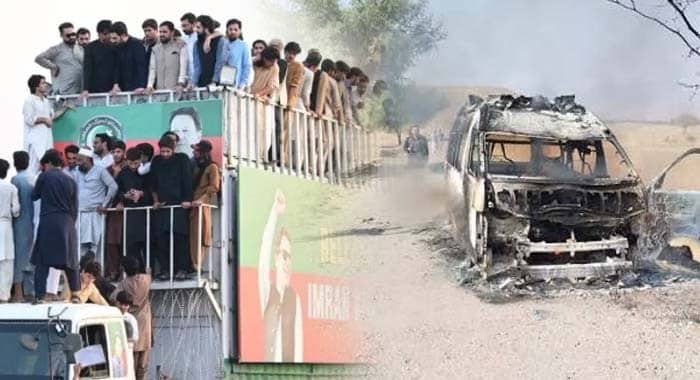
There is an uncomfortable contradiction at the heart of Khyber Pakhtunkhwa’s security debate. A political procession can travel through the province, generate headlines and project an image of political strength, while ordinary residents in some of the same districts remain fearful of travelling after sunset. That contrast deserves serious examination, particularly when the party leading the procession has governed the province for more than a decade.
PTI’s recent long march has been presented as a demonstration of public support for Imran Khan. Its supporters have emphasized the procession’s progress and the absence of reported terrorist attacks against it. A peaceful march is certainly a positive development. No political party should be penalized for exercising its constitutional right to assemble, and the absence of violence should be welcomed rather than treated as an accusation.
But the larger question is difficult to avoid: why should the ability to move safely appear exceptional for political participants when ordinary citizens expect the same basic security as a matter of routine?
For residents of terrorism-affected districts, insecurity is not an argument in a political debate. It is a daily calculation. Can a family travel after dark? Can a trader transport goods without fear? Can a police officer return home safely? Can a student attend school without parents worrying about the road ahead? These are the questions that determine whether a government is delivering security.
The comparison between a political march and everyday life is not entirely straightforward. A high-profile procession may receive extensive security arrangements, intelligence monitoring, route planning and deployment of personnel. Its organizers may also choose routes and timings carefully. Ordinary citizens cannot arrange the same protection for every journey. A march passing safely through an area therefore does not, by itself, prove that the area is secure.
That distinction, however, strengthens the case for accountability rather than weakening it. If the state can coordinate security for a major political gathering, citizens are entitled to ask how the same institutions can be supported in protecting communities, transport routes, markets and schools. The answer requires evidence about resources, deployment, intelligence and operational capacity, not political slogans.
PTI’s long tenure in KP makes this question particularly relevant. The party cannot claim credit for its political mobilization while treating persistent insecurity as a problem entirely detached from its own provincial record. Nor can its opponents fairly assign every terrorist attack to the provincial government. Counterterrorism involves federal institutions, provincial police, intelligence agencies, regional developments and terrorist networks operating across borders.
The point is not to establish responsibility through coincidence. It is to demand measurable performance from those entrusted with governing.
If PTI can mobilize supporters and organize a high-profile procession, its leadership should also be able to explain what its provincial administration is doing to restore ordinary freedom of movement in vulnerable districts. What has improved in police preparedness? Are vulnerable routes receiving adequate protection? Are intelligence gaps being addressed? Are citizens seeing measurable improvements in their daily lives?
The people of KP do not need their insecurity converted into ammunition for one party against another. They need a government that treats their safety as a priority regardless of whether cameras are present.
A peaceful march is no small achievement in a troubled security environment. But it is not the final measure of success. The real test is whether ordinary people can travel, work, study and return home safely after dark, without needing the protection of a political convoy.
Until that becomes the norm, every claim of political triumph will invite the same question: if a march can pass safely, why do so many citizens still struggle to feel safe?



