
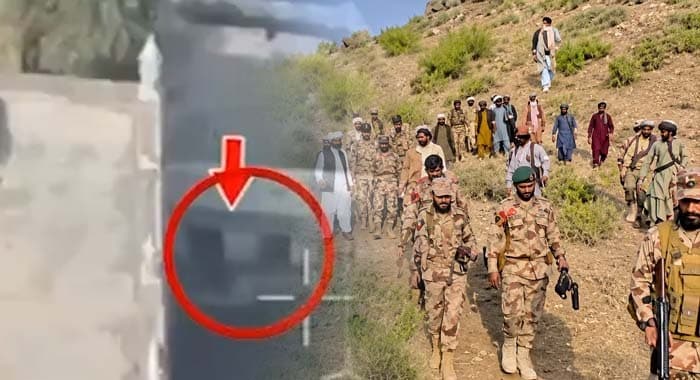
The use of mosques and civilian homes by Fitna al-Khwarij for storing weapons, sheltering armed operatives and facilitating terrorist activities has reinforced the need for stronger public cooperation to protect communities and prevent terrorist groups from exploiting religious and residential spaces.
Video evidence showing armed Khwarij inside a mosque in Haider Khel, Mir Ali, North Waziristan, has raised serious concerns about the exploitation of religious institutions for terrorist purposes. The footage shows armed men inside a place meant for worship, religious education and community peace, violating its sanctity and exposing worshippers and residents to grave security risks.
The incident is not an isolated example. Similar cases have previously surfaced in Palangzai, North Waziristan, and Kohi Hassan Khel near Peshawar, indicating that terrorist groups have repeatedly attempted to turn religious institutions into shelters and operational facilities. In another development, security forces cleared two terrorist hideouts established inside mosques in Muzak village near Mir Ali, recovering weapons, ammunition and explosives. A separate recovery of a substantial weapons and explosives cache from an unoccupied house in Haider Khel further highlighted how terrorists exploit civilian properties to conceal their activities.
Such practices not only endanger local residents but also violate the sanctity of places that hold immense religious and social importance. Terrorists deliberately exploit the trust associated with mosques and the protection offered by civilian neighborhoods, putting entire communities at risk of security operations, intimidation and retaliation.
Religious scholars have repeatedly rejected such exploitation, emphasizing that terrorism is alien to Islam and that using mosques, seminaries and civilian homes for terrorist activities is condemnable. More than 500 religious scholars and spiritual leaders from across Khyber Pakhtunkhwa reaffirmed their support for the fight against terrorism at a conference in July. Their position underscores the importance of a clear distinction between Islam’s teachings and the actions of terrorist groups that misuse religious symbols and institutions to justify violence.
The stance of religious scholars is particularly important because mosques and seminaries enjoy the trust of local communities. Their cooperation can help prevent terrorist groups from using religious platforms to spread extremist narratives, recruit supporters or establish operational facilities. Religious leaders can also encourage residents to report suspicious activities and reject any attempt to provide shelter or logistical support to armed groups.
Tribal elders and local communities have also demonstrated their willingness to stand against terrorism. At a jirga in Mir Ali on November 18, tribal elders and religious scholars pledged full cooperation with security forces against terrorist networks. A separate gathering of tribal elders and Regional Development Council representatives in Miranshah on November 21 expressed confidence in the Pakistan Army’s efforts and renewed their commitment to supporting measures aimed at restoring lasting peace.
These commitments reflect an important reality: counterterrorism cannot succeed through security operations alone. The willingness of communities to deny terrorists local support, identify suspicious movements and cooperate with law enforcement agencies is essential to preventing armed groups from establishing a foothold in populated areas.
In several parts of the province, local resistance has gone beyond public declarations. In Kreakot, Lower South Waziristan, residents acted against the movement of members of a banned organization and burned their motorcycles. In Gomal, Tank, local residents foiled an attempt to abduct a shopkeeper, confronting the attackers and eliminating those involved. Such incidents demonstrate that communities are not necessarily passive victims of terrorist intimidation. When residents stand together, they can disrupt terrorist activities and deny armed groups the freedom to operate.
The role of local residents is equally important in providing timely information about terrorist hideouts, suspicious individuals and movements. Human intelligence often enables security forces and police to identify threats before they develop into attacks. Cooperation between residents, tribal elders, religious scholars, police and security institutions can therefore make counterterrorism efforts more effective and help protect civilian lives.
Conversely, silence, fear or facilitation can provide terrorists with the space they need to operate. Allowing armed groups to occupy homes, exploit mosques or intimidate residents can undermine years of security and development efforts. It also places future generations at risk by allowing violence, coercion and extremist influence to take root in local communities.
Protecting mosques and civilian homes is therefore a collective responsibility. Religious scholars must continue to reject the misuse of Islam, tribal elders must strengthen community unity, and residents must cooperate with law enforcement agencies to prevent terrorist groups from exploiting their neighborhoods. Sustained public awareness and collective vigilance can deny the Khwarij the local support and safe spaces they seek.
The message must remain unequivocal: mosques are for worship, homes are for families, and neither can be allowed to become a sanctuary for terrorism. Silence can cost communities their peace and future, while collective resolve and cooperation can help safeguard both.



