
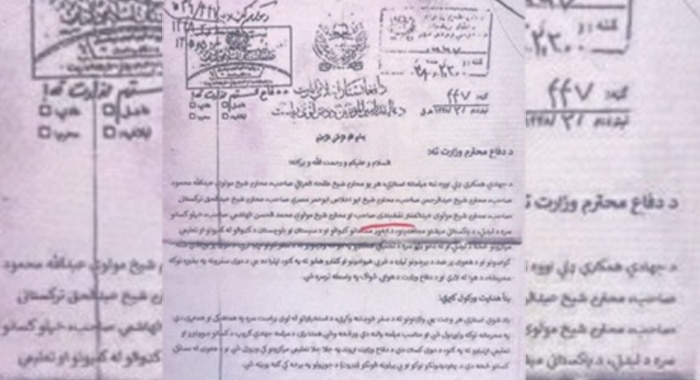
A leaked official directive bearing the signature of Afghan Taliban Supreme Leader Maulvi Hibatullah Akhundzada has exposed a disturbing picture of the Taliban regime’s support for Khawarij networks operating across the region, raising serious questions about Kabul’s commitments to regional peace and security.
The document, identified as No. 447, dated 21 February 1448 AH (4 August 2026), is addressed to the Taliban Ministry of Defence. Its contents reveal instructions concerning the accommodation, protection, transportation and facilitation of foreign Khawarij commanders and their affiliated networks operating from Afghan territory.
According to the leaked directive, seven senior commanders associated with the so-called Jihadi Cooperation Council, including Sheikh Talha al-Iraqi, Sheikh Maulvi Abdullah Mahmood, Sheikh Abdul Rahman, Sheikh Abu Ikhlas Abu Omar al-Misri, Sheikh Abdul Haq Turkistani, Sheikh Maulvi Abdul Ghaffar Naqshbandi and Sheikh Maulvi Muhammad al-Hassan al-Hashimi, held operational meetings with representatives of the Tehreek-e-Taliban Pakistan (TTP), Hafiz Gul Bahadur Group (HGBG), Balochistan Liberation Army (BLA), Uyghur fighters and Khawarij elements from Iran’s Sistan-Baluchestan region.
The meetings involved inspections of Khawarij camps, coordination among armed groups and discussions on joint operations. The contents expose the scale of security concerns surrounding the presence and activities of transnational armed networks on Afghan soil.
The most alarming revelation concerns direct instructions to the Taliban’s defence and intelligence institutions.
Akhundzada’s directive instructs the Ministry of Defence and the General Directorate of Intelligence (GDI) to secretly transport senior Khawarij commanders between Afghan provinces using military aircraft, shielding them from potential strikes by neighbouring countries and Western forces.
The document further outlines arrangements for accommodating foreign Khawarij fighters in designated military training centres and utilising their technical specialists for the production of explosives and weaponised drones.
These instructions expose the extent of institutional support and logistical facilitation described in the document, raising grave concerns about the use of Afghanistan’s state-controlled infrastructure for activities threatening regional security.
Such revelations directly contradict Kabul’s assurances that Afghan territory will not be used against neighbouring countries. They also raise fundamental questions about the role of the Taliban’s military and intelligence establishments in facilitating cross-border threats.
Pakistan has repeatedly raised concerns over Khawarij sanctuaries in Afghanistan and the use of Afghan territory for launching attacks against Pakistani security forces and civilians.
The United Nations Security Council’s monitoring report covering December 2025 to June 2026 also documented continued Taliban support for the TTP and links between armed networks operating in the region. It cited information from a Member State indicating that BLA elements had received training alongside TTP fighters from Al-Qaeda trainers in Afghanistan.
The implications extend far beyond Pakistan. The presence and coordination of foreign armed networks raise serious security concerns for China, particularly regarding Uyghur armed elements, as well as Iran, which faces security challenges along its eastern borders.



